
U.S. Air Force B-21 Raider Progresses to Weapons Testing Amidst Production Expansion
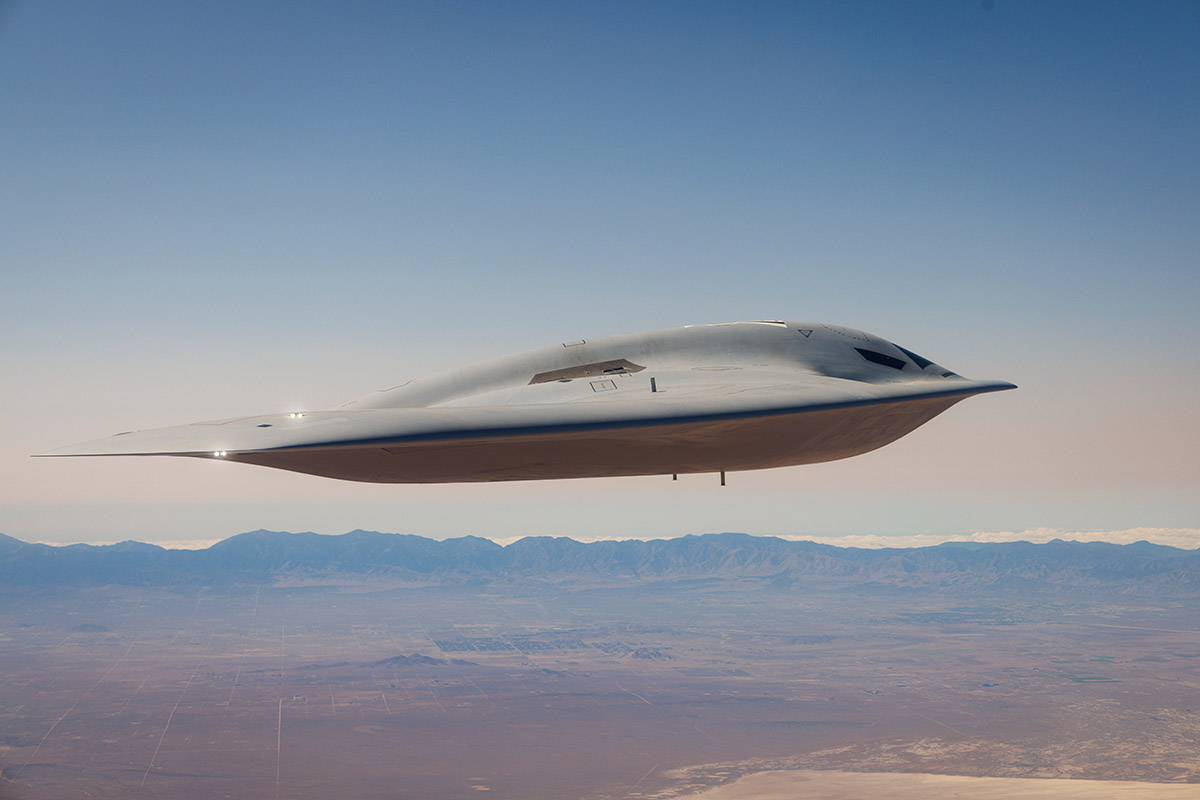
The United States Air Force’s B-21 Raider stealth bomber has reached a significant milestone, demonstrating weapons release capabilities during its ongoing flight test campaign. This development marks the aircraft’s official entry into weapons testing, a crucial phase in its journey toward operational deployment. The manufacturer, Northrop Grumman, concurrently reported an acceleration in production efforts as the program anticipates the arrival of the first bombers at Ellsworth Air Force Base in 2027.
Tom Jones, corporate vice president and president of Northrop Grumman Aeronautics Systems, characterized the weapons release as a pivotal step in bolstering American strategic deterrence. “The B-21 is another step closer to giving the U.S. unrivaled deterrence,” Jones stated, emphasizing the bomber’s future role. He further lauded the B-21 Combined Test Force, a collaborative effort between the Air Force and Northrop Grumman, for its sustained rapid test pace and significant progress. According to Jones, this pace has garnered admiration within the broader test community, underscoring Northrop Grumman’s ability to translate advanced technology into tangible military capability with both efficiency and speed.
Northrop Grumman highlighted that the recent test successfully demonstrated the bomber’s capacity to “carry and employ combat power,” a foundational requirement for any strike aircraft. This indicates that the B-21’s internal weapon bays and release mechanisms are functioning as designed, clearing the path for further integration and testing of various munitions. The company affirmed that the overall program is witnessing an accelerated pace in both its testing and manufacturing phases. A key enabler for this acceleration has been the introduction of aerial refueling into the flight test campaign earlier this year. Aerial refueling operations have “unlocked longer test sorties,” significantly extending the duration and scope of individual test flights and thereby speeding up the entire campaign by allowing more data to be collected per mission.
Beyond its demonstrated combat power, the B-21 has reportedly exhibited “outstanding stealth performance” during testing, a critical attribute for a penetration bomber designed to operate undetected in contested airspace. This advanced stealth capability is central to the aircraft’s mission profile, enabling it to bypass sophisticated enemy air defense systems. Furthermore, Northrop Grumman has made a notable claim regarding the B-21’s operational efficiency, asserting that it behaves more like a modern fighter aircraft than a legacy bomber in terms of maintenance turnaround times and cost per flying hour. If validated, this characteristic would represent a significant achievement, potentially leading to lower operational costs and higher sortie rates compared to its predecessors, the B-1 Lancer and B-2 Spirit, which are known for their demanding maintenance requirements and high operational expenses.
On the industrial front, Northrop Grumman is actively expanding its manufacturing footprint to support future production demands. The company has opened a new B-21 plant in Layton, Utah, adding an estimated 265,000 square feet of dedicated manufacturing space. Concurrently, groundbreaking has occurred for an expanded final assembly facility spanning one million square feet at Plant 42 in Palmdale, California, which is expected to accommodate the larger-scale production of the stealth bombers. These expansions signify a robust commitment to ramping up the production rate as the program transitions from development to full-rate manufacturing. The company also announced the completion of “lifetimes of fatigue testing months ahead of schedule,” a critical engineering assessment that simulates decades of operational stress on the aircraft’s airframe to ensure long-term structural integrity and safety. In preparation for long-term sustainment, Northrop Grumman is also actively collaborating with the first detachment squadron now operating at Ellsworth Air Force Base, ensuring that maintenance and support infrastructure are in place ahead of the bomber’s official arrival.
The flight test fleet saw an expansion in September 2025 with the arrival of the second B-21 aircraft at Edwards Air Force Base. The introduction of an additional test platform allows engineers and pilots to concurrently work on various aspects, including mission systems and weapons integration, thereby increasing the efficiency of the test program. In a notable acceleration of the traditional testing process, the U.S. Air Force conducted a flight in June with an operational test pilot flying alongside a developmental test pilot for the first time. This innovative approach merges two distinct phases of testing—developmental testing (focused on verifying design and performance) and operational testing (focused on evaluating mission effectiveness)—which are typically conducted sequentially. This integrated testing strategy is intended to identify and address potential issues earlier in the program, streamlining the path to operational deployment.
Public visibility of the B-21 increased in May 2024 when the U.S. Air Force released the first official images of the bomber in flight over Edwards Air Force Base, a moment widely reported, including by the UK Defence Journal. The B-21 is designed to eventually replace the aging B-1 Lancer and B-2 Spirit bomber fleets. The U.S. Air Force has articulated a strategic goal of acquiring a minimum of one hundred B-21 aircraft, a significantly larger fleet compared to the twenty B-2 Spirit bombers currently in service. This ambitious acquisition target underscores the long-term strategic importance of the B-21 to the nation’s air power capabilities.
Why This Matters
The ongoing development and testing of the B-21 Raider hold profound implications for global security, military strategy, and the future of air power. Its progression to weapons release and the acceleration of its production signify the rapid materialization of a crucial component of the U.S. military’s modernization efforts.
Strategic Deterrence and Global Power Projection:The B-21 is designed to be the backbone of the U.S. Air Force’s long-range strike capability for decades to come. As a highly stealthy, nuclear-capable (though also designed for conventional precision strike) bomber, it represents a significant upgrade in the ability to penetrate sophisticated enemy air defenses, a capability that is diminishing among existing bomber fleets. In an era of renewed great power competition, particularly with China and Russia, the B-21’s ability to hold targets at risk anywhere on the globe, potentially without detection, reinforces the credibility of U.S. deterrence, both conventional and nuclear. This capability helps maintain stability by discouraging aggression from potential adversaries.
Technological Advancement and Military Edge:The B-21 is more than just an aircraft; it is a platform embodying cutting-edge aerospace and digital technology. Its “outstanding stealth performance” is crucial for survivability in future conflicts, while claims of fighter-like maintenance efficiency suggest a revolutionary approach to bomber operations, potentially driving down the high costs and logistical burdens associated with legacy stealth aircraft. This focus on sustainment and affordability is vital for ensuring that a large, operationally ready fleet can be maintained for extended periods. Its advanced mission systems integration capability points towards a future of networked warfare, where the bomber operates as a node within a broader intelligence, surveillance, and reconnaissance (ISR) and strike architecture.
Economic and Industrial Impact:The B-21 program is one of the largest and most complex defense acquisition projects in the United States. The expansion of manufacturing facilities in Utah and California translates into significant job creation, investment in high-tech manufacturing, and the development of a skilled workforce. This sustained industrial activity is critical not only for national defense but also for regional economies, fostering innovation and technological leadership within the aerospace sector.
Future of Air Warfare and Allied Confidence:The B-21’s design and testing philosophy, including the innovative merging of developmental and operational testing, reflect a shift towards more agile and efficient defense acquisition processes. Its capabilities set a new benchmark for strategic bombers globally, influencing the strategic calculus of both allies and adversaries. For allies, the B-21 represents a commitment to maintaining a robust security umbrella and projecting power when necessary. For potential adversaries, it necessitates a reassessment of their air defense strategies and capabilities, potentially diverting resources to counter a threat that is designed to be exceedingly difficult to detect and engage.
Ultimately, the B-21 Raider is not merely a replacement for older aircraft; it is a transformative asset designed to address the complex security challenges of the 21st century. Its successful development and deployment will be a key determinant of the United States’ ability to project power, deter aggression, and maintain its technological advantage in an increasingly contested global environment.