
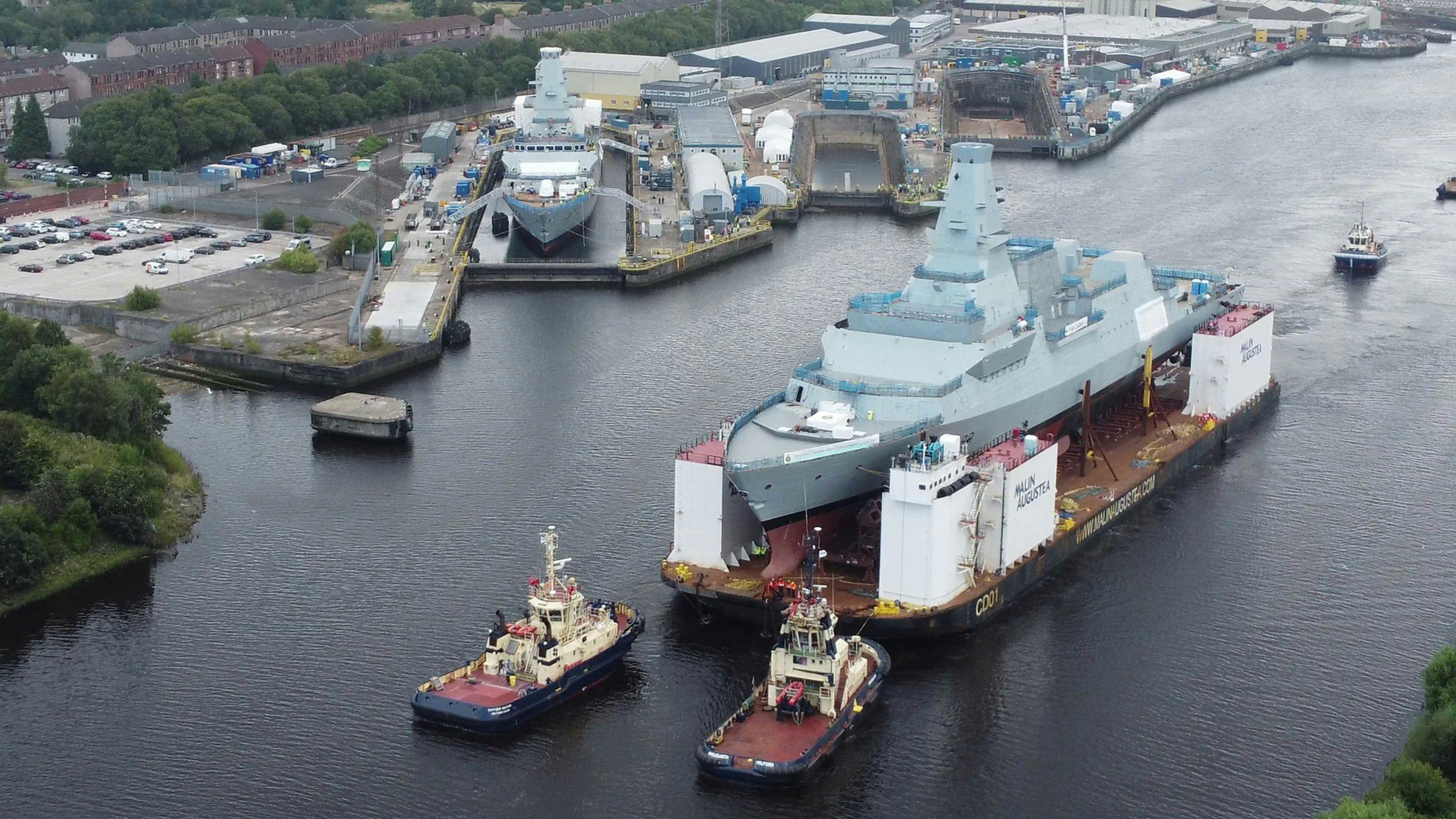
BAE Systems Reports Robust Overall Performance Despite Subdued Maritime Sector Growth Amid Frigate Program’s Initial Phase
LONDON, UK– BAE Systems, a leading global defense, aerospace, and security company, announced on Thursday that its strong overall financial and operational performance for the year to date has been bolstered by significant growth across most of its divisions. This robust performance has effectively offset a period of subdued growth and margins within its Maritime sector, primarily attributed to the “first-in-class” stage of the Type 26 frigate program for the Royal Navy.
In a detailed market update, BAE Systems affirmed that strong trading within its Electronic Systems, Air, and Platforms and Services sectors had more than compensated for the challenges faced by its naval shipbuilding division. The company did not disclose specific financial figures for the impact of the Maritime sector’s performance but reiterated its full-year guidance for sales, profit, and earnings. In a positive signal to investors, BAE Systems also raised its forecast for free cash flow to approximately £3 billion, indicating strong liquidity and financial health.
The “first-in-class” stage refers to the initial production phase of a new vessel design, specifically the lead ship, HMS Glasgow. This critical phase involves significant upfront investment in design proving, testing, and production process refinement. As the pioneering vessel in its class, HMS Glasgow carries the bulk of the research and development costs and the inherent learning curve associated with a new complex warship. Subsequent ships in the class are expected to benefit from the experience gained, leading to more efficient production and improved margins over time. BAE Systems constructs the Type 26 frigates at its shipyards in Govan and Scotstoun, both located on the River Clyde in Scotland.
The Type 26 Global Combat Ship program is a cornerstone of the Royal Navy’s future surface fleet, with eight frigates currently on order for the United Kingdom. These advanced multi-mission warships are designed for anti-submarine warfare and air defense, capable of operating globally. HMS Glasgow has been steadily progressing through its build and commissioning phases, moving closer to anticipated sea trials, which will mark a significant milestone in its journey towards operational readiness. The UK government has explicitly stated its ambition to accelerate the delivery of new warships, reflecting a strategic imperative to modernize and expand the Royal Navy’s capabilities in a rapidly evolving global security landscape.
Beyond the domestic program, the Type 26 design has garnered international recognition. Norway recently selected the Type 26 as the blueprint for its own next-generation frigates, a significant endorsement of the ship’s design and capabilities. This international adoption was highlighted by Douglas Alexander, the Secretary of State for Scotland, during a visit to Oslo this week, where he emphasized that Norway’s choice of the Clyde-built design was not coincidental but a testament to its quality and advanced engineering.
The Maritime sector’s activities extend beyond the Type 26 program. BAE Systems also announced that it had secured approximately £4.3 billion in further funding during the second half of the year for the Dreadnought class nuclear deterrent submarines. These critical submarines, built at the company’s shipyard in Barrow-in-Furness, Cumbria, form the future backbone of the UK’s continuous at-sea nuclear deterrent. This substantial funding injection is earmarked to advance the construction of these highly complex vessels, bringing them closer to their eventual entry into service and ensuring the long-term viability of the UK’s strategic defense posture.
Commenting on the company’s performance, Charles Woodburn, BAE Systems Chief Executive, expressed confidence in the company’s trajectory. “We’ve delivered strong financial and operational performance year to date, as well as positive order intake momentum,” Woodburn stated. “Our substantial backlog provides good visibility and, with our portfolio aligned to evolving threats and customer priorities, we remain well positioned to deliver sustainable growth over the years ahead.” His remarks underscore the company’s strategic positioning within a buoyant global defense market, driven by increasing geopolitical tensions and renewed investment in national security capabilities by various governments.
Why This Matters
The performance of BAE Systems, and particularly its Maritime sector, carries significant implications across several critical domains, from national security and industrial strategy to international relations and the global defense market.
For National Security and Defense Capability:The Type 26 frigates and Dreadnought submarines are foundational to the United Kingdom’s naval power projection and strategic defense. The Type 26s are designed to enhance the Royal Navy’s anti-submarine warfare capabilities, crucial for protecting sea lanes and carrier strike groups in an era of resurgent naval powers. The Dreadnought class submarines, meanwhile, are essential for maintaining the UK’s continuous at-sea nuclear deterrent, a cornerstone of its national security strategy. The progress, or challenges, in these programs directly impacts the timeline and effectiveness of these critical defense assets. The government’s push to accelerate warship delivery highlights a perceived urgency in strengthening the Royal Navy amidst evolving global threats.
For Economic Impact and Industrial Strategy:BAE Systems is one of the UK’s largest employers and a key player in its advanced manufacturing sector. Its shipbuilding activities on the Clyde and in Barrow-in-Furness sustain thousands of highly skilled jobs, not just within BAE but also across an extensive supply chain comprising hundreds of smaller businesses. The continued investment in these programs represents a significant commitment to regional economies and high-tech industrial capabilities. The challenges of the “first-in-class” stage, while impacting short-term margins, also represent an investment in future efficiencies and the retention of specialized shipbuilding expertise within the UK, aligning with broader government goals for industrial growth and sovereign capabilities.
For International Relations and Global Standing:Norway’s selection of the Type 26 design is a powerful testament to the UK’s engineering prowess and defense industry’s competitiveness. This international sale strengthens bilateral ties with a key NATO ally, promotes interoperability between allied navies, and bolsters the UK’s reputation as a reliable and innovative defense exporter. Such deals can open doors for further international collaborations and sales, contributing to the UK’s influence on the global stage and generating export revenue.
For BAE Systems as a Company:The ability of BAE Systems to offset subdued performance in one critical sector with robust growth in others demonstrates the strategic advantage of its diversified portfolio. This financial resilience is vital for investor confidence and allows the company to absorb the significant upfront costs associated with developing cutting-edge defense technologies. The substantial order backlog and increased free cash flow forecast provide strong visibility into future earnings and financial stability, positioning BAE Systems favorably for sustained growth in a dynamic global defense market characterized by increasing demand for advanced military hardware and services.