
Key Takeaways
- Methodical Entry into Health AI:Apple is launching a significant, year-long study to understand human interaction with AI for health, partnering with OpenEvidence and emphasizing clinically validated information over instant, general chatbot responses.
- Privacy-First Design:The study’s app ensures user data is anonymized, not used for AI training, and query/response data is deleted within 24 hours, reinforcing Apple’s long-standing commitment to user privacy in sensitive health contexts.
- Building a Foundation for Trust:Aiming for up to 200,000 participants, Apple’s rigorous research approach seeks to build a trusted, clinically grounded foundation for future health AI tools, potentially integrating insights into HealthKit or Siri down the line.
While other AI giants rush to deploy general-purpose health chatbots, Apple is taking a distinctly cautious, research-driven path, launching a massive study to explore how clinically grounded AI can genuinely support users’ health journeys.
Apple’s Measured Ascent into Health AI: A Deep Dive into Its New Clinical Study
The artificial intelligence landscape is in a state of hyper-acceleration, with major industry players like OpenAI and Anthropic rapidly rolling out sophisticated chatbots capable of tackling an increasingly broad spectrum of queries – including those pertaining to personal health. This rapid expansion has paved the way for a new frontier: specialized AI designed to provide health-related answers with enhanced precision and contextual understanding. Yet, amidst the fervent race to integrate AI into every conceivable digital niche, Apple, a tech giant long celebrated for its meticulous approach to innovation and unwavering commitment to user privacy, is charting a uniquely deliberate course. Rather than rushing to deploy a ready-made health-focused AI solution, the iPhone maker is embarking on an extensive, clinically-grounded research endeavor designed to rigorously understand how intelligent systems can genuinely empower and assist individuals in navigating their health.
A Groundbreaking Partnership for Clinically Grounded Insights
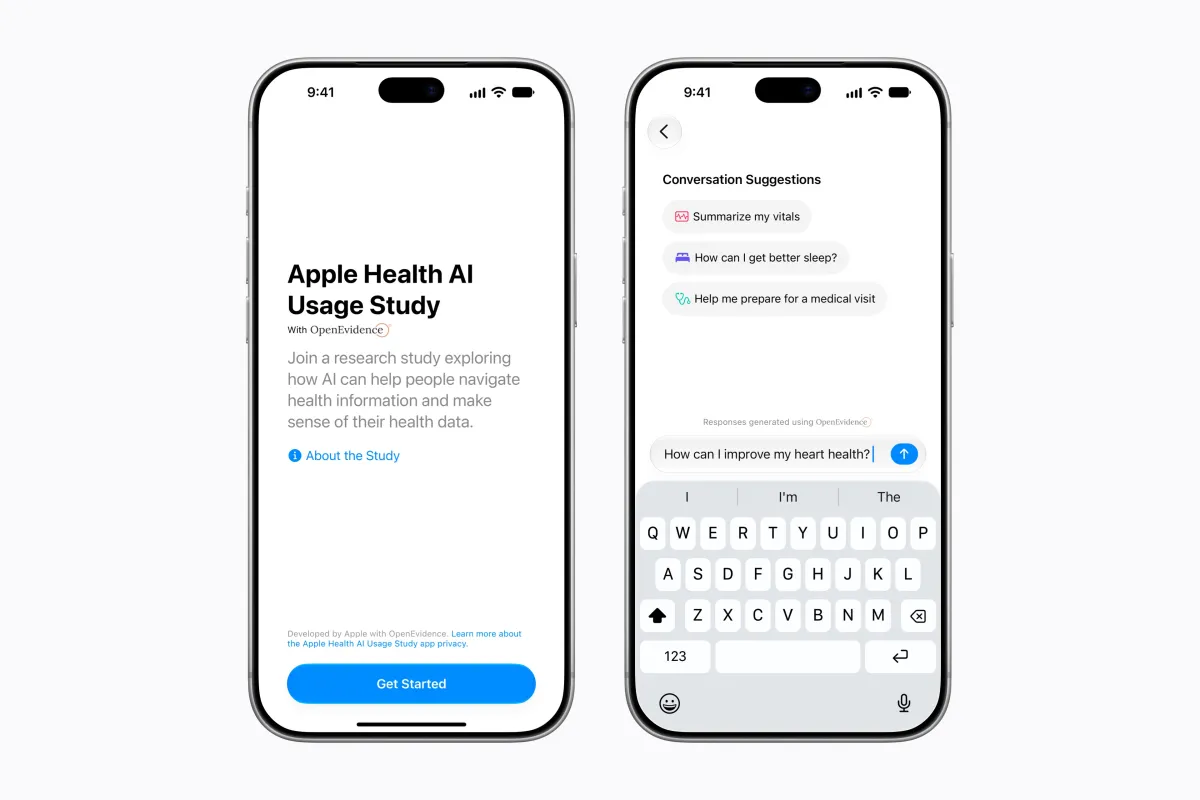
At the core of Apple’s thoughtful strategy lies a significant collaboration with OpenEvidence, a company renowned for its expertise in healthcare-focused AI solutions. Together, they are introducing an innovative new study app, a tangible manifestation of Apple’s deep commitment to scientific rigor and ethical development in the health sector. This isn’t merely a pilot program; Apple is extending an invitation to a substantial cohort of up to 200,000 eligible participants across the United States to join this ambitious, year-long research initiative. To ensure the study leverages the latest technological capabilities, potential users must be over 21 years of age, own an iPhone 15 or later, be running iOS 26 or later, and have Apple Intelligence enabled on their device. These stringent requirements underscore the advanced nature of the study and Apple’s dedication to capturing high-quality data from a technically prepared user base.
This substantial, multi-faceted investment in a long-term clinical study unequivocally signals Apple’s core philosophy: when addressing a domain as inherently personal and critical as health, accuracy, comprehensive understanding, and a superior user experience must unequivocally take precedence over mere speed to market. While many general-purpose chatbots may offer rapid-fire answers, Apple’s objective is to meticulously validate the efficacy, safety, and real-world impact of AI-driven health insights within a rigorously controlled and clinically informed environment.
Inside the Health AI Usage Study App: Bridging Personal Data and Professional Knowledge
The newly launched Health AI Usage Study app offers a familiar interface, allowing users to pose health-related questions much like they would with popular consumer AI chatbots. However, its defining characteristic—and its most crucial differentiator—is the unimpeachable provenance of its information. Unlike generic large language models that draw from the vast, often unfiltered expanse of internet data, this app’s responses are meticulously “grounded in clinical data.” This means every answer is derived from highly reputable, peer-reviewed medical journals and authoritative sources, including the esteemed New England Journal of Medicine, the Journal of the American Medical Association (JAMA), and Nature. The overarching goal is to distill complex medical concepts into simplified, easily digestible answers for everyday health queries, thereby democratizing access to sophisticated clinical knowledge for the average individual.
Beyond merely providing static answers, the app is engineered for dynamic interaction and deep personalization. Participants are actively encouraged to rate the accuracy and helpfulness of the responses, providing direct, invaluable feedback that will continuously inform and refine the study’s understanding. Furthermore, monthly surveys will systematically gather their evolving perceptions and nuanced experiences with the AI. A pivotal feature is the option for users to share anonymized data from their HealthKit, encompassing a range of metrics such as resting heart rate, activity levels, sleep patterns, or even lab results. This seamless, secure integration empowers the app to offer more personalized and contextually pointed suggestions, elevating general health advice into insights specifically tailored to an individual’s unique health profile.
Moreover, the app aims to function as a proactive tool for enhanced health management. It is designed to assist participants in preparing more effectively for doctor’s visits, helping them compile pertinent information or formulate key questions. For instances involving more serious or concerning medical issues, the app is programmed to guide users toward specific, qualified healthcare providers, reinforcing the critical principle that AI serves as a powerful supportive tool, not a substitute for professional medical consultation and diagnosis.
Upholding Privacy: A Non-Negotiable Core Principle in Health AI
In an era where data privacy concerns are at an all-time high, particularly concerning highly sensitive health information, Apple is making unequivocal and stringent commitments. The company has explicitly stated that all collected data will undergo rigorous anonymization processes before being transmitted to a secure third-party cloud provider. Crucially, and as a direct counterpoint to common industry practices where user interactions frequently fuel model refinement, Apple affirms that this study data “won’t be used to train any kind of AI models.” Furthermore, OpenEvidence, Apple’s partner in this critical venture, has committed to deleting all query and response data after a mere 24 hours, ensuring transient data retention and significantly minimizing any potential privacy risks.

Dr. Sumbul Desai, Apple’s vice president of Health and Fitness, eloquently articulated this unwavering commitment: “At Apple, we believe responsible innovation starts with scientific rigor and clinical grounding. Health is deeply personal, and conducting a dedicated research study is the most thoughtful way to understand how people engage with, comprehend, and evaluate health AI in everyday life.” She further emphasized, “Insights from this study will help advance the broader scientific conversation and ensure that as technology evolves, we continue building trusted tools that genuinely support people wherever they are on their health journey.” This powerful statement not only reinforces Apple’s deep-seated philosophy but also strategically positions the study as a significant, altruistic contribution to the broader academic and medical communities.
The Long Game: Why Apple’s Deliberate Pace Matters in Health AI
While the Health AI Usage Study app is available for U.S. users starting today, Apple has deliberately refrained from confirming if or when AI-powered answering capabilities will be directly integrated into its native Health app or Siri. This measured, step-by-step rollout stands in stark contrast to the often-quoted “move fast and break things” ethos prevalent in the wider tech world. The underlying rationale for this pronounced caution is abundantly clear: health information is intrinsically sensitive and carries immense weight. Misinformation or inaccurate advice dispensed by an AI can precipitate severe, tangible consequences, ranging from generating unnecessary anxiety to causing delayed or even incorrect medical treatments. By undertaking such a comprehensive and carefully structured study, Apple is proactively striving to mitigate these inherent risks, thereby ensuring that any future health AI offerings it eventually deploys are not only supremely powerful but also unequivocally safe, reliable, and trustworthy.
The potential market for intelligent health AI solutions is, without a doubt, astronomically massive. OpenAI has previously disclosed staggering figures, reporting that its users were submitting over 300 million health-related queries each week, a statistic that vividly underscores an immense, unmet public appetite for accessible and understandable health information. Apple, with its expansive ecosystem of seamlessly integrated devices and its deeply entrenched HealthKit platform, is uniquely and powerfully positioned to address this burgeoning demand. However, it aims to do so with an unshakeable commitment to accuracy, ethical standards, and user well-being, effectively carving out a distinctive niche where profound trust and rigorous clinical validation are the ultimate, non-negotiable currency.
Bottom Line
Apple’s strategic foray into health AI, epitomized by its new study app, serves as a powerful declaration: in the profoundly critical and sensitive domain of personal well-being, responsible innovation unequivocally triumphs over mere speed of deployment. By meticulously prioritizing scientific rigor, embedding deep clinical grounding, and maintaining an unwavering commitment to user privacy, Apple is not simply developing another AI feature; it is painstakingly laying the foundational groundwork for a transformative future where intelligent technology can genuinely serve as a trusted, invaluable partner in managing and optimizing one’s health. The profound insights garnered from this ambitious, large-scale study will undoubtedly play a pivotal role in shaping the responsible evolution of health AI, potentially setting a new, gold-standard benchmark for how technology companies approach such impactful and sensitive applications across the globe.
When you purchase through links in our articles, we may earn a small commission. This doesn’t affect our editorial independence.
{content}
Source:{feed_title}