
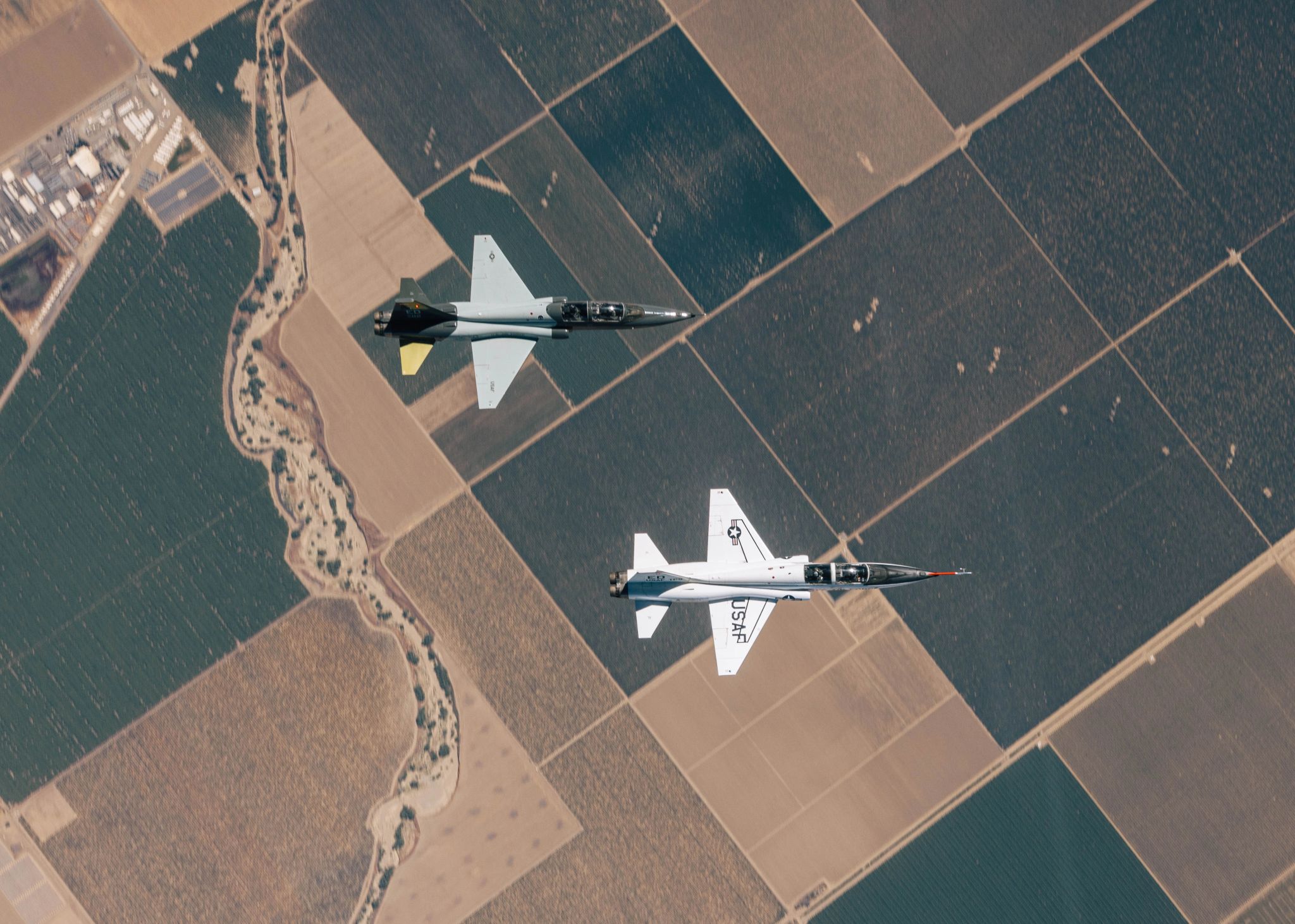
Washington D.C.– The United States Air Force is set to continue utilizing its 1960s-era T-38C Talon trainer aircraft into the late 2030s, a decision driven by the slower-than-anticipated progress of its successor, the T-7A Red Hawk. Lt. Gen. Clark J. Quinn, head of Air Education and Training Command (AETC), confirmed this extended timeline on November 16, highlighting both the resilience of the aging fleet and the inherent risks involved.
The T-7A Red Hawk is currently projected to achieve initial operational capability (IOC) by August of the coming year. However, General Quinn noted that “there is risk to making that date.” He further elaborated that acquiring a sufficient number of T-7s to fully replace the T-38 fleet, which stands as one of the Air Force’s oldest and largest inventories, will extend over several years.
The T-38, first flown in 1961, has a current fleet of 490 trainer jets, with the average age of these aircraft nearing 60 years. Air Force leadership has expressed ongoing concerns regarding the Talon’s increasing age and its impact on operational reliability. General Quinn corroborated these concerns, stating that the T-38s are mission capable approximately half the time. He indicated that this rate is unlikely to improve as the fleet ages further, citing its 65-year design heritage, its status as out of production, and the repeated overhauls of existing engines.
While recent engine-related issues that had limited T-38 availability have largely been resolved, the overarching challenge of maintaining an antique fleet persists. “It’s going to be flying until 2037 or 2038, doing pilot training missions, which sounds fantastically far away, and it is,” Quinn stated. “But we believe the aircraft will make it. There’s always the black swan event that nobody can predict, but I’m just hopeful. We don’t have any indication that that’s going to be out there.” The Air Force’s commitment to the T-38’s extended service life is underscored by a $900 million contract awarded to Boeing earlier this year for T-38 avionics sustainment, extending through March 2036.
The Air Force’s long-term plan involves acquiring more than 350 T-7 Red Hawks. However, achieving a high production rate for the new trainer has proven time-consuming. The T-7 program only transitioned into low-rate initial production (LRIP) in May. The fiscal year 2027 budget request includes funding for 23 T-7s, with projections indicating a ramp-up to 60 aircraft per year by 2030. This gradual introduction of the T-7 will coincide with a phased retirement of the T-38s. The Pentagon’s May report on force structure changes in the 2027 budget outlined plans to retire 157 Talons over the next five fiscal years, commencing with just one in fiscal year 2027 and accelerating to 82 by 2031.
T-7 Progress and Modern Capabilities
General Quinn highlighted the significant advantages of the T-7 over its predecessor. He emphasized that the T-38, a 1950s design, was constructed to train pilots for “Century Series fighters” — aircraft known for their challenging flight characteristics. Modern fighter jets, however, present a different set of demands, primarily centered on managing complex systems, processing vast amounts of information, and making rapid, informed decisions.
The T-7 is specifically designed to simulate the high information load experienced by pilots flying contemporary aircraft. Quinn recounted a flight in the T-7 several months prior, noting, “my second landing in the T-7 was probably better than my average landing in the T-38. It was just a relatively easy-to-fly airplane. There actually was a part of me that thought maybe this is too easy to fly.” He clarified that the true instructional value of the T-7 lies not in basic flight mechanics, but in its capacity to teach students critical decision-making skills mid-flight and the efficient management of multiple sensors, weapons systems, and other advanced avionics.
To reach the critical IOC milestone, AETC requires three specific conditions to be met: the delivery of 14 operational T-7 aircraft, the certification of 14 training instructors, and an expanded flight envelope for the aircraft. Currently, the Air Force possesses only three T-7s. One of these is dedicated to training maintenance personnel, leaving fewer available for flight testing and pilot instruction. More deliveries are essential to facilitate increased flight hours and comprehensive testing, which in turn will enable the Air Force Materiel Command and the Air Force Test Center to validate the aircraft’s performance across its full operational spectrum. This expanded flight envelope is a prerequisite for fully certifying training instructors.
Quinn acknowledged the ongoing effort to develop mission-specific instructor checks. “There really is no mission or instructor check yet. That’s something that needs to be built,” he said. While eight pilots are currently qualified to fly the T-7, they are not yet conducting “mission representative sorties.” This will change as more aircraft become available and the flight envelope is progressively expanded through developmental testing, a process Quinn described as advancing “incrementally every day.” The continuation of T-38 operations underscores the challenges in modernizing the Air Force’s pilot training infrastructure amidst the complexities of new aircraft procurement and development.
Why This Matters
The extended service life of the T-38C Talon and the delays in the T-7A Red Hawk program have significant implications for U.S. national security, defense readiness, and the future of military aviation.
Pilot Readiness and Training Modernization:The primary mission of trainer aircraft is to prepare future fighter and bomber pilots for the complexities of modern aerial warfare. The T-38, designed in the 1950s, lacks the advanced avionics, sensor integration, and digital cockpits that define contemporary combat aircraft. Prolonged reliance on this older platform means that aspiring pilots receive foundational training on systems that are fundamentally different from those they will encounter in operational units. This creates a gap that must be bridged later in their careers, potentially requiring additional training time and resources, or leaving pilots less prepared for the demands of fifth-generation fighters like the F-22 and F-35. The T-7’s design to simulate modern information loads is critical for developing pilots who can effectively manage advanced combat systems from the outset of their training.
Operational Risk and Maintenance Burden:Operating an aircraft fleet nearing 60 years old introduces escalating operational risks. A 50% mission capability rate for the T-38 means half the fleet is unavailable for training at any given time, directly impacting training schedules and pilot production rates. Maintaining an out-of-production aircraft requires extensive efforts to source parts, often involving costly reverse engineering or custom manufacturing. While the $900 million sustainment contract helps, it represents a substantial investment in an aging platform that could otherwise be directed towards new capabilities. The risk of unexpected structural or system failures in such an old fleet, what General Quinn termed a “black swan event,” is an ever-present concern for flight safety and operational continuity.
Strategic Competition and Technological Edge:In an era of increasing global competition, particularly with peer adversaries developing advanced air capabilities, maintaining a technological edge is paramount. The U.S. Air Force relies on its highly trained pilots to operate sophisticated aircraft and dominate contested airspace. Delays in introducing a modern trainer like the T-7 could be perceived as a lagging investment in the human element of airpower. Ensuring pilots are trained on the most relevant and advanced systems is crucial for sustaining the U.S.’s qualitative military advantage against potential adversaries.
Defense Spending and Resource Allocation:The decision to extend the T-38’s service life and the associated sustainment costs highlight broader challenges in defense procurement and budget allocation. The Air Force must balance the immediate need to maintain current training pipelines with the long-term imperative to modernize its assets. Delays in the T-7 program, whether due to production challenges or funding constraints, mean that resources continue to be diverted to legacy systems instead of fully transitioning to more efficient and capable modern platforms. This ongoing expenditure on older assets can strain defense budgets and impact other modernization priorities.
Ultimately, the saga of the T-38 and T-7 illustrates the complex interplay between technological advancement, fiscal realities, and strategic imperatives in maintaining a world-class military air force. The ability to effectively train the next generation of pilots directly underpins the nation’s airpower capabilities and its capacity to project influence globally.