
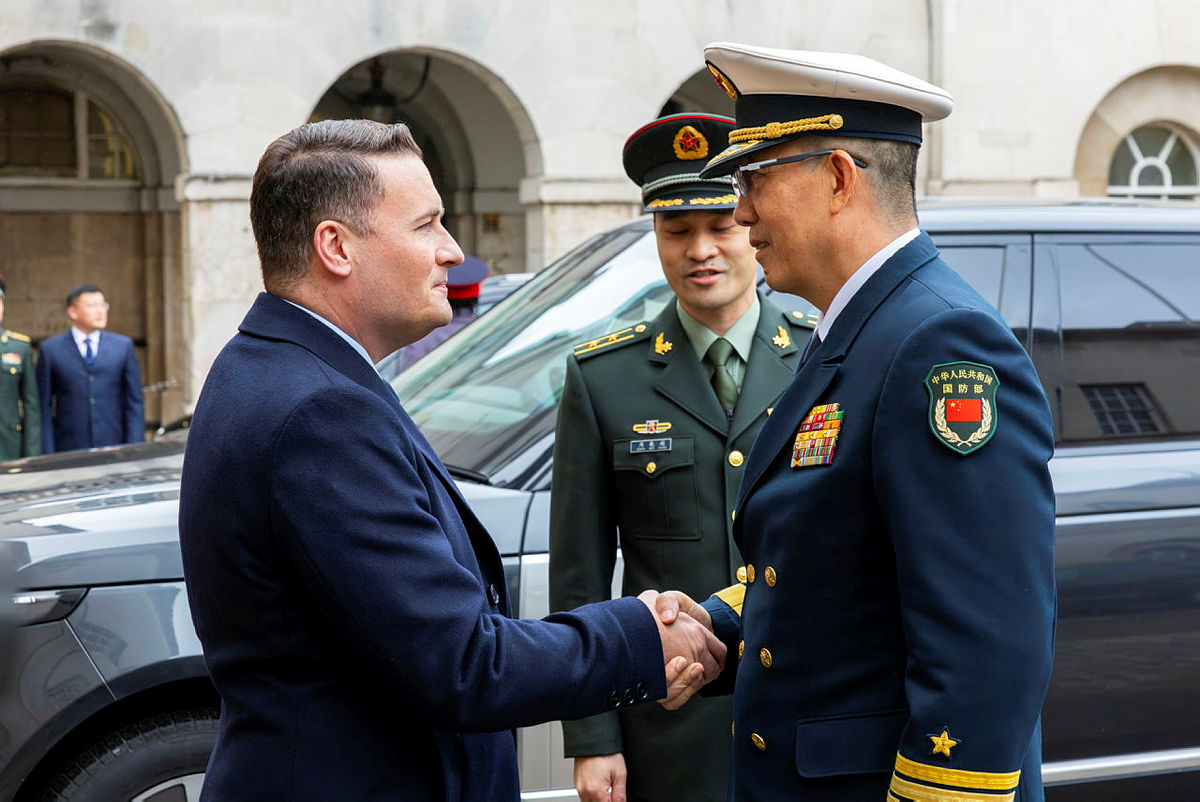
United Kingdom Hosts Chinese Defence Minister in Landmark Visit Amidst Calls for Direct Dialogue
United Kingdom Defence Secretary Wes Streeting recently hosted China’s Defence Minister, Admiral Dong Jun, marking the first such high-level defence engagement between the two nations in 26 years. The visit underscores the British government’s stated commitment to maintaining open communication channels with Beijing, even as profound differences persist, aiming to prevent strategic rivalry from escalating into military confrontation through misunderstanding or miscalculation.
In a detailed written statement to Parliament, Streeting articulated the rationale behind the significant meeting, noting its historical importance as the first since a Labour government was last in power. He directly addressed anticipated questions and skepticism regarding the wisdom of engaging so directly with a country whose political system, strategic ambitions, and conduct differ fundamentally from those of the United Kingdom. Streeting acknowledged a history of inconsistent approaches by Britain towards China, suggesting this had previously undermined both economic and security relationships and caused confusion among allies, particularly those in the Indo-Pacific region who look to the UK for support, security, and stability.
The current UK government, according to Streeting, has adopted a “responsible and clear-sighted approach” to its engagement with China. This strategy involves stepping up interaction in a consistent and coordinated manner, guided by British values and interests. As a result, Streeting stated, the bilateral relationship with China—despite navigating several difficult issues—is now on a more stable footing, underpinned by a realistic assessment of both the opportunities and the inherent risks involved. He affirmed that China’s global influence is simply too great to ignore, describing this as an undeniable reality. However, he emphatically stated that recognizing China’s importance does not equate to acceptance of its conduct, nor would economic engagement ever translate into strategic dependence under the current government.
Streeting outlined several areas where the United Kingdom would continue to speak plainly and challenge China’s actions. These include advocating for human rights, insisting that China honors its international commitments, and opposing any form of coercion in the Indo-Pacific region. He referenced explicit warnings from UK security services regarding the risks arising from cyber-attacks, espionage, and foreign interference. In response, the government has committed to protecting critical technologies, defending sensitive infrastructure, diversifying vulnerable supply chains, and actively challenging unfair trading practices employed by China.
As Defence Secretary, Streeting emphasized his “additional responsibility” to ensure that strategic rivalry between global powers does not devolve into military confrontation, particularly through misunderstanding or miscalculation. He argued that in an increasingly contested international landscape, reliable communication channels between major global powers are not merely diplomatic niceties but rather “strategic necessities.” He highlighted that engaging directly with Admiral Dong aligns with approaches taken by his counterparts in key allied nations, including the USA, France, Germany, and Italy, in recent years. This suggests a broader, coordinated Western strategy for managing complex relations with Beijing.
Despite acknowledging “profound differences” between the United Kingdom and China—with the UK strengthened by its belief in parliamentary democracy, the rule of law, accountable government, independent institutions, and essential freedoms—Streeting contended that recognizing the depth of these disagreements must not lead to the dangerous conclusion that cooperation is either impossible or undesirable. He underscored China’s status as a 21st-century superpower, noting its position as the UK’s third-largest trading partner, supporting an estimated 370,000 British jobs. China’s scientists and companies are also at the cutting edge of technological advancements poised to shape the future. As a permanent member of the UN Security Council and maintaining the world’s largest active military force, China’s participation is deemed “indispensable” if the global community is to effectively address critical challenges such as climate change, the proliferation of artificial intelligence, pandemics, nuclear proliferation, and the prevention of broader conflicts.
Streeting articulated what he termed “the central paradox of our age”: the intensifying strategic competition between great powers occurring precisely at the moment when the world’s most serious challenges demand greater international cooperation. Against this backdrop, he drew a clear distinction between “extending the hand of diplomacy” and “lowering our guard,” characterizing the former as an expression of confidence and the latter as an invitation to risk. He concluded that in its dealings with China, the United Kingdom must never confuse the two, committing to a balanced approach: “We will co-operate where we can, and challenge where we must.” This, he asserted, is the approach of a country confident in its values, meeting the world as it is, while actively working to shape it as it ought to be.
This high-level defence meeting follows a visit by the British Prime Minister to China in January—the first such trip in eight years—which reportedly resulted in approximately £2.2 billion in export deals. That visit was framed by the government as bringing “stability, clarity and a long-term strategy” to UK-China engagement. Separately, Streeting had recently expressed a desire for military backchannels with Russia to reduce the risk of miscalculation, although ministers informed Members of Parliament that Russia has largely ignored or rejected British efforts for senior military communication. The broader strategic context of the UK’s engagement with China is further highlighted by recent intelligence assessments. The day after Admiral Dong’s visit, Lieutenant General Matthew Jones, Chief of Defence Intelligence, listed “the mind-boggling scale and pace of the military capability build-up in East Asia” as a significant threat facing Britain in a speech at the Cambridge Intelligence Seminar. Furthermore, MPs and peers were informed in November that Russia and China have collectively increased their counterspace arsenals by 70% since 2021, adding another layer to the strategic security discussions surrounding global defence interactions.
Why This Matters
The visit of China’s Defence Minister to the United Kingdom, the first in over two decades, is a critically important development with far-reaching implications for international diplomacy, security, and global stability. It underscores several key dynamics in the current geopolitical landscape:
- Managing Great Power Competition:This engagement exemplifies the complex challenge faced by Western democracies in managing relations with a rising China. It reflects a strategy of balancing robust competition with essential dialogue to prevent miscalculation and maintain stability. For the UK, it’s about asserting its values and protecting its interests while acknowledging China’s undeniable global influence.
- Preventing Escalation and Enhancing Security:Direct military-to-military communication channels, particularly between nations with significant and rapidly advancing defence capabilities, are crucial for de-escalation and risk reduction. In an increasingly volatile world, establishing and maintaining these lines of communication can help prevent misunderstandings from spiraling into direct conflict, especially in contested regions like the Indo-Pacific.
- UK’s Role on the Global Stage:By hosting such a high-level meeting, the UK signals its intent to remain a significant player in global diplomacy and security. It demonstrates a proactive approach to engaging with major powers, positioning itself as a nation willing to tackle complex international challenges and contribute to shaping global norms, particularly in the context of its “Indo-Pacific tilt.”
- Addressing Global Challenges:Many of the world’s most pressing issues—such as climate change, the responsible development of artificial intelligence, pandemic preparedness, and nuclear proliferation—require multilateral cooperation. China’s participation is indispensable for effective global action on these fronts. The visit highlights the pragmatic necessity of engaging even strategic rivals on shared existential threats.
- Balancing Economic Interests with Security Concerns:The UK, like many Western nations, has deep economic ties with China, which serves as a major trading partner and supports a substantial number of British jobs. However, these ties are increasingly scrutinized in light of concerns over national security, human rights, cyber espionage, and unfair trade practices. This visit represents an ongoing effort to navigate this delicate balance, protecting critical national infrastructure and values while seeking economic opportunities.
- Regional Stability in the Indo-Pacific:The UK’s consistent emphasis on opposing coercion and supporting allies in the Indo-Pacific is a key aspect of its foreign policy. Direct dialogue with China’s defence leadership allows the UK to communicate these stances clearly and directly, potentially contributing to a more stable and predictable environment in a region vital for global trade and security.
- Transparency and Trust-Building:While profound differences and a lack of trust persist between the UK and China, military-to-military dialogue can foster a degree of transparency regarding intentions and capabilities. This is a foundational step in de-escalation and risk reduction, even if it doesn’t immediately resolve underlying geopolitical tensions.