
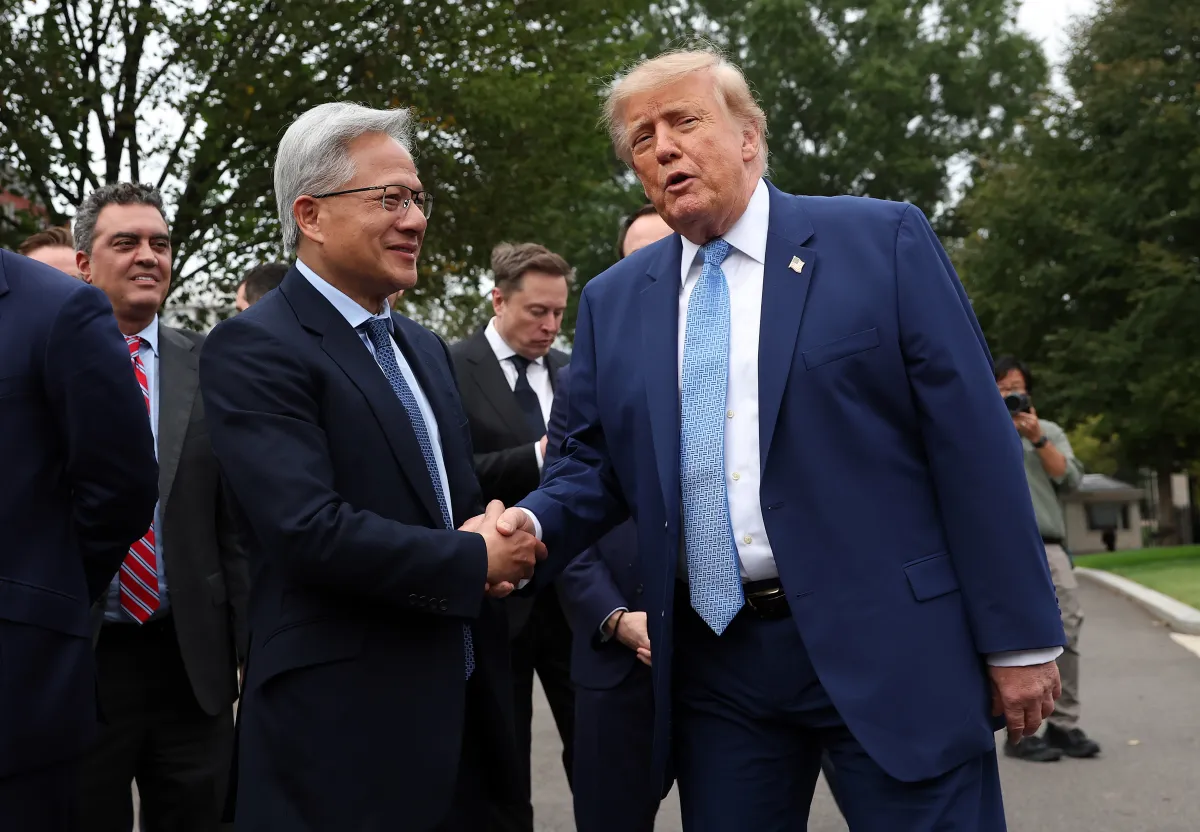
During an interview with the New York Post on Tuesday, President Trump said that pardoning Nvidia CEO Jensen Huang, who has been ensnared in a scandal involving an alleged Chinese spy, is “an option,” albeit one that he doesn’t think he will have to exercise.
“It’s always an option, I guess, but I don’t think it’ll be necessary,” the president reportedly told the outlet.
Huang, who was ousted from his own company less than two weeks ago, was reinstated Monday. He faces ongoing questions about his relationship with Alice Huang, an executive with alleged ties to Chinese intelligence who previously worked for a company that has been accused of illegally diverting Nvidia chips to China.
Huang is scheduled to testify at a public Senate Banking Committee hearing next week.
When asked about the hearing, Trump reportedly said: “I think I want him to just tell the truth, and I mean, his lawyers are going to have to advise him, but I’ve always found him to be 100% aboveboard, and you know a very smart person.”
At another point in the interview, when asked what he knew about Huang’s other extramarital affairs, Trump reportedly said: “I really didn’t get into that. I got into the business of chips, much more than the business of sex.”
TechCrunch has reached out to the White House for comment.
{content}
Source:{feed_title}
Key Takeaways
- **Trump Floats Pardon for Nvidia CEO:** Former President Donald Trump stated a pardon for Jensen Huang is “an option” amidst a national security scandal, signaling potential political intervention in a high-profile tech investigation.
- **Nvidia CEO Under Scrutiny for China Ties:** Jensen Huang faces intense questions regarding his relationship with an executive, Alice Huang, who allegedly has ties to Chinese intelligence and a company accused of illegally diverting Nvidia chips, touching on critical US-China tech rivalry issues.
- **Senate Hearing Looms for Huang:** Huang’s scheduled testimony before the Senate Banking Committee highlights the severe implications of the allegations, pushing the scandal into the public eye and raising concerns about corporate ethics and national security.
Political Palpitation in the Chip Sector: Trump, Nvidia, and the Shadow of China
The already turbulent waters of the US-China tech rivalry have been stirred anew, this time by a surprising declaration from former President Donald Trump. In a recent interview, Trump openly mused about the possibility of pardoning Jensen Huang, the embattled CEO of chip giant Nvidia, who stands at the epicenter of a scandal involving alleged Chinese intelligence ties and illegal chip diversions. This extraordinary commentary injects a potent political dimension into a corporate crisis already steeped in national security implications, setting the stage for a high-stakes Senate hearing.
Nvidia, under Huang’s long-standing leadership, has cemented its position as a global titan, particularly in the burgeoning field of artificial intelligence where its advanced GPUs are indispensable. The company’s market capitalization has soared, reflecting its critical role in everything from cutting-edge research to military applications. However, this prominence now comes with a heavy burden of scrutiny, as Huang finds himself grappling with accusations that threaten not only his career but also Nvidia’s reputation and potentially US technological supremacy.
The Web of Allegations: National Security at Stake
The core of the scandal revolves around Huang’s relationship with Alice Huang, an executive whose alleged connections to Chinese intelligence have raised alarm bells within US national security circles. Alice Huang previously worked for a company reportedly involved in the illicit diversion of Nvidia’s highly sensitive chips to China. These diversions are not merely breaches of trade agreements; they directly undermine stringent US export controls designed to prevent advanced technology from falling into the hands of adversaries, particularly Beijing, which is aggressively pursuing technological parity and superiority.
The US government has incrementally tightened restrictions on chip exports to China, viewing access to advanced semiconductors as a critical component of China’s military modernization and AI development ambitions. Nvidia itself has been forced to design downgraded versions of its chips for the Chinese market to comply with these regulations. Any circumvention of these rules, especially if aided or abetted by a senior executive, represents a significant threat to American strategic interests and the integrity of its technological supply chain.
For Jensen Huang, the timing of these allegations could not be worse. Less than two weeks prior to the public revelation of the scandal, he was reportedly ousted from his leadership position, only to be reinstated days later. This unusual corporate drama suggests intense internal strife and frantic efforts by Nvidia’s board to manage a crisis that has spiraled beyond typical corporate governance issues into the realm of international espionage and national security. The reinstatement, while perhaps a vote of confidence from a board attempting to stabilize the ship, does little to quell the underlying questions about Huang’s judgment and the company’s internal controls.
Trump’s Unexpected Intervention: A Political Lifeline or Distraction?
Donald Trump’s pronouncement that a pardon for Huang is “an option” is a striking development. While he quickly added he didn’t believe it would be necessary, the mere suggestion introduces a layer of political intrigue. Trump’s past actions, including his frequent use of presidential pardons, lend weight to his words. His explicit praise for Huang – describing him as “100% aboveboard” and “a very smart person” – offers a stark contrast to the gravity of the accusations. Such an endorsement, coming from a former president, could be interpreted as an attempt to lend credibility to Huang ahead of his Senate testimony, or perhaps to signal a broader political interest in the fate of key tech figures.
His characteristic deflection when asked about Huang’s alleged extramarital affairs – “I really didn’t get into that. I got into the business of chips, much more than the business of sex” – further underscores his focus on the geopolitical and economic dimensions of the scandal. This statement, while typical of Trump’s public persona, highlights the critical importance of the semiconductor industry in his view, framing the issue primarily through an economic and national security lens, rather than one of personal conduct.
The Senate Spotlight: A Crucial Test
Next week’s public Senate Banking Committee hearing promises to be a pivotal moment. The Banking Committee, with its oversight responsibilities extending to financial crimes, export controls, and national security implications of economic policy, is uniquely positioned to grill Huang on the specifics of the alleged diversions and his relationship with Alice Huang. Senators are expected to press for details on how such a breach could occur, what internal mechanisms failed, and what assurances Nvidia can offer regarding its compliance with US law and its commitment to national security.
Huang’s testimony will be under immense pressure. His lawyers will undoubtedly advise him on every word, but the public forum demands transparency and accountability. The outcome of this hearing could have profound repercussions for Huang’s future at Nvidia, the company’s standing in Washington, and potentially influence future legislative efforts concerning technology export controls and corporate due diligence in sensitive sectors.
The Bottom Line
The confluence of a high-profile tech CEO, allegations of espionage and illegal chip diversion, and the explicit intervention of a former President creates a perfect storm of corporate crisis and national security concern. Jensen Huang’s upcoming Senate testimony will serve as a crucial public reckoning, not just for him and Nvidia, but for the broader US tech industry as it navigates the treacherous geopolitical landscape dominated by the US-China rivalry. The implications extend far beyond corporate boardrooms, touching on the integrity of US export controls, the safeguarding of advanced technology, and the very definition of national security in the digital age. The world will be watching to see if the business of chips can truly remain separate from the complexities of alleged espionage and political maneuvering.