
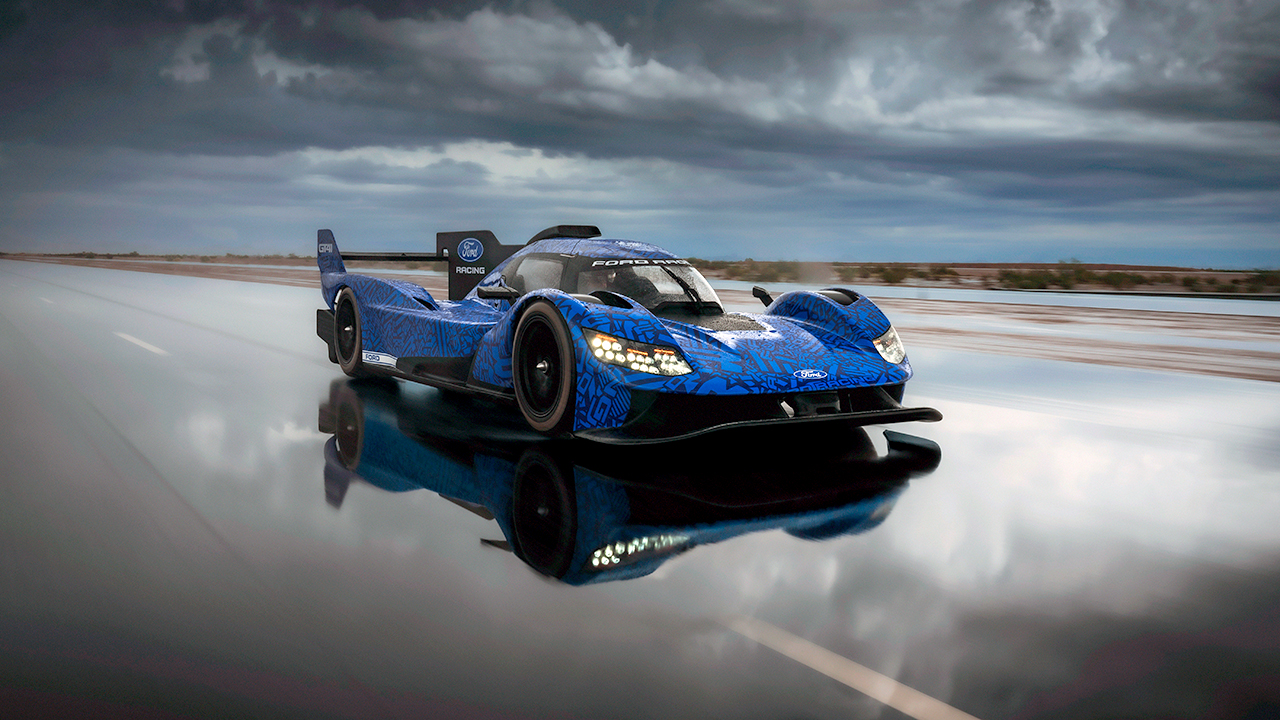
Ford CEO Jim Farley discusses the company’s new GT 41 Hypercar.
**Key Takeaways:**
1. **Strategic R&D and Brand Halo:** Ford’s return to Le Mans with the GT41 Hypercar is a significant investment in both cutting-edge research and development, particularly for hybrid powertrains, and a powerful global brand-building exercise designed to elevate its performance image and attract top engineering talent.
2. **Direct Technology Transfer:** CEO Jim Farley explicitly links racing innovations in battery technology, hybrid software, and predictive failure diagnostics to tangible benefits for Ford’s commercial and consumer vehicle lines, underscoring a practical ROI beyond mere marketing.
3. **Market Positioning and Investor Confidence:** The high-profile launch and “America’s Race Team” narrative aim to solidify Ford’s market position, reinforce its commitment to innovation, and potentially enhance investor confidence by demonstrating the company’s long-term vision and engineering prowess in a highly competitive automotive landscape.
Ford Motor Company (NYSE: F) on Thursday unveiled its new Hypercar, known as the Ford GT41, a strategic move during the Thanksgiving Day NFL game at Detroit’s Ford Field between the Lions and Bears. This high-profile debut signals Ford Racing’s ambitious return to compete at the legendary 24 Hours of Le Mans next year, a critical juncture for the company’s brand narrative and technological development.
The Ford GT41 is more than just a racing machine; it’s a direct lineage to the iconic GT40, which famously secured four consecutive victories at Le Mans starting in 1966—a triumph immortalized in the 2019 film “Ford v Ferrari.” This historical connection is being leveraged to underscore Ford’s deep-rooted performance heritage and inject emotional resonance into its current market strategy, aiming to translate racing success into consumer appeal and investor confidence.
Ford CEO Jim Farley, speaking to FOX Business, framed the new Hypercar as intrinsically linked to Ford’s racing legacy and a bold statement of the company’s contemporary ambitions. “Now we’re going back to Le Mans next summer in June to take on Ferrari and the best of the world to win Le Mans outright. It’s an all-Ford effort. We’re not having another company manage the athletes and the effort – this is all on Ford with some key partnerships,” Farley emphasized, highlighting the internal commitment and control over this high-stakes project. This ‘all-Ford’ approach signals a deeper integration of racing endeavors into the company’s core engineering and marketing strategies, suggesting a direct flow of resources and expertise rather than an outsourced venture.
Farley further articulated the intrinsic value of motorsports: “We’re doing this because racing is an indigenous sport. Ford was basically funded from a race with Henry Ford in Lake St. Clair, and this really proves out our best technology versus these great companies.” This perspective positions racing not merely as a marketing expense, but as a crucible for innovation, a high-pressure environment where engineering lessons are rapidly developed and proven. These invaluable insights, Farley affirmed, are then directly incorporated into production vehicles, offering a tangible return on investment for Ford customers in their daily drivers.
FORD OPENS MASSIVE NEW ARCHIVE PUTTING OVER A CENTURY OF AUTOMOTIVE HISTORY ON DISPLAY
The Ford GT41 Hypercar on a road seen from the side.(Ford Motor Co.)
The Ford GT41 was developed by Ford Racing with its engine designed in-house, a critical detail for investors monitoring proprietary technology development. The Hypercar pairs a naturally aspirated, 5.4-liter Coyote-based V8 engine with a hybrid system. This choice of a V8-hybrid powertrain is particularly relevant in today’s automotive market, showcasing Ford’s commitment to advanced internal combustion engines while simultaneously embracing electrification—a transitional strategy for many legacy automakers.
Ford leveraged extensive engineering expertise from its diverse global motorsport programs, including insights from Formula 1 through its collaboration with Red Bull Ford Powertrains and lessons from demanding off-road racing activities like the Dakar Rally. This cross-pollination of knowledge from various racing disciplines accelerates the Hypercar’s development, providing a rapid prototyping environment for technologies that could eventually find their way into consumer vehicles. Such synergies represent an efficient use of Ford’s global engineering talent and resources, reducing R&D cycles.
The integration of racing and consumer vehicle programs is a core tenet of Ford’s strategy. Farley elaborated on the direct benefits of the Hypercar’s advanced hybrid system. Ford has already established itself as a leader in deploying hybrid systems across its product range, from the highly popular hybrid F-150 and Maverick trucks to its performance-oriented Mustang. “There are direct benefits on the battery technology, the software that controls the hybrid system, even predictive failure so that our Pro customers are never off the road. We can take the predictive failure from Le Mans, a specific component of the AI software that does that, and apply it to a Transit van or a Super-Duty to benefit our customers,” Farley explained. This direct transfer of advanced diagnostics and hybrid management software from the grueling demands of Le Mans to commercial fleets underscores a clear and quantifiable business advantage, promising improved uptime and reduced operational costs for Ford’s high-volume commercial vehicle segment.
FORD UNVEILS 2027 F-150 WITH HANDS-FREE TOWING, FIRST-EVER CARHARTT EDITION
The Ford GT41 Hypercar drives in the rain.
The Ford GT41 Hypercar’s liveries were also strategically designed to reflect its evolution toward 2027, transitioning from functional camouflage used during technical and aerodynamic testing to its striking blue-on-blue design unveiled on Thanksgiving. This visual progression is part of a broader marketing narrative, building anticipation and showcasing the aesthetic prowess derived from its engineering. The design meticulously emphasizes Ford Racing’s identity as America’s Race Team, embedding hidden details such as the American flag, a bald eagle, and “The Spirit of Detroit” sculpture. This deliberate focus on American iconography aims to resonate deeply with a domestic audience, fostering national pride and brand loyalty.
Farley reiterated the significance of the launch venue and timing, stating that unveiling the Hypercar at Detroit’s Ford Field during the NFL game on Thanksgiving was the “perfect place to launch the effort” at a time when Americans are traditionally gathered with family on an “iconic American holiday.” This calculated marketing strategy maximizes exposure to a vast and diverse audience, extending Ford’s reach beyond traditional motorsports enthusiasts to a broader demographic of potential customers and investors.
FORD’S US MANUFACTURING EXPANSION TO BRING ‘THOUSANDS AND THOUSANDS OF JOBS,’ LUTNICK SAYS
The Ford GT40 as seen from the side.
Ford’s announcement was further amplified by a cinematic anthem film celebrating the debut of the new GT41 Hypercar and its return to Le Mans. The ad spot cleverly draws on the iconic “go like hell” line from the “Ford v Ferrari” film, featuring Matt Damon, who portrayed race car driver and builder Carroll Shelby in the movie, as a voiceover actor. This celebrity endorsement and cinematic tie-in are powerful marketing tools, leveraging popular culture to amplify brand messaging and connect with consumers on an emotional level.
“When we won in ’66 and our effort in 2027, what’s common is ‘go like hell.’ This is an all-American effort to win the most challenging race in the world in France like we did all those years ago, over 60 years ago,” Farley passionately articulated. “We really think of ourselves as America’s Race Team. We’re the most American brand, we make 85% of what we sell here in the U.S., and this is a great experience for many American sports fans, even if they’re not motorsports fans, to see a great American company like Ford compete against Ferrari,” Farley added. This emphasis on American manufacturing and identity serves to strengthen domestic appeal, a crucial factor for Ford given its significant market share in the U.S. truck and SUV segments.
CLICK HERE TO DOWNLOAD THE FOX NEWS APP
**Market Impact:**
Ford’s unveiling of the GT41 Hypercar and its strategic return to Le Mans represents a calculated investment designed to yield significant returns beyond the racetrack. For investors, this initiative signals Ford’s commitment to innovation, particularly in advanced hybrid powertrains, and its ability to attract and retain top engineering talent by participating in premier global motorsport. The explicit link between racing technology and consumer/commercial product development, as articulated by CEO Jim Farley, provides a clear pathway for improved vehicle performance, reliability, and cost efficiencies across Ford’s high-volume segments like the F-Series and Transit vans. While racing expenditures are often scrutinized, this program is framed as a critical R&D accelerator and a potent global marketing platform, enhancing Ford’s brand perception, justifying premium pricing for advanced features, and ultimately reinforcing its competitive standing against rivals like General Motors and international luxury brands. A successful campaign at Le Mans could provide a significant halo effect, boosting brand desirability and potentially translating into stronger sales and market share, particularly in performance-oriented and technologically advanced vehicle categories.