
Telsey Advisory Group CEO and chief research officer Dana Telsey discusses what to expect from holiday sales and emerging consumer trends businesses are embracing on ‘Barron’s Roundtable.’
Key Takeaways for Investors:
- Resilient Consumer & Digital Dominance:Despite persistent inflation, elevated interest rates, and tightening household budgets, Black Friday’s record online spending of $13.1 billion underscores the American consumer’s resilience and a definitive pivot towards digital channels for value-seeking, signaling strong tailwinds for e-commerce pure-plays and retailers with robust omnichannel strategies.
- Strategic Discounting & Tech Adoption:Retailers’ aggressive promotional strategies, particularly in electronics and apparel, alongside consumers’ increasing reliance on “Buy Now, Pay Later” (BNPL) services and AI-powered shopping tools, highlight an evolving retail landscape where technology and flexible payment options are crucial drivers of conversion, market share, and operational efficiency.
- Nuanced Retail Performance & Economic Barometer:While online sales soared, a notable dip in physical store traffic paints a mixed picture for the retail sector. This divergence provides critical insights into shifting operational priorities, real estate valuations, and serves as an early barometer for overall consumer health and Q4 corporate earnings expectations amidst ongoing macroeconomic uncertainties.
NEW YORK –Black Friday 2023 delivered a robust, albeit complex, message to financial markets: the American consumer, while undeniably cost-conscious, remains highly engaged, with a clear and accelerating preference for digital channels when seeking holiday deals. Online spending on the critical shopping day surged to an impressive $13.1 billion, according to comprehensive data from Adobe Analytics. This figure not only comfortably surpassed the initial market forecast of approximately $12.9 billion but also marked a significant 11% climb from last year’s total. This performance offers a crucial early read on consumer sentiment and purchasing power ahead of the peak holiday season, particularly against a persistent macroeconomic backdrop of stubbornly high inflation, elevated interest rates, and mounting household debt.
The stellar online performance unequivocally underscores a prevailing market trend that has only accelerated post-pandemic: the undisputed dominance and operational efficiency of e-commerce. As Dana Telsey, CEO and chief research officer at Telsey Advisory Group, discussed on ‘Barron’s Roundtable,’ businesses are rapidly embracing emerging consumer trends, with digital accessibility, seamless user experience, and a compelling value proposition at the forefront of their strategies. This Black Friday, consumers actively leveraged online platforms to navigate a landscape where optimizing every dollar spent is paramount, seeking out aggressive promotions on a diverse range of categories.
Electronics and gaming products emerged as particularly strong-selling categories, signaling a willingness among consumers to invest in discretionary items when discounts are sufficiently compelling. This trend is a vital indicator for tech retailers, hardware manufacturers, and semiconductor companies, whose Q4 earnings are often heavily influenced by holiday demand and consumer discretionary spending. Shoppers also capitalized extensively on promotions for apparel and appliances, suggesting that retailers successfully deployed aggressive pricing strategies to clear inventory, stimulate demand, and potentially bolster market share in sectors that have seen fluctuating performance throughout the year. The sustained high demand for everyday essentials—including cleaning supplies, pet care products, and personal hygiene items—further highlights a pragmatic consumer balancing discretionary treats with necessary household replenishment, often seeking the best online deals to optimize their overall budgets and mitigate inflationary pressures.
BLACK FRIDAY SHOPPERS BRAVE EARLY LINES, PACKED AISLES TO SCORE IN-STORE DEALS
Americans spent $13.1 billion online on Black Friday, surpassing expectations despite persistent inflation and pressure on household budgets.(REUTERS/Anna Rose Layden / Reuters)
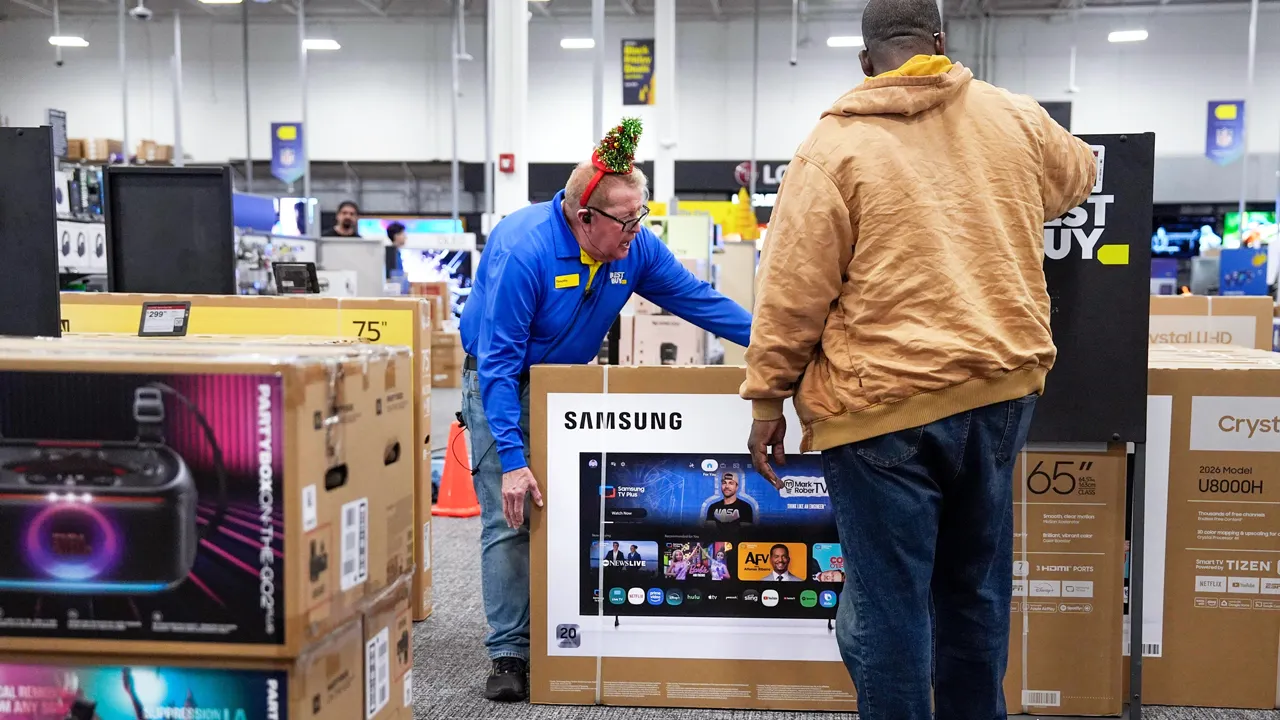
However, the retail narrative wasn’t uniformly positive across all channels, revealing a nuanced picture for market participants. The boost in online sales coincided with a noticeable dip in foot traffic at traditional brick-and-mortar retailers. Geospatial analytics company PassBy reported nearly 930 million visits on Black Friday, marking a 2.2% drop from a year earlier. This divergence reinforces the strategic challenges facing traditional retailers and mall operators, emphasizing the critical necessity of robust omnichannel capabilities. Retailers that failed to seamlessly integrate their online and physical storefronts, offering convenient options like buy online, pick up in-store (BOPIS) or ship from store, likely ceded valuable market share to more digitally adept competitors. For investors, this persistent trend continues to weigh on the valuations of retail-focused real estate investment trusts (REITs) and legacy department stores, signaling a fundamental shift in retail asset utilization.
The online holiday shopping frenzy is projected to extend well into Cyber Monday, with Americans anticipated to spend an additional $15.1 billion online, representing a robust 6.2% increase from the prior year. This would bring the total online spending over the five-day Thanksgiving shopping period to an estimated $47.5 billion, underscoring the sheer scale and economic significance of digital commerce during this critical window. The sustained momentum provides positive signals for e-commerce giants, payment processors (like Visa, Mastercard, and PayPal), and logistics companies that facilitate these transactions, indicating strong revenue streams and healthy transaction volumes for the fourth quarter.
SMALL BUSINESS SATURDAY PUTS LOCAL AMERICAN BUSINESSES FRONT AND CENTER

Foot traffic at U.S. retail stores declined 2.2% from a year earlier on Black Friday as online spending surged.(USA TODAY Network via Reuters Connect / Reuters)
Adding another layer to evolving consumer financing trends, Adobe Analytics noted a significant uptick in the use of “Buy Now, Pay Later” (BNPL) services. These flexible payment options are expected to account for $1.09 billion in online spending on Cyber Monday alone, a 5.3% increase from last year. This growth highlights consumers’ increasing reliance on installment plans to manage larger purchases amidst tight budgets, a trend that boosts sales for retailers but also raises questions for credit quality and fintech companies offering these services. While BNPL facilitates immediate purchasing power, its rapid adoption warrants careful monitoring for potential impacts on consumer debt levels and default rates within the broader financial system.
Furthermore, technology played a pivotal role in optimizing shopping efficiency and retailer conversion rates. Consumers increasingly utilized AI-powered shopping tools to compare prices and find the best deals in a highly competitive market. Adobe data revealed that traffic originating from chatbots and AI-enabled browsers converted into purchases a remarkable 68% more effectively than a year earlier. This indicates a growing sophistication in consumer shopping behavior and a clear competitive advantage for retailers making significant investments in artificial intelligence and machine learning to enhance the customer journey. For tech investors, this trend points to strong and sustained demand for AI solutions within the retail technology sector.

Retailers offered steep discounts on electronics, apparel and appliances to attract shoppers during the Black Friday shopping rush.(Anthony Behar/Sipa USA / Reuters)
Looking at the broader holiday season, the National Retail Federation (NRF) projects that U.S. holiday sales in November and December 2026 will climb 4.2% from last year, reaching a staggering $1.01 trillion. This forecast outpaces the 3.1% growth seen a year ago, signaling a relatively optimistic outlook for the overall retail sector and its contribution to GDP. However, it’s crucial for investors to note that this projected increase in dollar value is driven in part by higher prices this year, meaning real volume growth (unit sales) might be more modest than the headline figure suggests. This distinction is critical for investors assessing the underlying health and profitability of individual retailers, as top-line revenue growth fueled primarily by inflation doesn’t necessarily translate to proportional increases in unit sales or expanding profit margins.
The robust online Black Friday performance, coupled with the NRF’s optimistic full-season forecast, suggests that despite ongoing economic pressures, consumers are determined to participate in the holiday shopping tradition. Retailers that successfully adapted to the digital-first, value-driven consumer benefited significantly, setting a strong precedent for the remainder of the holiday season and providing valuable insights into evolving market dynamics and consumer behavior that will shape strategies well into the next year.
GET FOX BUSINESS ON THE GO BY CLICKING HERE
Reuters contributed to this report.
Market Impact:
The strong Black Friday online sales figures provide a critical uplift for investor sentiment surrounding the Q4 retail landscape, particularly for e-commerce pure-plays (e.g., Amazon, Etsy) and omnichannel giants (e.g., Walmart, Target) that have invested heavily in digital infrastructure. Positive revenue guidance from these companies could follow, potentially boosting their stock valuations. Conversely, the decline in brick-and-mortar traffic signals continued pressure on traditional retail outlets and commercial real estate investment trusts (REITs) focused on shopping centers, necessitating strategic adaptations or further consolidation within the physical retail footprint. Payment processing companies (e.g., Visa, Mastercard, PayPal) and fintechs facilitating BNPL services (e.g., Affirm, Klarna) are likely beneficiaries of increased transaction volumes and evolving payment methods. The strong performance in electronics and gaming could also provide a lift to tech hardware manufacturers, gaming companies, and related supply chain entities. Overall, this early holiday data offers the Federal Reserve a nuanced perspective on consumer spending—robust in nominal terms, yet still heavily influenced by price sensitivity and a pervasive shift to digital efficiency—which will factor into future monetary policy considerations regarding inflation and interest rate trajectories. The data suggests a resilient, albeit discerning, consumer, supporting a cautiously optimistic outlook for the broader economy entering the new year, provided retailers can maintain profitability amidst aggressive discounting and rising operational costs.