
**Key Takeaways**
1. **Fiscal Overhaul Potential:** David Lisnard’s ascendance signals a growing appetite among French voters for aggressive fiscal consolidation, including significant spending cuts and pension reforms, which could address France’s high public debt (120% of GDP) and world-leading public spending (57% of GDP).
2. **Pro-Market Alternative:** As a self-proclaimed economic liberal admiring Javier Milei, Lisnard offers a starkly pro-business, anti-state interventionist platform, presenting a potential market-friendly alternative to the more statist or radical economic proposals from far-left and far-right contenders.
3. **Shifting Investor Sentiment:** His rise reflects a broader dissatisfaction with France’s traditional statist model and President Macron’s reform pace, suggesting a potential shift in investor confidence towards a more deregulated, competitive French economy, albeit with inherent political risks during implementation.
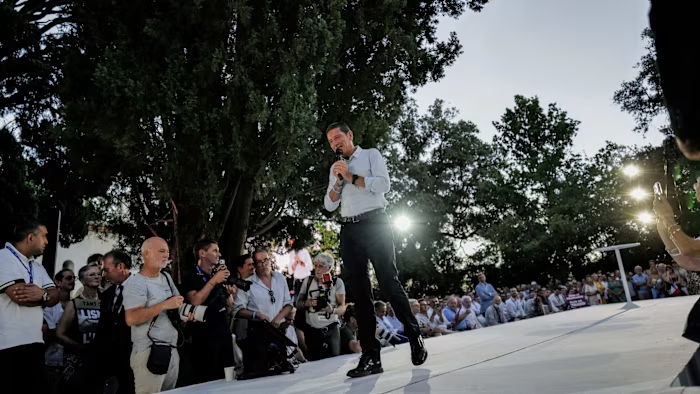
David Lisnard, the rightwing mayor of Cannes, has risen so suddenly in French presidential polls that his campaign has been forced to double the capacity of his first big rally to 10,000 people. This unexpected surge is not merely a political phenomenon; it signals a potential seismic shift in France’s economic policy landscape, capturing the attention of market analysts and investors alike.
The December 13 event in Lyon will be a critical test of the once little-known politician, an avowed economic liberal who openly admires Argentina’s iconoclastic, market-radical president, Javier Milei. Lisnard’s central platform — to put France’s “obese state” on a crash diet — resonates with a growing number of voters and, crucially, with financial markets concerned about the nation’s soaring public debt and high tax burden. His proposals to drastically cut government spending, reduce bureaucracy, and empower the private sector directly challenge France’s deeply entrenched statist model.
Once ridiculed, Lisnard’s campaign slogan, “Something is happening”, is starting to ring true in a very tangible way. The 57-year-old marathon runner and recently re-elected head of France’s influential association of mayors has climbed to around 12 per cent in first-round polling scenarios. Some surveys even see him surpassing former prime minister Édouard Philippe, positioning himself as a significant contender within the centre-right. Both, however, remain trailing far-right leader Marine Le Pen and far-left firebrand Jean-Luc Mélenchon, raising market concerns about a potentially polarising runoff.
The crowded field on the centre and right risks splitting the moderate vote, paving the way for a presidential run-off between Le Pen and Mélenchon. Most polls suggest the far-right leader would win, a scenario that would introduce significant policy uncertainty and potential market volatility given her protectionist and anti-EU leanings. The inability of Philippe and other contenders to agree on a joint primary to rally behind a single candidate only exacerbates this risk, making Lisnard’s disciplined, pro-market message all the more salient for investors seeking stability and reform.
Lisnard has a flair for punchy one-liners, canny social media posts, and scathing attacks on the French state’s excesses — runaway public spending, punitive taxes that stifle investment, and suffocating bureaucracy that impedes business growth. His prescription is a smaller, more efficient state, greater fiscal autonomy for the provinces, enhanced freedom for business, and a tougher stance on crime and immigration. These are not merely political talking points; they represent a fundamental economic reorientation that, if implemented, could profoundly impact France’s long-term growth prospects and sovereign risk profile.
“The state keeps trying to patch things up, but you can’t patch up the Titanic!” he told LCI news in mid-September, a metaphor that starkly highlights his view of France’s current economic trajectory. He argues that France’s high-tax, generous welfare model is heading for an iceberg, as economic stagnation and demographic pressures mount. “Too much spending and too much bureaucracy are destroying the state’s ability to act,” he warns, a sentiment that resonates with economists and investors concerned about the sustainability of French public finances.
In France, such free-market liberalism has historically been a hard sell. Citizens look to the state as their ultimate protector and provider, from free schooling to generous pensions, in a tradition of pervasive government intervention stretching back centuries. The numbers starkly reflect that deep attachment to the state: public spending accounts for an astonishing 57 per cent of GDP – among the highest in the developed world – the tax burden is also among the world’s highest, and public debt is approaching 120 per cent of GDP. These figures are a persistent drag on economic competitiveness and a major concern for credit rating agencies and bond investors.
However, faith in the state may be fraying. After nearly a decade under President Emmanuel Macron, who has overseen a significant accumulation of debt while often retreating from politically challenging structural reforms, voters appear increasingly ready to question the French model. An Ipsos poll found that roughly 80 per cent want radical or profound change, while about 90 per cent believe their country is in decline. This growing disillusionment provides fertile ground for Lisnard’s reformist agenda, suggesting that the public might be more amenable to market-oriented solutions than previously assumed.
Lisnard’s rise stems partly from his image as an outsider who never worked for Macron, said Bernard Sananès, a pollster at Elabe. Macron’s record-low 14 per cent approval rating has tainted politicians associated with him, notably Philippe and another former prime minister, Gabriel Attal. This anti-establishment appeal is a powerful asset in a political climate where voters are seeking fresh faces and radical departures from the status quo, offering markets a potential escape from the perceived inertia of the current administration.

“Lisnard is benefiting from being a novelty and offering a real rupture,” said Sananès. “But there may be a Lisnard bubble, just as we have seen in the past where challengers emerge in the autumn only to fade by spring.” For investors, discerning whether this is a fleeting political moment or a genuine shift in the political landscape is crucial for long-term strategic planning in France.
Born in Limoges to a ballet dancer and a professional footballer, Lisnard took a different path from France’s political elite, bypassing the prestigious Parisian schools that have produced so many of its leaders. Instead, he gained a rare taste of the private sector working in his parents’ clothing business, an experience he said first exposed him to the thickets of regulation and administrative burden that he now vows to dismantle. This background gives him a unique credibility when speaking about business freedom and deregulation.
Lisnard has an earthy, straight-talking style reminiscent of Jacques Chirac, who famously downed beers on the campaign trail in the 1990s. At an agriculture show, he even made a lewd joke to a mascot dressed in a cow costume, showcasing a populist touch that contrasts with the often-aloof French political class. This appeal to the common person, combined with his pro-market message, could broaden the base for economic liberalism.
Whether Lisnard can succeed depends on voters’ appetite for deep structural change. He is proposing more aggressive spending cuts than his rivals — a staggering €200bn by 2032, largely through a sweeping reduction in the number of civil servants. Such a move would be welcomed by bond markets seeking fiscal discipline, potentially leading to a narrowing of French bond spreads and an improved sovereign credit outlook.
His programme includes potentially explosive reforms: making people work until at least 65 for a full pension, up from 63 now, and scaling back state pensions in favour of a private pillar. This latter idea, while deeply controversial in France due to its challenge to the national solidarity model, holds significant implications for the domestic asset management industry and could boost long-term private savings. He also wants to strip teachers of their civil servant status and introduce private sector competition into France’s sacrosanct public education system, aiming for efficiency gains and better outcomes, but facing strong union resistance.
“We are the country with the highest public spending in the world, yet we have fewer and fewer public services. Perhaps we should ask ourselves why,” he said in an interview with BFMTV, directly addressing the paradox of France’s oversized state delivering diminishing returns to its citizens and taxpayers.
Some executives and rival campaign officials question whether French voters truly want Lisnard’s liberal policies, fearing they may be too radical. “I don’t think there is a space for what are very minority views,” said one banker. However, recent data suggests otherwise. An Ipsos survey for Institut Montaigne found that 54 per cent of French people favour limiting the state’s role in the economy and giving businesses more freedom, up from 45 per cent in 2022. Moreover, more than three quarters favour cutting government spending, indicating a significant shift in public opinion towards a more economically liberal approach.
His lack of experience in international affairs could prove a weakness at a time when Europe is grappling with Russia’s war in Ukraine, escalating trade tensions with the US and China, and broader geopolitical instability. Markets would be keen to understand his foreign policy leanings and how he would navigate complex international economic relations, which could influence trade agreements and investor confidence.
Lisnard has built a national following on social media, strategically bypassing traditional news outlets that long paid him little attention. Punchy AI-generated videos cast him as a superhero or World Cup winner, while more conventional clips show him in a navy suit railing against the establishment. This direct communication strategy allows him to control his narrative and reach a younger, digitally native audience, disrupting traditional political campaigning.
In one stunt inspired by Argentina’s Milei, he famously fed pages representing France’s 4,000-page labour code, along with environmental and building regulations, into a paper shredder. The Ramones’ “Blitzkrieg Bop” blares as he shouts: “Vive la liberté!” This performative act, while symbolic, sends a clear message to businesses burdened by excessive regulation that a Lisnard presidency would prioritize deregulation and ease of doing business, potentially unlocking significant economic potential.
Alexandra Borchio-Fontimp, a senator from Lisnard’s Nouvelle Énergie party, said the stunt was typical of his irreverent humour and penchant for provocation. “He wants to break with convention as a candidate outside the system,” she said. This ‘outsider’ status, combined with a clear reform agenda, could make him an attractive prospect for investors tired of incremental change.
In Cannes, Lisnard inspects a different street each morning to check its cleanliness, said Borchio-Fontimp, demonstrating a hands-on approach to governance. He has a track record of fiscal prudence at the local level, having cut spending by reducing staff numbers and renegotiating contracts, while investing in a sweeping renovation of the famous Croisette promenade. Municipal taxes were also lowered under his tenure, showcasing a practical implementation of his smaller-state, lower-tax philosophy that could inspire confidence in his ability to deliver at the national level.
His rise has naturally rattled rivals. Le Pen accused him of leaving workers “defenceless” by seeking to repeal the labour code, while Philippe said Lisnard was courting the far right. These attacks underscore the political friction his radical economic proposals are generating, hinting at potential social unrest during implementation – a key risk factor for markets.
But Hervé Morin, a centrist politician from Normandy, described Lisnard as a pragmatist rather than an ideologue. Their political alliance was forged over a long dinner. “I invited him over to my house for roast chicken and potatoes . . . We drank quite a few bottles of red wine and decided to start working together, later inviting intellectuals to discuss all sorts of subjects, filling notebooks with ideas,” Morin recounted, painting a picture of a thoughtful, collaborative approach to policy development.
Asked whether Lisnard could really prevent a presidential run-off between Le Pen and Mélenchon, Morin was unequivocal: “If it’s not him, it will be no one.” This statement highlights the high stakes for France’s political and economic future, suggesting Lisnard could be the centrist-right’s last best hope to avert a market-disrupting populist showdown.
Additional reporting by Sarah White
Market Impact
David Lisnard’s growing influence injects a significant, albeit uncertain, pro-market element into the French presidential race. Should his candidacy gain further momentum, markets would likely react positively to the prospect of a leader committed to fiscal discipline, deregulation, and private sector growth. French sovereign bond yields (OATs) could tighten relative to German Bunds, reflecting improved confidence in France’s long-term fiscal sustainability and a reduced sovereign risk premium. Equity markets, particularly those sectors benefiting from deregulation and reduced bureaucracy, could see a boost. However, the path to implementation of his radical reforms would be fraught with political challenges and potential social unrest, posing risks to short-term market stability. Any perception of political instability or an inability to pass key legislation could temper initial enthusiasm. Furthermore, while his pro-market stance offers an alternative to more extreme candidates, the crowded field still raises the specter of a Le Pen-Mélenchon runoff, a scenario that would likely trigger significant market apprehension and volatility, impacting the Euro and French asset valuations.