
Access the Editor’s Summary without cost
Roula Khalaf, the FT’s Editor, compiles her preferred articles for this weekly bulletin.
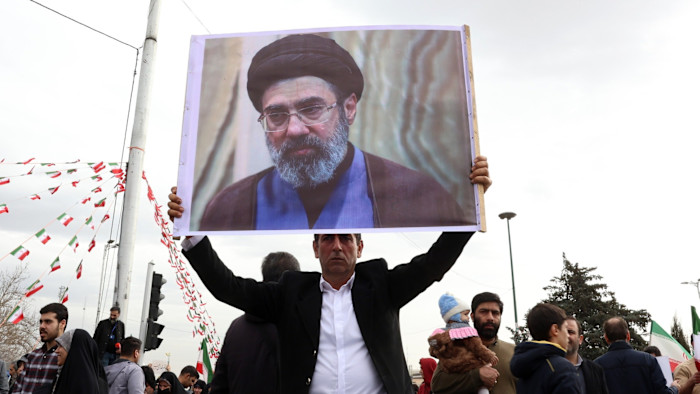
Mojtaba, son of Ayatollah Ali Khamenei, has surfaced as a primary contender to succeed his deceased father as Iran’s supreme leader, as supporters of the regime championed him as the Islamic republic’s forthcoming head merely hours after senior clerics convened to select a replacement.
Fars news agency, which maintains close ties with the formidable Islamic Revolutionary Guard Corps, indicated on Wednesday that the determination regarding the next leader would likely occur in the coming week.
Nevertheless, following an online gathering on Tuesday of members of Iran’s Assembly of Experts — the clerical body tasked with appointing the supreme leader — those loyal to the regime utilized social media platforms to endorse Mojtaba as the chosen successor.
Hatef Salehi, a journalist connected to the political establishment, posted an image of Mojtaba on X, uttering an Arabic plea for divine protection for “our leader Imam Khamenei”.
A family member of Khamenei informed the FT: “It is not yet finalized, but his prospects are exceedingly high.”
“The meetings are conducted virtually. They are deliberating and are nearing the conclusive stages of their decision-making process,” he further explained. Mojtaba, he noted, held a “slight lead”.
However, even as Mojtaba’s name was put forth as a potential successor, Israel issued a threat to eliminate any new leaders.
Israeli defence minister Israel Katz declared on X on Wednesday that every new leader “will be an unambiguous target for extermination” and that it “is irrelevant what his designation is or his hiding place”.
Israel attacked the Assembly of Experts structure in Qom on Tuesday, although Iranian news agencies reported the edifice was vacant.
Mojtaba’s fate and whereabouts have remained unknown since his father, who had governed Iran since 1989, along with his mother, spouse, sister, brother-in-law, and niece, perished in US and Israel air assaults on the supreme leader’s compound last Saturday.
Mojtaba, who has fostered strong connections with the influential Revolutionary Guards, maintained a discreet profile prior to the conflict.
The 56-year-old has been broadly regarded within Iranian political circles as a prospective successor for nearly two decades, though his precise political function has never been formally articulated.
Some Iranian analysts have previously theorized that if Mojtaba were to succeed his father, he might enact extensive reforms in close collaboration with the Revolutionary Guards, yet there is no indication of what his directives would entail should he assume authority.

Conversely, others have suggested that his ascension to supreme leader would signify a reversion to Iran’s history of dynastic governance, and that he would uphold his father’s tenets — implying he would be less inclined to introduce the transformations many Iranians desire to resolve the republic’s persistent tribulations.
“His principal vulnerability is his family designation,” remarked one reformist analyst. “Otherwise, he surpasses other potential candidates. He has been integral to the nation’s affairs for many decades.”
Sanam Vakil, Middle East director at Chatham House, noted that other nominees could still be under consideration within Iran’s obscure and intricate political framework, which encompasses rival factions.
“He’s re-emerged as the individual being considered. I believe the regime will need to contend with this. I didn’t think he was on the preliminary list before, due to the republic’s nature not being a hereditary system,” she stated. “It undermines the ideological foundation supporting the regime. If he is chosen, it will be because of the prevailing circumstances. Individuals are vying for roles; it’s more transparent than it appears.”
Other aspirants include Alireza Arafi, a high-ranking cleric who is part of a three-member provisional leadership council appointed subsequent to Khamenei’s demise, and Hassan Khomeini, the grandson of the Islamic republic’s founder, according to analysts.
Vakil observed that appointing a supreme leader presently was “fraught with peril; they instantly become a target”.
The US and Israel have eliminated several high-level Iranian officials and military commanders since initiating the conflict. US President Donald Trump informed reporters on Tuesday that “49 individuals were neutralized in the initial assault” on Saturday.
He further mentioned that there was “another strike [on Tuesday] on a fresh leadership, and it seems that was quite substantial as well”, which appeared to allude to Israel’s attack on the sacred city of Qom.
Trump declared this week that the administration had identified potential post-war leaders but asserted that the US-Israeli bombardment on Saturday had “eliminated most of the candidates”.
“It won’t be anyone we were considering because they are all deceased. Second or third in line is dead,” he conveyed to ABC.
Fars news agency, citing an unnamed official, stated that the subsequent session of the Assembly of Experts, comprising 88 clerics as its members, would convene next week “under the most stringent security measures”. This, it added, would occur following the ceremonial processions and interment for Khamenei.