
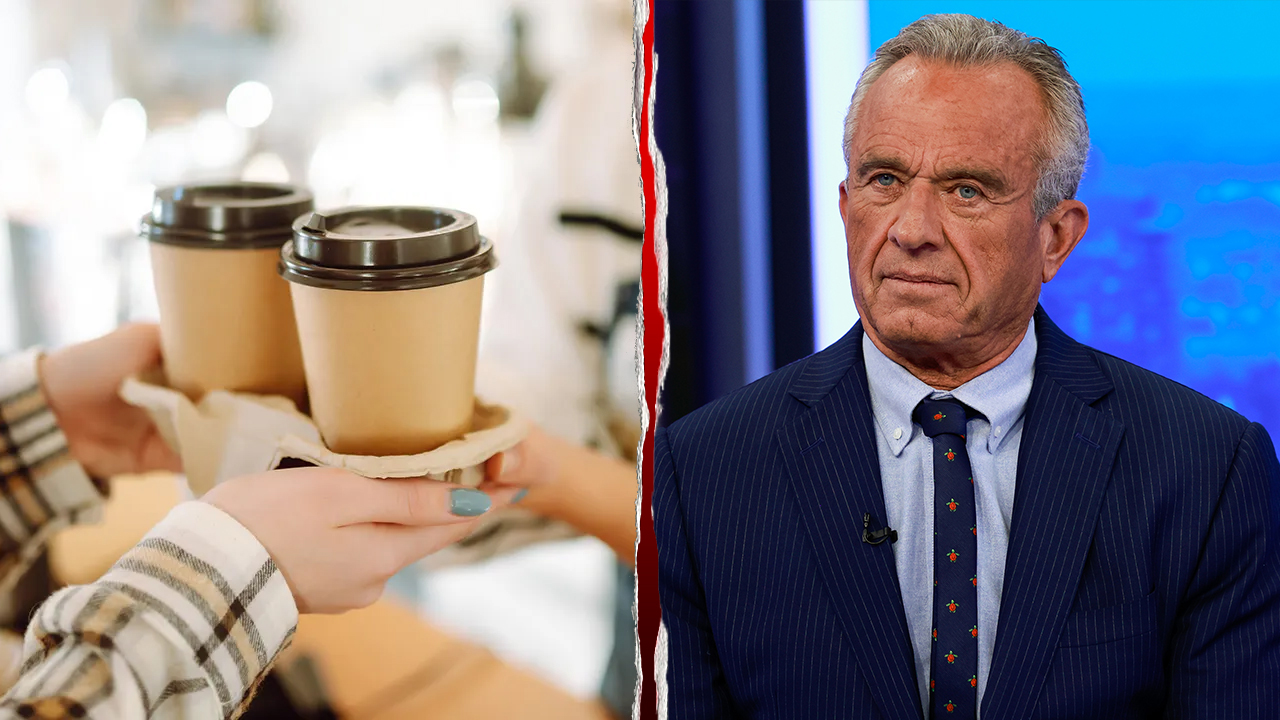
The Health and Human Services Secretary, Robert F. Kennedy Jr., addressed measures aimed at discontinuing the use of artificial, petroleum-derived colorants in the country’s food chain during ‘Jesse Watters Primetime.’
Robert F. Kennedy Jr., the Health Secretary, provoked extensive digital outcry after his inquiry into the safety of sweetened chilled coffee beverages offered by Dunkin’ and Starbucks – with Massachusetts’ chief executive among those voicing dissent.
At the “Eat Real Food” gathering in Austin, Texas, on February 26th, Kennedy stated, “Our intention is to request from Dunkin’ Donuts and Starbucks, ‘Provide us with the safety data demonstrating it’s suitable for an adolescent female to consume an iced coffee containing 115 grams of sugar.’”
“I doubt they will be capable of doing so,” he further commented.
These comments promptly elicited a reaction in Massachusetts, the birthplace of Dunkin’ and where it holds status as a cultural icon.
STARBUCKS TO INAUGURATE NEW FACILITY IN NASHVILLE, RELOCATE SOME POSITIONS FROM SEATTLE
Health and Human Services Secretary Robert F. Kennedy Jr. voiced apprehensions about sweetened drinks at a gathering in Austin, Texas, on February 26, 2026.(Jason Mendez/Getty Images; iStock / Getty Images)
On Wednesday, Massachusetts Governor Maura Healey utilized the platform X to champion the renowned New England beverage, sharing a flag graphic featuring the motto, “Come and take it.”
Although certain X users denounced Healey, contending she ought to advocate for improved dietary benchmarks, other individuals supported the chief executive due to worries that the administration might aim at their preferred beverages.
“Perhaps this current government ought to recall that we treat beverages with utmost gravity in New England,” an individual commented, accompanied by a graphic portraying the 1773 Boston Tea Party.
Other users interchanged the “Don’t tread on me” slogan for, “Donut tread on me.”
BURGER KING IMPLEMENTS ALTERATIONS FOR DISTINCTIVE WHOPPER FOR THE INITIAL OCCASION IN NEARLY A DECADE

Health Secretary Robert F. Kennedy Jr. alluded to Dunkin’ in conversation about prospective oversight of overly sweetened drinks.(Paul Weaver/SOPA Images/LightRocket via Getty Images / Getty Images)
The Department of Health and Human Services offered no prompt reply to FOX Business’ inquiry for a statement regarding whether the administration intends to execute its mandates and impose curbs on beverages at Dunkin’ or alternative coffee establishments.
Dunkin’ and Starbucks provided no immediate reply to FOX Business’ plea for a statement.
MAHA Action, a non-profit entity committed to supporting the “Make America Healthy Again” movement, declared in a post-event declaration that Kennedy announced the sealing of a regulatory gap within the “Generally Recognized As Safe” (GRAS) food ingredient approval program, an enduring approval channel that permits corporations to independently affirm the safety of particular constituents.
“Corporations such as Dunkin’ Donuts and Starbucks will be mandated to furnish safety information they ought to have preserved. These changes endeavor to guarantee American foods adhere to the most stringent global safety and dietary benchmarks,” the organization stated.

Health and Human Services Secretary Robert F. Kennedy Jr. posited that corporations like Dunkin’ and Starbucks might be required to prove the harmlessness of specific sweetened beverages subject to more rigorous governmental oversight.(Zhang Peng/LightRocket via Getty Images / Getty Images)
Kennedy commenced advocating for changes to the GRAS system shortly following his designation and endorsement, as reported byThe Boston Globe, which highlighted that the classification originated to spare firms from seeking authorization for widely used components.
Nevertheless, progressively, the framework has broadened to encompass thousands of novel constituents, such as those employed in highly processed edibles, the publication indicated.
TAP HERE TO ACCESS FOX BUSINESS ANYWHERE
This re-energized attention on sweetened beverages emerges concurrently with Kennedy’s initiation of a more extensive endeavor to reform the country’s dietary provisions.