
Access the Editor’s Summary without charge
Roula Khalaf, the FT’s Editor, curates her preferred articles for this weekly bulletin.
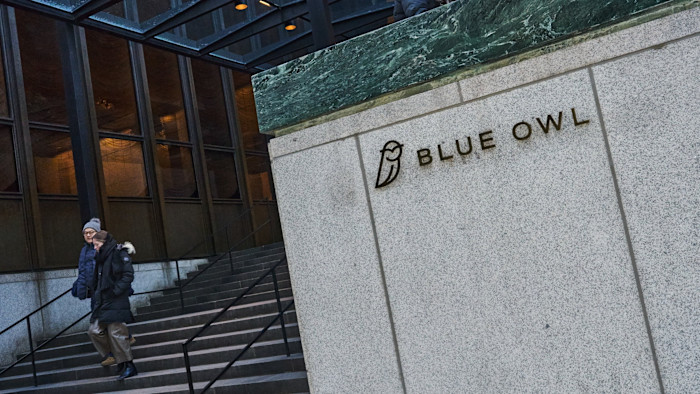
A US investment fund specializing in distressed debt has informed its investors that private credit providers, including Blue Owl, are concealing vulnerabilities within their asset portfolios, and a substantial market correction in fixed-income instruments is fast approaching.
In a presentation reviewed by the FT, Glendon Capital Management, a $5 billion firm based in Los Angeles, asserted that private credit funds overseen by Blue Owl and numerous peer organizations had “falsely portrayed” default rates within their holdings and were sitting on “greater impairments than disclosed”.
The firm, established by Oaktree long-serving professional Holly Kim, refused to disclose if it was speculating against Blue Owl, any of its credit instruments, or the loans within its asset portfolios that it had criticized.
Over the last decade, private capital has boomed, evolving into a multitrillion-dollar sector that attracts enormous sums of money from diverse institutional and individual investors. Nevertheless, elevated borrowing costs and monetary challenges faced by some portfolio companies have begun to reveal deficiencies in loan origination, sparking worries regarding cash flow and debt worthiness that could jeopardize several prominent fund managers.
The fund directed its critiques primarily at how Blue Owl had assessed loans within one of its largest investment vehicles, the $17 billion Blue Owl Capital Corporation. It observed the investment vehicle’s elevated appraisals for its loans, recorded at the close of 2025, when juxtaposed with present public market prices for financial obligations linked to identical enterprises, thereby raising “doubts regarding the actual worth” of its holdings.
Glendon asserted that loans across numerous firms within the Blue Owl credit fund, known as OBDC, showed the financing provider had appraised more precarious, subordinate portions of debt it held at values substantially greater than the recent public market rates of more secure, priority obligations issued by identical entities. Subordinate segments are infrequently assigned greater value than superior ones due to their diminished recovery precedence during an insolvency or reorganization event.
For instance, OBDC appraised $235 million in subordinate preferred shares and junior secured debt it owned in human resources software company Cornerstone OnDemand at approximately 90 cents on the dollar at the close of 2025.
However, the firm’s paramount debt segment, owned by Clearlake Capital, recently exchanged hands at merely 78 cents on the dollar, a rate generally regarded as an indicator of financial difficulty. This discrepancy suggests OBDC will be compelled to partially reduce the value of its subordinate Cornerstone investments for the period concluding later this month.
OBDC’s present stock price suggests a 25 percent reduction compared to its stated net worth at the conclusion of the previous year.
Glendon highlighted comparable disparities in the financing provided by Blue Owl to KKR-owned cybersecurity firm Barracuda, Peraton Corp (a defense supplier owned by private equity group Veritas Capital), and Conair Holdings (a PE-owned vendor of hair styling devices and Cuisinart culinary gadgets), among other examples. Glendon raised doubts about whether Blue Owl would be compelled to additionally reduce the value of these loans, which accounted for 3 percent of the fund’s $17 billion in total assets.
An individual knowledgeable about Blue Owl’s perspective stated that Glendon’s analogy was “apples to oranges,” considering that appraisals were performed at the close of 2025, whereas fixed income values have declined steeply in 2026. This source also emphasized that the obligations were appraised at reduced rates compared to where the superior debts exchanged hands at the end of last year, thereby validating the assessments.
Numerous other fund administrators, including Ares and KKR, managed financing vehicles with comparable or greater appraisals than those Glendon had highlighted at Blue Owl. These firms did not promptly reply to inquiries for a statement.
Numerous capital funds contacted by the FT in recent months have expressed worry about subordinate segments of credit appraised at values that exceeded where corresponding senior segments exchanged on open markets.
Amidst mounting concerns of loan impairments and diminishing returns within its fixed income holdings, OBDC’s stock value has fallen by over 20 percent during the last year.
Stock in Blue Owl, which oversees the investment vehicle for a charge, has declined even more, dropping by over 60 percent during the last year amidst increasing withdrawals from its individual credit funds.
Glendon additionally contended that business development companies — private credit funds like OBDC — promoted default rates in promotional documentation that were insufficient considering the risk characteristics of the enterprises they provided credit to. The financing portfolios it reviewed at multiple BDCs publicized impairment rates of under one-tenth of a percent.
Glendon described the impairment rates as deceptive and asserted that the types of firms that had secured funding from private credit fund managers were intrinsically feebler, consequently “compelled to resort to private credit after being declined by open markets.”
Glendon conjectured that “[p]rivate credit impairments are falsely portrayed and the financing is considerably more problematic than anticipated,” observing that returns for subordinate high-yield bonds, presently below 7 percent, were consistently more economical than priority private credit facilities which typically generate approximately 10 percent or higher.
Numerous publicly traded BDCs, including those backed by KKR and BlackRock, have decreased payouts or significantly lowered appraisals on specific portfolio holdings lately, following substantial devaluations.