
The audio version of this article is presented by the Air & Space Forces Association, celebrating and aiding our Airmen, Guardians, and their families. Discover more at afa.org
An alliance of nine defense contractors, tasked with developing the management and oversight component for the Pentagon’s Golden Dome missile protection system, recently performed a live demonstration. According to the initiative’s leader, Gen. Michael Guetlein, this showcase demonstrated it is on schedule to provide a functional system by 2028.
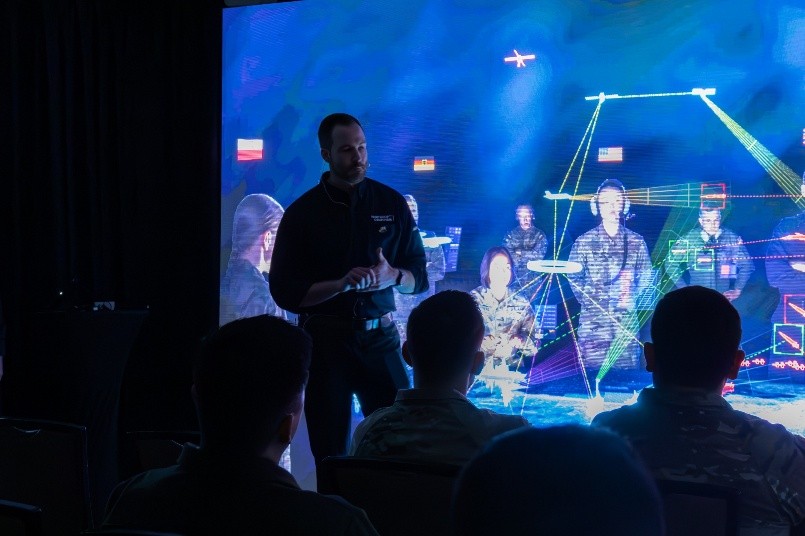
While addressing the McAleese Defense Programs Conference on March 17, Guetlein refrained from detailing the demonstration’s specifics. Nevertheless, he asserted that it confirmed the Golden Dome’s C2 infrastructure to be, to date, “on par” with the functions of the legacy Missile Defense Agency and Army systems.
Security authorities have asserted that effective command and control is crucial for Golden Dome’s capacity to integrate detectors from aerial, terrestrial, and orbital domains into a unified situational overview. At a March 17 session of the House Armed Services Committee’s strategic forces subpanel, General Gregory Guillot, chief of U.S. Northern Command, underscored the C2 component’s significance, explaining that no solitary detector could furnish military leaders with the requisite data to monitor and counter sophisticated ballistic dangers from initial launch preparations to final impact stages.
“The foremost hurdle General Guetlein and I deliberate upon, perhaps, is how to integrate all these elements into a unified command-and-control system. This system must consolidate numerous diverse command-and-control frameworks onto a singular display, allowing personnel to observe from the initial acceleration phase extending to the terminal phase, and effortlessly incorporate all the various detection and interdiction systems needed to neutralize that,” Guillot stated.
Crafting such a function, which Guetlein terms Golden Dome’s “integrating stratum,” represents a considerable undertaking. This explains why the initiative commenced promptly to formulate a collective of vendors to address the difficulty. This sector group originated approximately half a year prior with a sextet of companies—an independently constituted alliance—each holding separate agreements with the Pentagon, Guetlein conveyed.
“They function collaboratively as a single entity,” he remarked. “They determine their construction objectives, timelines, methodologies, and identify the most proficient member among them for each task. Subsequently, they maintain mutual responsibility on a weekly or biweekly schedule.”
Weekly, the collective updates Guetlein regarding its advancement.
“Should any member fail to fulfill their obligations at any juncture during that week, they possess the power to remove that participant from the team,” he explained. He further noted that his lead engineer holds the ultimate decision-making authority, and to date, no alliance participants have been ousted from the initiative.
Subsequent to the original sextet of companies joining the project, the Pentagon has incorporated three primary vendors to assist in directing the undertaking: Northrop Grumman, Lockheed Martin, and Raytheon Technologies. When questioned about any single contractor spearheading the project, Guetlein clarified that the Defense Department is acting as the principal coordinator.
“The government maintains control of the technical foundation, yet that collective of nine partners are functioning autonomously while ensuring mutual responsibility through colleague influence, as it were, to execute their duties,” he articulated. “To date, it’s proving exceptionally effective.”
President Donald Trump, who unveiled the bold Golden Dome project early in his second tenure, has imposed a demanding schedule on Guetlein and his team, mandating the provision of a preliminary function by 2028. Prior to that, Guetlein has established intermediate goals: to showcase a segment of the C2 capability this summer, and to commence incorporating missile interceptors—a further engineering achievement—into that framework by the summer of 2027.
The Pentagon’s projected expenditure for Golden Dome has already increased to $185 billion, marking a $10 billion rise over its original projection. Guetlein attributed this escalation to the prompted need for expeditiously expanding deployments of the program’s crucial orbital components. Certain analysts anticipate the project could incur substantially higher expenses. For instance, the American Enterprise Institute has suggested the overall expenditure might range from $250 billion to $2.4 trillion, contingent on the framework’s final configuration.
Guetlein asserted that these external projections are founded upon erroneous presumptions regarding what the Pentagon is truly constructing—details the agency has kept confidential. He refused to divulge the expense of Golden Dome’s command and control component, adding that the Pentagon is improbable to unveil its financial projections for the architecture’s separate constituent parts.
The audio version of this article is presented by the Air & Space Forces Association, celebrating and aiding our Airmen, Guardians, and their families. Discover more at afa.org