
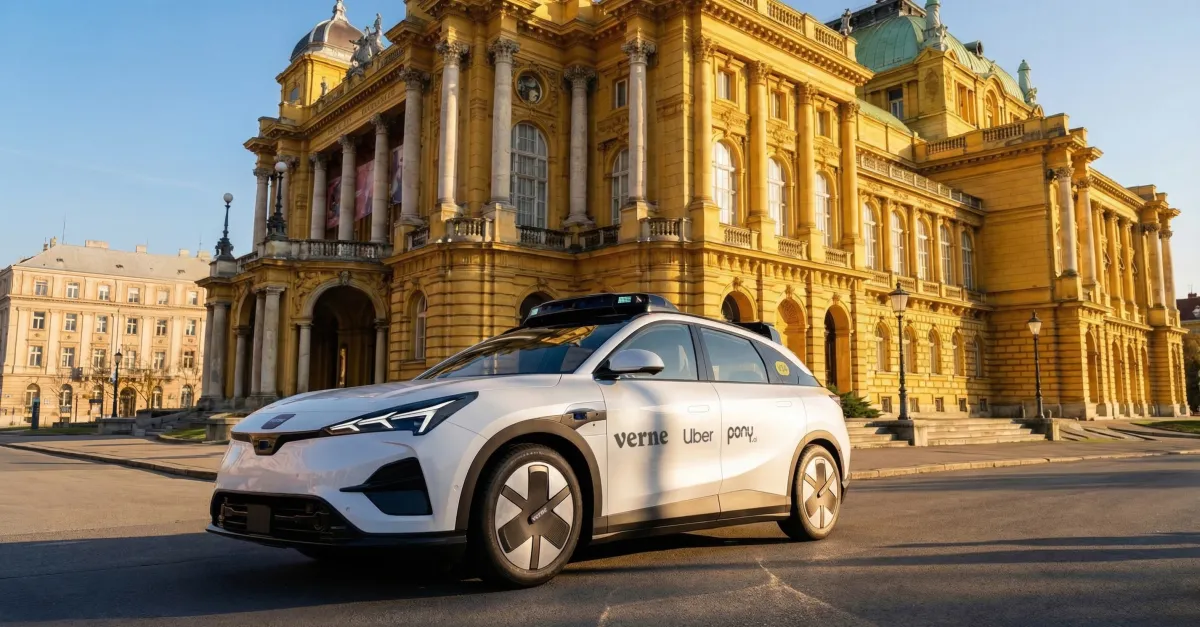
Uber is collaborating with two entities, China’s Pony AI and Croatia’s Verne, to introduce what it asserts will be Europe’s inaugural commercially operational robotaxi service. These autonomous vehicles are presently undergoing trials in Zagreb, Croatia, where Verne is based, and will imminently be accessible to patrons via Uber’s ride-sharing platform.
This disclosure represents Uber’s most recent effort to safeguard itself against the economic repercussions of autonomous taxis potentially supplanting the conventional ride-sharing sector. The company has forged alliances with numerous autonomous vehicle developers in the preceding year, in a bid to convince stakeholders that it possesses the resilience to endure the forthcoming autonomous taxi epoch.
Its newest collaborators include Pony AI, which is presently deploying self-driving cars in various Chinese urban centers, and Verne, which originated as a spin-off from the high-performance car manufacturer Rimac. As per the agreement’s stipulations, Uber shall furnish the ride-sharing platform and its clientele; Verne will oversee the vehicle contingent; and Pony AI will engineer the self-driving capabilities. The initial deployment is slated for Zagreb, with expansion into additional European territories anticipated thereafter. The overarching objective involves augmenting the fleet to comprise “thousands of robotaxis” within the forthcoming years.
Presently, these entities are verifying the technology within Zagreb’s thoroughfares, utilizing Pony AI’s Arcfox Alpha T5 Robotaxi, outfitted with the Chinese firm’s seventh-generation technological architecture. This conveyance was collaboratively engineered and produced alongside the state-backed Beijing Automotive Group Co (BAIC). Upon the commencement of fare collection, they foresee it becoming Europe’s pioneering commercial robotaxi operation.
Regarding Verne, information has been sparse since its initial unveiling as a robotaxi initiative affiliated with Rimac. Mate Rimac, the originator and Chief Executive of Rimac Group, showcased a contingent of 60 experimental autonomous vehicles towards the close of the previous year. Nonetheless, their eventual integration into Uber’s fleet remains an unresolved query.
{content}
Source:{feed_title}