
Stay informed with free updates
Simply sign up to the Technology sector myFT Digest — delivered directly to your inbox.
The writer is co-founder and CTO of Chinese autonomous vehicle company Pony.ai
Key Takeaways
- The Race Shifts from Lab to Road:The autonomous driving industry’s pivot from simulation-heavy R&D to real-world operational deployment marks a critical inflection point, with commercial scalability and safety in dynamic, complex environments now paramount for market leadership.
- Operational Edge and Cost Efficiency are Decisive:Beyond technological prowess, success hinges on a company’s ability to accumulate vast amounts of diverse, driverless operational data efficiently and to drive down the total cost of ownership (TCO) to compete with human-driven ride-hailing services.
- Regulatory Fragmentation Drives Market Dynamics:Divergent regulatory approaches globally, particularly between China/US and Europe/UK, are creating distinct competitive landscapes, influencing investment flows, data accumulation rates, and the pace of commercialization for robotaxi operators.
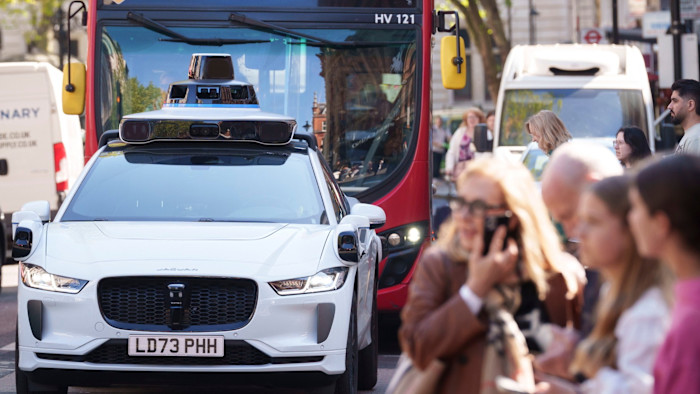
At this year’s Beijing auto show, robotaxis moved from the margins to the centre for the first time. Automakers, mobility platforms, and technology groups all presented their versions of autonomous ride-hailing, signalling a significant shift in market sentiment. This display indicates that robotaxis are no longer an experimental niche pursued by a handful of deep-pocketed specialists but are widely perceived as the next frontier in urban mobility and a substantial investment opportunity.
Still, a crowded race is not the same as a mature one. Billions of dollars have been poured into the sector by venture capitalists, tech giants, and traditional automotive OEMs, inflating valuations and fueling intense competition. Launching a robotaxi pilot is becoming easier, thanks to advancements in sensor technology and AI. However, building a system that can scale commercially and operate safely across diverse, complex urban environments remains an immensely difficult challenge with significant capital expenditure and operational costs.
For much of the past decade, the autonomous-driving industry has behaved as if the decisive breakthrough would come solely from a lab: larger AI models, more training data derived from human driving, extensive simulation, and ever-increasing compute power. That view, as the industry is now rapidly discovering, is fundamentally flawed when it comes to achieving market-ready Level 4 autonomy. A robotaxi’s own distinct driving reactions will fundamentally change the behaviour of other road users in ways that historical human-to-human interaction data cannot always predict or replicate.
This distinction matters profoundly because robotaxis are not judged by whether they perform well most of the time but by their ability to operate safely and reliably in the most ambiguous, socially negotiated, and often mundane scenarios. These include a cyclist drifting erratically between lanes, a scooter cutting across a designated pick-up point, or a human driver cautiously edging into a gap without fully committing. Such edge cases, while rare individually, collectively present an immense challenge for market acceptance, regulatory approval, and managing liability risks.
Merely collecting more human driving data, while foundational, is not sufficient for true autonomy. Yes, it can teach machines how people respond to other people. But if an autonomous vehicle behaves differently – perhaps with more caution, or with a slightly less predictable trajectory – the surrounding traffic will learn to respond to that new behaviour. This complex feedback loop cannot be fully inferred from static historical data; it must be observed and learned through extensive, real-world driverless operations. This translates directly into a need for vast, expensive fleets on the road, accumulating miles and data.
This is not only a technical challenge but also a significant regulatory and operational hurdle, directly impacting market development. In parts of China and the US, cities have allowed operators like Waymo, Cruise, Baidu, and Pony.ai to move from testing to paid driverless services in defined geo-fenced areas. This regulatory arbitrage gives these companies a critical advantage, allowing them to accumulate real-world, driverless operational data at a far greater rate. In contrast, the UK and Europe have adopted a more cautious, fragmented approach to regulatory approval. This disparity creates a two-speed market, potentially consolidating market leadership and technological advantage in regions with more progressive regulatory frameworks, while stifling innovation and investment in others.
This is where “world models” matter – not as a substitute for real-world roads, but as an advanced methodology to turn the rich, nuanced data collected by driverless vehicles into repeatable training and testing scenarios. A sophisticated world model acts as a system for understanding intricate cause and effect: If the robotaxi slows unexpectedly, will the scooter behind it attempt to pass aggressively? If it behaves overly cautiously at a complex junction, does that create confusion or frustration for other drivers, potentially leading to unsafe interactions? These models represent a crucial technological moat, enabling faster iteration and a more efficient path to robust safety, reducing the cost of development and accelerating market readiness.
The next stage is to make the learning loop self-directed, creating a system that intelligently knows what specific training data is most needed to improve performance. The most difficult cases are often not dramatic accidents but mundane, ambiguous moments of hesitation, negotiation, and misread intention. Identifying and resolving these long-tail events efficiently is key to unlocking Level 4 autonomy and gaining public trust, which is a significant barrier to widespread adoption and market growth.
Finally, the robotaxi industry’s cost curve is as important as its model architecture. If driverless vehicles remain too expensive to deploy widely, companies will not generate enough interactions or revenue to improve their systems, creating a vicious cycle. This is increasingly an operations race disguised as a software race. While compute power, top-tier talent, and data are essential, they do not replace the critical need for large, live fleets operating consistently. The capital intensity of hardware (sensors like LiDAR, advanced compute platforms) combined with the ongoing operational expenses (remote support, charging infrastructure, maintenance) presents a formidable barrier to entry and a challenge for achieving positive unit economics.
Regulators and, crucially, passengers will not accept a business model that treats rare but severe failures as mere statistical noise. To attain the gold-standard autonomy known in the industry as “Level 4,” a robotaxi must maintain core driving functions even after an unexpected hardware or software failure, executing a safe pullover if required. This demands an extremely high level of system redundancy and fault tolerance, directly impacting vehicle design, manufacturing costs, and subsequently, the total addressable market.
The commercial challenge is equally severe. Robotaxis must eventually compete on price and convenience with existing human-driven ride-hailing services, public transport, and private car ownership. If they only work reliably in limited operational design domains (ODDs), under narrow weather conditions, or with high levels of remote human support, then they will not be economically scalable or attractive to mass-market consumers. The pursuit of purpose-built autonomous vehicles, designed from the ground up to reduce sensor costs and enhance efficiency, is one strategy to address this looming cost parity problem and unlock profitability.
That is why the next three years will be decisive for the industry. As more companies, from established OEMs to well-funded startups, set out their ambitions and roll out pilots, the market will become noisier with competing claims and technological demonstrations. But noise should not be confused with genuine progress. It is on the road, through millions of driverless miles, robust safety records, and demonstrable economic scalability – not merely in the lab or through impressive simulations – that the autonomous driving race will ultimately be won, and the true market leaders will emerge.
Market Impact
The trajectory of the robotaxi industry over the next three years will have profound implications across several sectors. For investors, it will clarify which business models are sustainable and which companies can achieve a viable path to profitability, likely leading to significant consolidation, M&A activity, and potentially some high-profile failures among the less capitalized players. Consumers stand to benefit from safer, more convenient, and potentially more affordable transportation options, fundamentally altering urban mobility patterns and reducing private car ownership in dense areas. Traditional automotive manufacturers face a critical juncture: either successfully pivot to become mobility service providers or risk becoming mere hardware suppliers in an autonomous future. Furthermore, the broad adoption of robotaxis will impact urban planning, logistics, insurance markets, and even the future of employment in the transportation sector, marking a transformative shift for the global economy.