
Unlock the White House Watch newsletter for free
Your guide to what Trump’s second term means for Washington, business and the world
Crypto Billionaire Sues Trump-Linked World Liberty Financial Amidst Escalating ‘Politi-Fi’ Battle
Key Takeaways
- Political-Crypto Convergence Risks:The high-stakes legal battle between crypto billionaire Justin Sun and a Trump-family-backed venture underscores the significant regulatory, reputational, and market volatility risks inherent in the rapidly expanding intersection of politics and decentralized finance (DeFi).
- Token Issuer Control & Investor Rights:Allegations of World Liberty Financial (WLF) restricting Sun’s ability to sell tokens and threatening legal action raise critical questions about token issuer control, investor liquidity, and the enforceability of digital asset ownership rights within a project’s ecosystem.
- Regulatory Spotlight on “Politi-fi”:This prominent dispute, involving a major political family and a key crypto figure, will inevitably draw intensified scrutiny from US securities regulators and potentially influence future policy decisions concerning politically-themed tokens and their classification.
Crypto tycoon Justin Sun has launched a lawsuit against the Trump family’s World Liberty Financial (WLF), marking the latest and most significant escalation in a bitter feud between the prominent blockchain entrepreneur and one of the firm’s largest early backers. This high-profile dispute not only exposes the inherent risks in the burgeoning “politi-fi” sector but also casts a spotlight on issues of tokenomics, investor rights, and the influence of political figures in the volatile digital asset landscape.
The lawsuit, filed in a California court late on Tuesday, alleges that WLF orchestrated a “fraudulent scheme” targeting Sun. Central to the claim is the assertion that WLF illegally seized the WLFI tokens he had purchased from the company, digital assets that at their peak were valued at approximately $1 billion. This allegation, if substantiated, points to a concerning level of centralized control over supposedly decentralized assets, a critical concern for investors in the broader crypto ecosystem.
WLF boasts a significant political pedigree, counting the US president’s sons, Donald Trump Jr. and Eric Trump, among its founders, alongside the sons of US special envoy to the Middle East, Steve Witkoff. President Donald Trump himself has declared personal income derived from the venture, further intertwining the project with high-level political influence and making it a key player in the nascent “Trump-coin” or “politi-fi” market segment.
Eric Trump swiftly defended the firm on social media on Wednesday, choosing to frame Sun’s legal action in a dismissive light. “The only thing more ridiculous than this lawsuit is spending $6 million on a banana duct-taped to a wall,” he posted, referencing Sun’s well-known multimillion-dollar acquisition of Maurizio Cattelan’s conceptual artwork, “Comedian,” a banana infamously affixed to a wall, which Sun later consumed. This retort, while aiming to discredit Sun, also highlights the stark cultural and financial contrasts between traditional finance and the often-unconventional world of crypto, where such conceptual art purchases are not uncommon amongst the ultra-wealthy.
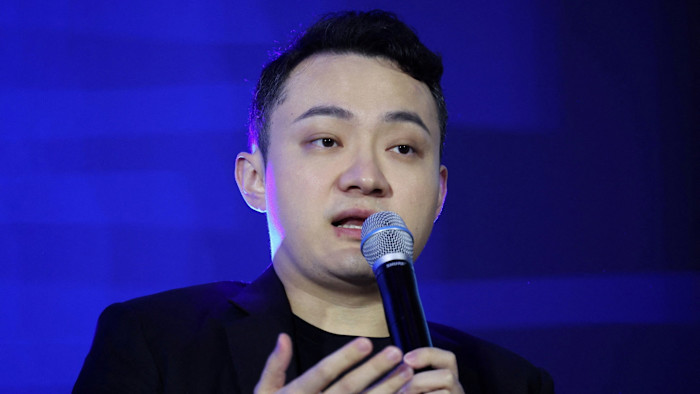
Justin Sun, a billionaire founder of the Tron blockchain and a significant figure in the wider crypto industry with ties to exchanges like Poloniex and Huobi, had been one of the most visible and vocal public backers of Trump-related crypto ventures. His involvement lent considerable credibility and market visibility to WLF’s offerings, a critical factor for new token projects seeking to establish market traction and investor confidence.
Following Trump’s re-election in 2024, Sun made a substantial “anchor investment,” purchasing $45 million worth of the WLFI token issued by WLF. According to the suit, a significant motivator for this investment was “because of the Trump family’s association with the project.” This highlights a growing trend where political alignment and celebrity endorsements drive investment in digital assets, often overshadowing fundamental project utility or robust technical frameworks. The value of Sun’s tokens subsequently surged as WLFI gained popularity, riding a wave of speculative interest fueled by its political connections. However, in line with the high volatility inherent in such assets, WLFI has since plummeted 75 percent from its peak, underscoring the extreme risk associated with politically-charged, narrative-driven tokens.
Sun’s substantial “anchor investment” reportedly earned him a coveted role as an adviser to the firm. The lawsuit further asserts that Sun’s “name and credibility” were instrumental in driving approximately $550 million in token sales by WLF. This raises critical questions about the role of key opinion leaders (KOLs) and influencers in the crypto space, where their endorsement can significantly sway market sentiment and investment decisions, often without full disclosure of potential conflicts of interest or exit strategies.
Soon after his initial investment, Sun claims that the firm began imposing restrictions on his ability to sell his tokens. These restrictions, he alleges, were not merely procedural but were strategically employed to pressure him into increasing his investment in the company. Such actions, if true, represent a severe breach of investor trust and raise alarms about the centralized control over token liquidity, a scenario that fundamentally contradicts the decentralized ethos often championed in the crypto world. The lawsuit further alleges that WLF escalated its pressure tactics, threatening to “report him to US criminal authorities if he tried to vindicate his rights (a pressure tactic that itself qualifies as criminal extortion).” This particular claim adds a layer of legal and ethical complexity, suggesting a potentially aggressive and coercive approach by the token issuer towards a major investor.
Zach Witkoff, chief executive of WLF, quickly dismissed Sun’s allegations via X (formerly Twitter), stating that Sun’s “claims are entirely meritless, and World Liberty looks forward to getting the case thrown out promptly.” He added a counter-accusation, claiming that “[Sun] engaged in misconduct that required World Liberty to take action to protect itself and its users.” This suggests a tit-for-tat narrative, where both parties allege wrongdoing, creating a murky situation for investors trying to discern the truth and assess the project’s legitimacy.
Beyond his investment in WLFI, Sun also reportedly bought at least $100 million of Donald Trump’s memecoin, a separate but related venture that further solidified his ties to the former president and earned him a seat at a dinner with the president. This demonstrates the profound financial and political capital being exchanged in this new frontier of digital assets. Coincidentally, US securities regulators later settled a fraud case and dropped certain charges against Sun, a move that was perceived by many in the crypto community as one of several friendly gestures towards the crypto industry during Trump’s second term. This previous regulatory leniency towards Sun, coupled with the Trump family’s direct involvement in WLF, adds a layer of complexity to the current legal battle, potentially raising questions about political influence on regulatory outcomes.
In recent weeks, the feud had already spilled into the public arena, with Sun launching a series of public attacks on WLF across social media platforms, criticizing its governance and operational practices. WLF, in turn, has defended itself against these allegations and threatened its own legal action against Sun. This public spat, prior to the formal lawsuit, indicates a deep-seated conflict, with both parties leveraging public opinion and digital platforms to bolster their respective positions, adding to the volatility and uncertainty surrounding WLF’s future.
Market Impact
The escalating legal conflict between Justin Sun and World Liberty Financial is set to send ripples across the nascent political-finance (“politi-fi”) sector and potentially the broader crypto market. For politically-aligned tokens, investor confidence could wane amidst concerns over governance, issuer control, and the opaque nature of some project agreements, leading to increased price volatility and a flight of capital from similar ventures. This lawsuit may also serve as a critical test case for regulatory bodies, particularly the SEC, compelling them to clarify guidelines around celebrity-backed crypto ventures, the classification of politically-themed tokens as securities, and the legal standing of digital assets. Increased regulatory scrutiny could lead to a more cautious approach from institutional investors towards such projects, while retail investors might become warier of projects lacking transparent exit liquidity or robust legal frameworks. Ultimately, the outcome of this dispute could profoundly shape how political influence is leveraged in the crypto space, emphasizing the urgent need for greater transparency, robust investor protection mechanisms, and clearer regulatory boundaries in this evolving and highly speculative asset class.