
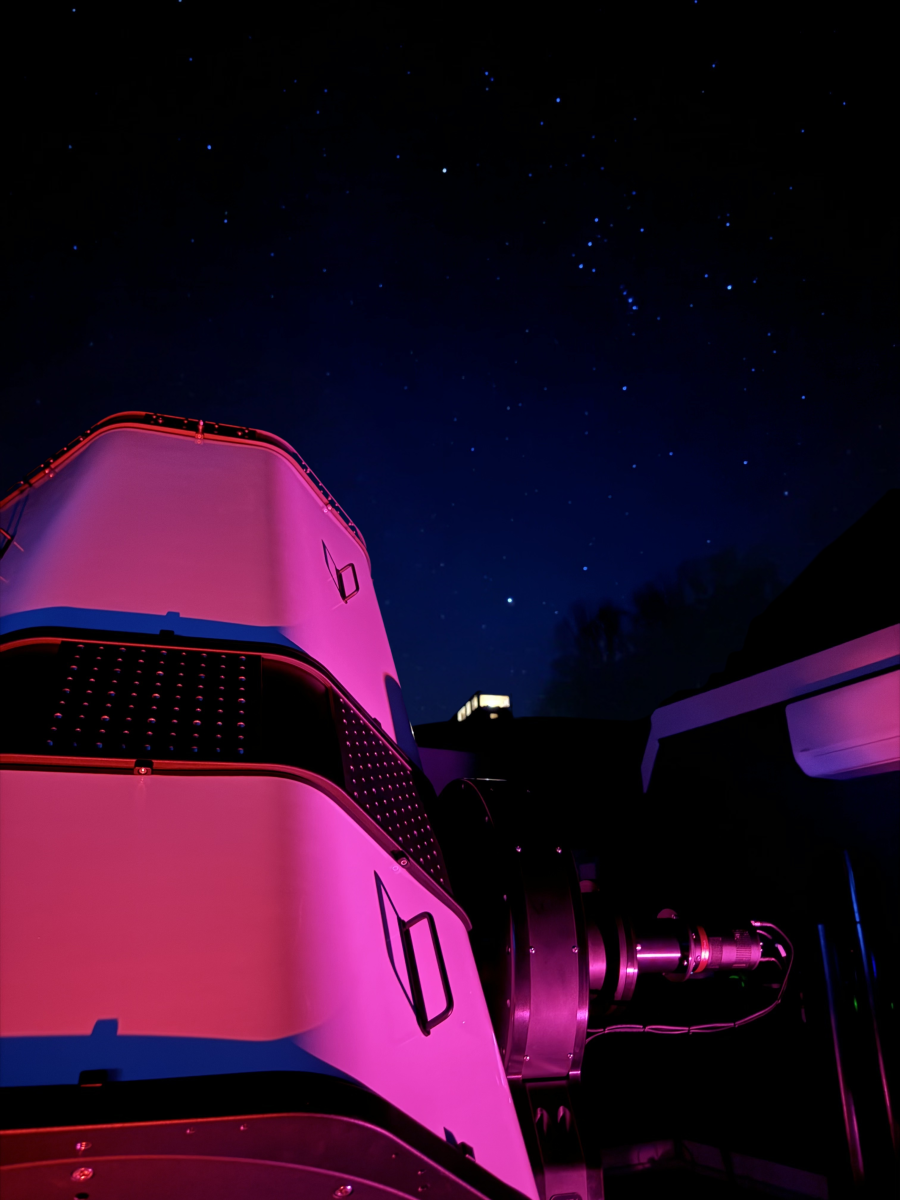
Earlier this month, NASA’s Artemis II mission made headlines not just for sending four astronauts to orbit the Moon, but for demonstrating a significant leap in space communication: ultra-fast laser data links. Critically, one of the primary receivers wasn’t a multi-million dollar NASA installation, but a low-cost, experimental terminal in Australia, built by Observable Space and Quantum Opus and operated by the Australian National University, which successfully pulled down dramatic 4K video and data from lunar orbit at 260 megabits per second. This achievement heralds a new era for affordable, high-throughput connections between Earth and deep space.
Key Takeaways:
- **Cost-Effective Deep Space Communication:** The Australian National University (ANU) terminal, built for under $5 million by Observable Space and Quantum Opus, successfully received 260 Mbps laser data from the Artemis II Orion spacecraft, proving that high-throughput space-to-Earth communication can be achieved at a fraction of traditional costs.
- **Validation of Laser Technology:** NASA’s Artemis II mission served as its most comprehensive demonstration of deep space optical communications to date, validating laser links as a viable, high-bandwidth alternative to traditional radio frequency for missions extending to the Moon, Mars, and beyond.
- **Vision for a Global Network:** This success paves the way for a global network of low-cost ground stations, enabling continuous, high-speed data downlinks from a rapidly expanding array of satellites and deep space missions, potentially democratizing access to critical space-derived information.
Laser Links to the Moon: A Game-Changer for Space Communication
The recent journey of NASA’s Artemis II mission around the Moon wasn’t just a historic step for human space exploration; it marked a pivotal moment for how we communicate with our spacecraft. While the four astronauts captivated the world, a silent revolution was unfolding in the realm of data transmission: the most comprehensive demonstration yet of deep space laser communications. This groundbreaking endeavor saw high-definition video beamed across vast distances, not through traditional radio waves, but via super-fast laser pulses.
What makes this demonstration particularly remarkable is not solely the technology itself, but its accessibility. While NASA operated its sophisticated primary receivers in California and New Mexico, a far more modest setup on the other side of the world proved equally capable. In an unassuming facility operated by the Australian National University (ANU), a low-cost terminal, developed through a collaboration between Observable Space and Quantum Opus, independently captured and decoded the laser transmissions from the Orion spacecraft. This Australian success story, pulling down data at an impressive 260 megabits per second, emphatically declares that high-throughput deep space connections are no longer the exclusive domain of multi-million dollar, bespoke government installations.
Democratizing Data Downlinks: The Power of Affordability
The core innovation lies in the cost-efficiency of the Australian terminal. Built for less than $5 million—a stark contrast to the tens of millions typically associated with cutting-edge space communication infrastructure—this system leveraged Observable Space’s advanced software and a specialized telescope to precisely lock onto the faint laser signals from Orion. Complementing this, Quantum Opus’s innovative photonic sensor was crucial in translating those light pulses into usable data. This achievement significantly lowers the barrier to entry for receiving high-volume data from space, a development with profound implications for the future of space exploration and commercial space ventures.
The ability to achieve such robust performance at a fraction of the traditional cost is a testament to clever engineering and a focused approach. By utilizing more standardized components and intelligent software algorithms, Observable Space and Quantum Opus have demonstrated that the path to widespread adoption of optical communications doesn’t require reinventing the wheel with every new project. Instead, it points to a scalable model that could see a proliferation of ground stations capable of supporting increasingly data-hungry missions.
Beyond Radio: The Laser Advantage in Deep Space
For decades, radio frequency (RF) transmissions have been the bedrock of space communication. However, as missions become more ambitious and generate exponentially more data—think high-resolution imagery, 4K video, and complex scientific telemetry—RF bandwidth limitations are becoming increasingly apparent. This is where laser communications, or optical communications, step in.
Laser systems offer several compelling advantages. Firstly, they boast significantly higher data rates, allowing for the transmission of massive amounts of information in a shorter time. Imagine downloading an entire movie from the Moon in seconds, rather than hours. Secondly, optical signals are more secure, as their narrow beams are harder to intercept or jam compared to broader RF signals. Finally, the hardware for laser communication systems can be smaller and lighter, a critical factor for spacecraft where every gram counts.
However, laser communications are not without their challenges. They require extremely precise pointing due to their narrow beam, making it akin to hitting a dime with a laser pointer from hundreds of miles away. Atmospheric conditions, particularly clouds, can also disrupt the signal, necessitating multiple ground stations strategically located across the globe to ensure continuous line-of-sight. This very challenge underscores the importance of the Australian receiving site, located on the opposite side of the planet from NASA’s primary facilities in California and New Mexico, ensuring mission critical redundancy.
Techcrunch event
San Francisco, CA
|
October 13-15, 2026
NASA’s Long Game and Australia’s Strategic Role
NASA has been a pioneer in testing deep space laser communications for several years. Previous demonstrations included successful data links with a spacecraft a staggering 218 million miles from Earth on its way to an asteroid. The Artemis II mission, however, marked its most comprehensive and public demonstration, showcasing the technology’s readiness for crewed missions and its ability to handle the demands of real-time, high-definition transmissions from lunar orbit. All receiving stations, including the ANU terminal, successfully collected the vital 4K video data, validating the robustness of the system.
Josh Cassada, a former U.S. astronaut and co-founder of Quantum Opus, highlighted the symbolic significance of Australia’s involvement, noting that it was the first continent to appear in the iconic “Earthrise” photo captured by the Artemis II astronauts. This anecdote underscores Australia’s vital geographical position, making it an ideal candidate for future global networks of space communication ground stations, especially for missions traversing vast distances.
Building the Global Data Superhighway for Space
Dan Roelker, CEO of Observable Space, is unequivocal: the mission proves that space-to-Earth laser downlinks are ready to scale. While optical communication has seen increasing adoption for satellite-to-satellite connections in low Earth orbit, its widespread use for transmitting data back to Earth has been hampered primarily by cost. Now, with the demonstrated affordability, Roelker envisions a future where a global network of these cost-effective terminals can receive data from satellites of all kinds, from Earth observation constellations to deep space probes.
“We can scale this over the next year or more,” Roelker told TechCrunch, detailing an ambitious vision for a global data superhighway. The precise path to achieving this—and the crucial question of who funds it—is still being charted. Roelker indicates a collaborative approach, stating, “We will partner with a lot of people around this, whether this is something we’re going to do ourselves, or partner with other ground station-as-a-service companies, or work with extremely large constellation providers that are going to want to own their own infrastructure.” This collaborative model is likely key to rapidly deploying the necessary infrastructure to handle the impending deluge of data from the burgeoning space economy.
Bottom Line
The success of the Artemis II laser communication demonstration, particularly the pivotal role of the low-cost Australian terminal, marks a turning point in how humanity interacts with space. It not only validates the superior capabilities of optical communication for future deep space missions but, more importantly, democratizes access to high-bandwidth data downlinks. This development is poised to unleash unprecedented opportunities for scientific discovery, commercial innovation, and global collaboration, fundamentally reshaping the economics and operational capabilities of the next generation of space exploration. The future of space communication is bright, fast, and increasingly within reach for a broader array of players.
When you purchase through links in our articles, we may earn a small commission. This doesn’t affect our editorial independence.
{content}
Source:{feed_title}