
Unlock the Editor’s Digest for free
Roula Khalaf, Editor of the FT, selects her favourite stories in this weekly newsletter.
### Key Takeaways
1. **Escalating Geopolitical Risk Premium:** The sophisticated drone incident at RAF Lakenheath underscores a growing threat landscape, likely to drive increased defense spending, particularly in counter-UAS technologies, benefiting defense contractors and security firms.
2. **Strategic Shift in Defense Procurement:** The failure to retrieve drones, despite successful repulsion, highlights gaps in current C-UAS capabilities, signaling an urgent need for advanced R&D and integrated security solutions, reshaping procurement priorities and creating market opportunities.
3. **Critical Infrastructure Vulnerability & Investment:** Concerns over potential attacks on civilian infrastructure adjacent to military sites, such as the Sunnica solar farm, will necessitate significant investments in physical and cyber-security for energy projects and other strategic assets, impacting project financing and insurance markets.
***
**Geopolitical Tensions Drive Defense Sector Scrutiny After UK Base Drone Swarm**
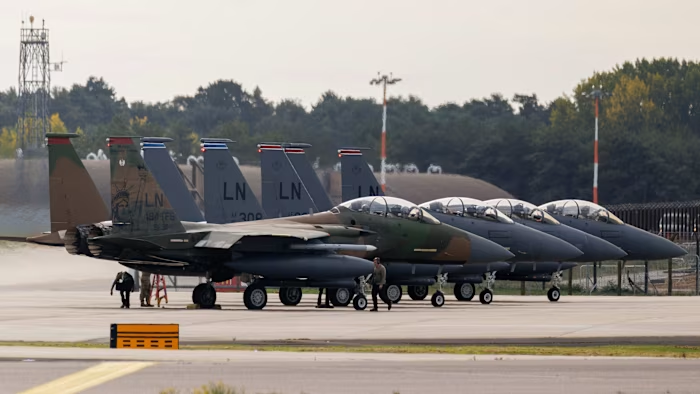
The quiet hum of unmanned aerial systems (UAS) over a critical British military installation this month has sent ripples through defense circles and, increasingly, into financial markets. An incident at RAF Lakenheath in Suffolk on November 13, where an estimated half-dozen drones swarmed the base before being repelled by US defensive equipment, serves as a stark reminder of the evolving threat landscape and its profound implications for global security expenditures, technological innovation, and critical infrastructure protection. While the initial reports were sparse, details emerging now suggest a sophisticated, unrecovered incursion, with suspected links to Iran, raising the geopolitical temperature and underscoring a growing risk premium across defense-related sectors.
RAF Lakenheath, housing the 48th Fighter Wing and serving as the largest US fighter jet operation in Europe with nearly 7,000 personnel, represents a cornerstone of NATO’s air power. The security alert issued to US personnel to shelter in place on November 13 underscored the gravity of the situation. While US counter-drone technology successfully neutralized the immediate threat, the critical failure to retrieve the unmanned aerial systems has left a significant void in intelligence gathering. This lack of recovery means authorities cannot definitively rule out that the drones carried payloads – be it espionage equipment, kinetic weapons, or other reconnaissance tools. This ambiguity alone fuels market uncertainty, as defense strategists and investors alike grapple with the implications of advanced, unidentifiable threats.
The incident is not isolated, forming part of a worrying pattern of security breaches at UK bases used by the US Air Force this year, including an alleged terror plot at RAF Fairford in Gloucestershire. Though Tehran has denied any involvement in the Lakenheath incident, the suspected linkage adds a layer of complexity, intertwining regional conflicts with broader Western security concerns. For investors, this translates into a heightened focus on companies positioned to benefit from increased defense spending, particularly those specializing in advanced counter-UAS (C-UAS) systems, electronic warfare, and integrated security platforms. The “Charlie alert” status, the second-highest threat level issued by the US defense department, which Lakenheath had confirmed in September, signals a persistent elevated risk environment that necessitates sustained, robust investment.
**Defense Spending and Technological Imperatives**
The UK Ministry of Defence’s swift response, affirming that the protection of military bases is “a top priority” and that security arrangements are “continually review[ed] and strengthen[ed],” is a direct signal to the market. Britain’s commitment of £470mn to bolster security at military sites—encompassing boosted physical protection, surveillance, and counter-drone capabilities—represents a significant capital injection. This investment will flow into various segments of the defense industry:
* **Advanced Sensor Systems:** Companies developing sophisticated radar, electro-optical/infrared (EO/IR) cameras, and acoustic sensors will see increased demand.
* **Electronic Warfare (EW) & Jamming Technologies:** The successful repulsion of the drones suggests effective EW capabilities, but the inability to capture them points to a need for more advanced, non-kinetic neutralization methods that allow for forensic analysis.
* **Integrated Command & Control (C2) Platforms:** Seamless integration of disparate C-UAS technologies requires robust C2 systems, creating opportunities for software and data analytics providers.
* **Physical Security Enhancements:** Reports of the RAF moving aircraft to hangars at night and planning anti-drone netting around exposed assets indicate tangible, immediate needs for physical security infrastructure.
These developments will likely accelerate R&D cycles and procurement timelines, benefiting established defense primes like BAE Systems, Leonardo, and Raytheon Technologies, as well as smaller, innovative tech firms specializing in drone detection and interception. The dynamic nature of drone threats, from off-the-shelf commercial drones modified for nefarious purposes to purpose-built military-grade systems, means the C-UAS market is in a constant state of evolution, presenting sustained growth opportunities.
**Critical Infrastructure: The Next Front Line?**
Beyond military installations, the incident at Lakenheath highlights a broader vulnerability: critical national infrastructure. Nick Timothy, MP for West Suffolk, raised acute concerns regarding the potential risk to RAF Mildenhall, also in Suffolk, from an attack on the Sunnica solar and battery farm being constructed just 2.5km away. Timothy’s revelation that the MoD “admitted… it did not take into account the risk of sabotage or arson when it was consulted as part of the planning process” is particularly troubling. This oversight, despite years of warnings from intelligence agencies like MI5 about hostile states targeting infrastructure, exposes a significant gap in risk assessment and mitigation.
The implications for the energy sector and related infrastructure projects are profound:
* **Increased Security Costs:** Developers of large-scale renewable energy projects, data centers, and other critical infrastructure will face pressure to invest heavily in physical and cyber-security measures, potentially impacting project economics and returns on investment.
* **Insurance Market Adjustment:** Insurers may reassess risk premiums for critical infrastructure, particularly those near sensitive military sites, leading to higher operational costs for operators.
* **Supply Chain Resilience:** The potential for sabotage or arson underscores the need for robust supply chain security protocols and diversified sourcing strategies.
* **Regulatory & Planning Scrutiny:** Governments are likely to implement more stringent security requirements during the planning and approval phases for strategic infrastructure projects, adding complexity and time to development cycles.
A UK government spokesperson’s assurance that “All projects are subject to a rigorous planning process in which security is considered” will need to be backed by tangible, proactive measures to reassure investors and the public. The intersection of military security, energy independence, and private sector investment creates a complex risk matrix that demands a holistic approach to national security.
**Market Impact**
The drone incident at RAF Lakenheath, coupled with broader geopolitical tensions, signals a definite uptrend in global defense spending, particularly for counter-UAS and integrated security solutions. Defense contractors, aerospace manufacturers, and cybersecurity firms are poised to see increased order backlogs and R&D investment. Investors are likely to price in a higher geopolitical risk premium, favoring defense stocks and potentially leading to re-evaluations of portfolios exposed to regions deemed less stable. Furthermore, the focus on critical infrastructure vulnerabilities will drive significant new investment in industrial security, surveillance, and resilience solutions for energy, utility, and data center operators. This will create new market opportunities for specialized security technology providers and may influence the financing structures and insurance costs for large-scale infrastructure projects. Overall, the market is adjusting to a new reality where advanced asymmetric threats necessitate continuous innovation and substantial capital allocation to security.