
Key Takeaways
- WhatsApp Finally Embraces Scheduling:The long-awaited message scheduling feature is now rolling out globally for both individual and group chats on iOS and Android, allowing users to pre-plan messages from 10 minutes to 14 days in advance.
- Boost for Personal & Professional Use:This update significantly enhances user convenience, proving invaluable for personal reminders (like birthdays across time zones) and critical for businesses managing customer communications, updates, and team coordination, even sending messages when the sender’s device is offline.
- Catching Up with Competitors:While a significant step forward for WhatsApp, the feature brings it in line with rivals like Telegram and Signal, who have offered similar capabilities for some time, highlighting WhatsApp’s continued effort to enrich its ecosystem and maintain its dominant position.
WhatsApp Unlocks Time: The Long-Awaited Message Scheduling Arrives
For years, WhatsApp users have yearned for a simple yet powerful feature that has become standard across many other messaging platforms: the ability to schedule messages. Today, that wait is officially over. Meta’s ubiquitous messaging service has begun its global rollout of message scheduling, a functionality poised to revolutionize how millions communicate, both personally and professionally.
This highly anticipated update, confirmed by WhatsApp on Wednesday, empowers users to compose messages and set them to be delivered at a future time, whether to a single contact or an entire group. The feature is being deployed progressively across both iOS and Android devices, ensuring that its vast user base, spanning billions worldwide, will soon gain access to this transformative tool.
How It Works: A Seamless Integration
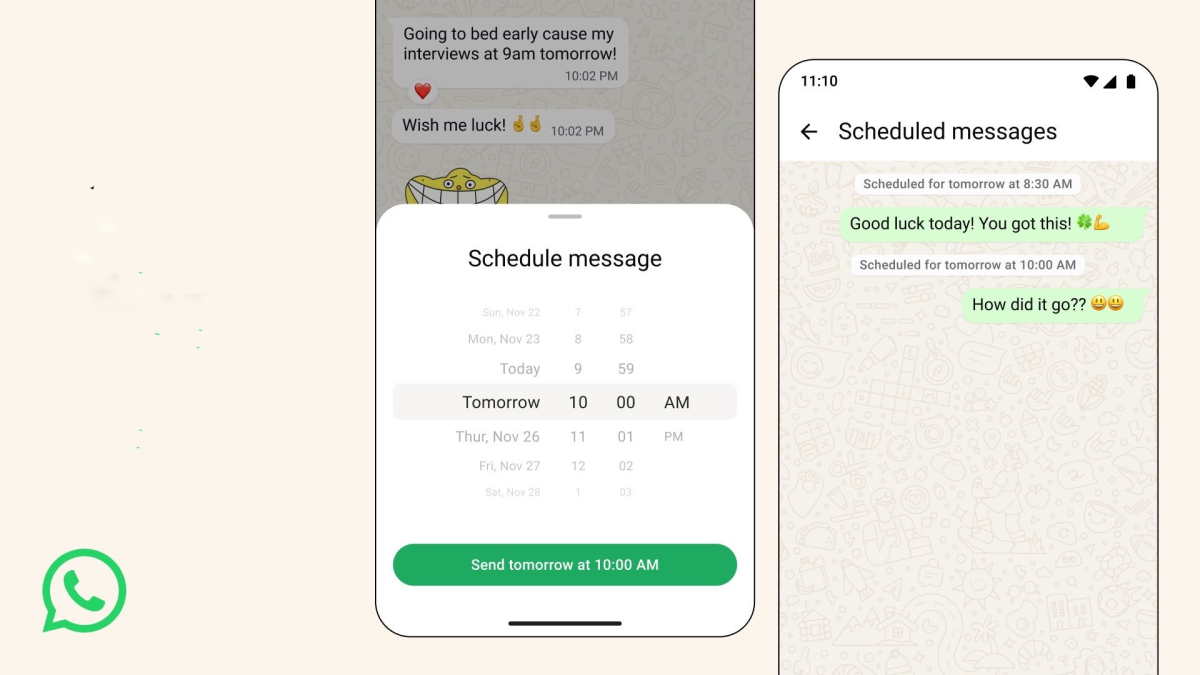
Integrating the scheduling function is remarkably straightforward, staying true to WhatsApp’s commitment to user-friendly design. Once the feature becomes available on your device – a process that’s expected to unfold over the coming days or weeks – sending a scheduled message is as simple as composing any other text, photo, or video message. The key difference lies in the final step: instead of a quick tap on the send button, users will perform a long-press.
Upon holding down the send button, a new menu option will appear, allowing you to ‘Schedule Message’. From there, an intuitive interface will guide you to select your desired delivery time and date. WhatsApp has provided a flexible window for scheduling, enabling messages to be dispatched anywhere from a mere 10 minutes after composition to up to 14 days into the future. This broad range caters to both immediate needs, like a quick reminder later in the day, and more long-term planning, such as a birthday wish two weeks out.
A critical aspect of this new functionality is its reliability. WhatsApp has confirmed that scheduled messages will be sent precisely at the designated time, irrespective of your phone’s status. This means if your device is off, out of network coverage, or simply without an internet connection when the scheduled time arrives, the message will still be delivered. This “fire and forget” capability ensures peace of mind, particularly for time-sensitive communications. Furthermore, the feature is comprehensive, supporting not just text messages but also scheduled delivery of photos and videos, expanding its utility significantly.
Managing Your Future Communications
WhatsApp has also built in management tools for scheduled messages. Users will have a dedicated section, likely accessible through the main chat interface or settings, where they can view all their pending scheduled messages. This centralized hub allows for oversight and enables users to delete any message if their plans change or if the message becomes irrelevant before its scheduled send time. What remains unclear, however, is whether there will be an option to edit the scheduled time or content of a message once it has been set. This could be a future enhancement or a deliberate omission for simplicity, but for now, deletion and rescheduling appear to be the primary modification options.
Beyond Convenience: Unlocking New Use Cases
The implications of this feature extend far beyond mere convenience. For individual users, it’s a potent tool for improving personal organization and communication etiquette. Imagine never missing a birthday or anniversary wish again, even if you’re asleep or busy when the clock strikes midnight. It’s also invaluable for coordinating with friends, family, or colleagues across different time zones, ensuring your message lands when they’re awake and receptive, rather than in the middle of their night.
The business landscape stands to benefit immensely. Small and medium-sized businesses (SMBs) heavily reliant on WhatsApp for customer engagement can now streamline their operations significantly. Scheduled texts can be used for a myriad of purposes: sending timely promotional offers, dispatching appointment reminders, delivering order confirmations, or pushing important service updates. This automation can free up valuable time for business owners and staff, allowing them to focus on core operations while maintaining consistent customer communication.
Furthermore, for teams and organizations that leverage WhatsApp for internal coordination, the scheduling feature will prove a game-changer. Project managers can schedule updates to their teams at the start of the workday, regardless of when they personally drafted the message. Meeting reminders can be pre-set, ensuring everyone receives a nudge just before a call. This fosters better communication flow and reduces the mental load of remembering to send messages at specific times.
Playing Catch-Up: A Competitive Landscape
While a welcome addition, it’s important to acknowledge that WhatsApp is playing catch-up in this regard. Competitors such as Telegram and Signal have offered message scheduling capabilities for a considerable period. Telegram, known for its feature-rich environment, has had this functionality for years, integrating it seamlessly into its platform. Signal, prioritizing privacy, also offers scheduling, albeit with a slightly different implementation. This delay by WhatsApp, often attributed to the immense scale of its platform and the rigorous testing required for a global rollout, has left a noticeable gap in its feature set.
The introduction of scheduling now underscores Meta’s ongoing commitment to evolving WhatsApp, not just as a personal chat app but as a robust platform for business and professional communication. By addressing long-standing user requests and aligning its features with those of its rivals, WhatsApp aims to solidify its market dominance and prevent user migration to platforms that offer more comprehensive tools. This move is part of a broader strategy to enhance the app’s utility, potentially paving the way for further business-centric features and deeper integrations.
Bottom Line
The rollout of message scheduling is more than just another feature; it’s a significant leap forward for WhatsApp, bringing it in line with modern messaging expectations and unlocking a new era of proactive communication. By empowering users to plan their messages, WhatsApp is enhancing convenience, efficiency, and reliability across both personal and professional spheres. While late to the game compared to some competitors, the sheer scale of WhatsApp’s user base means this update will have a profound and immediate impact on how billions interact daily, solidifying its position as a cornerstone of digital communication for years to come.
{content}
Source:{feed_title}