
Gain access to the Editor’s Summary without cost
Roula Khalaf, the FT’s Editor, compiles her preferred articles for this weekly bulletin.
The chief economist for the European Central Bank has cautioned that an extended conflict in the Middle East, coupled with an ongoing reduction in oil and gas provisions from that area, might trigger a “significant surge” in price escalation and a “steep decline in production” within the Eurozone.
Speaking to the FT, Philip Lane asserted that “as a general trend, a surge in energy costs exerts upward pressure on price levels, particularly in the immediate future,” and such an outcome would prove “detrimental” to economic expansion.
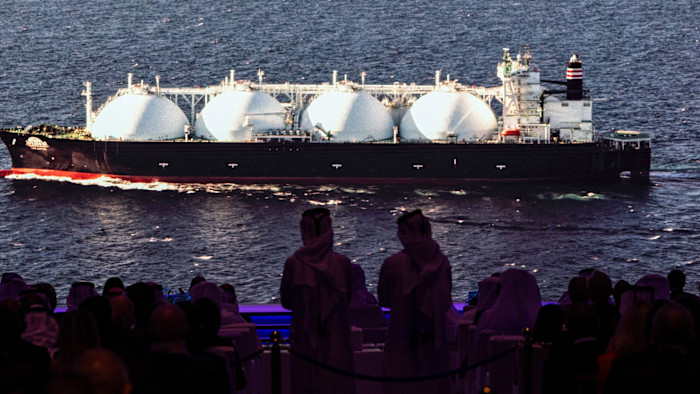
European gas prices soared by nearly fifty percent momentarily on Monday, after Qatar suspended its liquefied natural gas output subsequent to assaults by Iran, which has been assailed by the US and Israel since Saturday.
Oil prices climbed by nearly seven percent, reaching $77.74 per barrel, owing to an almost total cessation of consignments through the Strait of Hormuz. This is a vital maritime passage whereby approximately twenty percent of the globe’s oil and LNG transits.
The extent of the disruption originating from the Middle East would hinge “on the scope and longevity of the hostilities,” Lane stated. He further noted that “the consequence would be magnified if it also triggered a reassessment of peril in capital markets.”
The ECB “will be diligently observing unfoldings,” Lane indicated. He referred to a contingency study itissued in December 2023, which underscored “a significant surge in fuel-induced price hikes and a steep decline in production” should hostilities in the Middle East instigate an “ongoing reduction in energy provisions” alongside “disturbances in local commercial operations.”
Within the analysis, the ECB simulated that one-third of the oil and gas passing through the Strait of Hormuz would be interrupted. Under this eventuality, its economists calculated that oil prices, which at the time stood at approximately $80 per barrel, would increase over fifty percent to around $130 per barrel. Eurozone economic expansion would be 0.6 percentage points reduced in the following year, they stated, concurrently with price escalation exceeding 0.8 points.
Pre-conflict, ECB economists had forecasted that yearly price escalation would decline marginally beneath the monetary authority’s two percent objective, spanning from the second quarter of the current year through late 2027, prior to re-establishing two percent in 2028.
Based on Reuters statistics, investors presently perceive an eighty-eight percent likelihood that the ECB will maintain stable interest rates at two percent for the current year.
Lane expressed that he perceives no justification to alter the monetary authority’s position, stating: “I believe our current state is satisfactory.”
Lane remarked that, aside from a significant and enduring disruption originating from the Middle East, the Eurozone economy was “expanding close to its capacity,” and he emphasized he perceives no substantial dangers of excessive expansion.
“In 2023 and 2024, expansion was beneath its capacity. There remains unused capability, especially within the manufacturing sector,” he elaborated, adding “we would require a phase of above-potential growth to deplete that.”
He further underscored that price escalation, barring fluctuating energy costs, remained above the ECB’s mid-range two percent objective, and employee remuneration toward the end of the previous year was marginally exceeding forecasts.
“This is not a climate where I discern a justification for undertaking some inflation risk,” he further remarked.
Access the complete transcription of the FT’s discussion with Philip Lane via Monetary Policy Radarhere.