
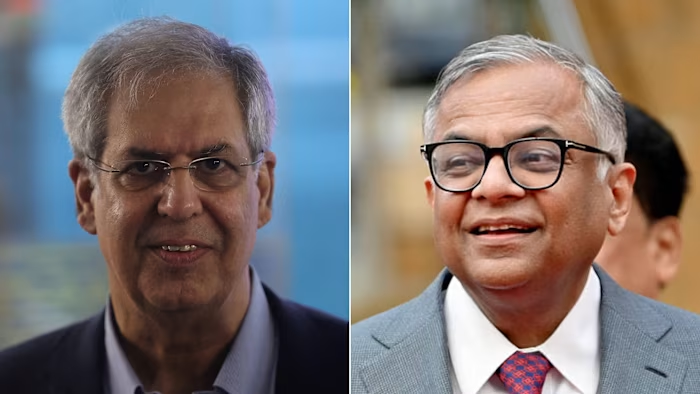
In a high-stakes boardroom drama that transcends mere corporate politics to touch the very foundations of India’s capital markets, Noel Tata, the 69-year-old scion of the nation’s most illustrious business family, found himself confronting a formidable alliance. Lined up against him were two senior executives of Tata Sons – the private holding company at the apex of the $280 billion Tata Group, controlling its 26 listed entities – along with two independent directors and a fellow nominee from Tata Trusts, the company’s largest shareholder. The confrontation was not just about leadership; it was about the fundamental structure, transparency, and market future of a conglomerate synonymous with India itself.
Key Takeaways
- **Governance vs. Control:** The central conflict pits traditional trust-based family control, championed by Noel Tata, against modern demands for greater corporate governance, transparency, and market discipline, advocated by N. Chandrasekaran and regulatory bodies.
- **Regulatory Catalysis:** A directive from the Reserve Bank of India (RBI) mandating Tata Sons’ listing on the stock exchange is the primary catalyst, signaling a heightened regulatory push for major Indian conglomerates to embrace public accountability and unlock shareholder value.
- **Market Reshaping IPO:** A potential $120 billion IPO of Tata Sons would be India’s largest, significantly altering the domestic equity landscape, attracting global investor attention, and potentially leading to a re-rating and restructuring of the entire Tata Group’s vast portfolio.
Top of Thursday’s agenda was the pivotal question of how to respond to a ruling from India’s central bank, the Reserve Bank of India (RBI), which declared that Tata Sons needed to list on the stock exchange. This directive, a significant regulatory intervention, struck at the heart of Noel Tata’s long-held conviction that public listing would irrevocably alter the group’s character and erode the long-term, philanthropic vision embedded in its trust-controlled structure. He had communicated to associates prior to the meeting his expectation of a renewed push to retain the current chair, N. Chandrasekaran, universally known as Chandra. Chandra, a staunch proponent of a listing as part of a broader transparency drive, had recently threatened to resign after failing to secure Noel’s backing for his extension.
As Noel walked past a mural depicting the vast spread of Tata’s business empire – from energy and IT services to steel manufacturing and car production – he exuded confidence. His preparations included written statements and a legal opinion from a former chief justice of India, asserting that Chandra should not receive an extension. “A decision upon the chairmanship taken now… would be open to serious legal challenge by any shareholder who chose to bring it,” Noel declared to the board, emphasizing the potential for market instability. “This company should not expose itself to a challenge of that kind at any time. It should certainly not do so at a moment when it has matters of far greater consequence pending before its regulator.” This statement underscored his concern for legal and market challenges, especially with the RBI’s listing mandate looming.
Yet, in a striking display of board independence, or perhaps strategic alignment with market forces, the board disregarded his counsel. The meeting concluded with a statement announcing Chandra’s reappointment for a further five years and a firm commitment from Tata Sons to commence steps towards complying with the central bank’s listing directive. Tata Trusts, Noel’s stronghold, promptly denounced the board’s decision as a “legal nullity,” citing a split among the Tata Trusts’ two nominees to the board – a procedural flaw that could fuel further legal and market uncertainty.
“It’s the first time I’ve seen the executive, in a sense, go against the larger shareholders. That’s clearly a first,” observed Amit Tandon, founder and managing director of Mumbai-based Institutional Investor Advisory Services. Tandon’s remarks highlight a critical shift in India’s corporate governance landscape, questioning the board’s ability to secure broader shareholder support at the upcoming Annual General Meeting (AGM), theoretically due by the end of the year. This unprecedented defiance by a board against its controlling shareholder sets a powerful precedent for corporate governance debates within India’s family-dominated conglomerates.
At stake is not just the leadership, but the very future of India’s biggest conglomerate and some of its most prized assets. A public listing of Tata Sons, with analysts estimating its value at over $120 billion, could potentially become India’s largest-ever IPO. This would not only unlock immense value for shareholders but also expose the intricate web of cross-shareholdings between Tata Trusts and some of its controlled companies to intense market scrutiny, potentially making them targets for corporate raiders if these holdings were unwound. The ramifications for investor sentiment and the broader market structure are profound, potentially influencing the valuation and strategic direction of existing listed entities like Tata Consultancy Services (TCS), Tata Steel, Jaguar Land Rover, and Air India.
The more than 150-year-old Tata Group has historically operated with a unique blend of corporate power and philanthropic mission, often benefiting from special treatment from Indian authorities to maintain control via its charitable trusts. In the past three decades, legislative amendments have allowed the company to buy back shares to strengthen control, and a 2002 government exemption removed the need for a government-appointed nominee for its trusts. These historical concessions underscore the deep-seated resistance to market-driven transparency, contrasting sharply with the current regulatory environment. A decade ago, a similar governance battle saw Noel’s predecessor and half-brother, Ratan Tata, remove Cyrus Mistry, an heir of the minority shareholder Shapoorji Pallonji (SP) Group, as chair of Tata Sons – a dispute ultimately resolved in Ratan’s favor by the Supreme Court. These historical precedents illustrate the long-standing tension between family control and minority shareholder rights within the Tata ecosystem.
Even as Noel campaigned against a listing, insiders reveal that two powerful blocs actively lobbied officials in favor of the move. On one side was Chandra and his allies, well-connected within New Delhi’s corridors of power, pushing for market alignment and transparency. On the other were the heavily indebted minority shareholders, the SP Group, eager to monetize their significant 18 percent stake – a clear demonstration of how financial pressures can drive a demand for market liquidity and corporate transparency.
When the board convened, Chandra was asked to recuse himself while his extension was discussed. With Noel firmly opposing and trust vice-chair Venu Srinivasan in favor, the company’s chief financial officer, Saurabh Agrawal, backed Chandra. The two independent directors, Anita George and Harish Manwani, also supported Chandra, citing the critical need for an experienced hand to navigate the complex listing directive. Chandra and Srinivasan did not respond to requests for comment, but their alignment with market-oriented strategies is evident.
Tata’s immense national importance means that decisions about its future, such as the central bank ruling, often require prior approval from the highest echelons of the Indian government, according to several sources. “Delhi definitely had a role to play,” in the central bank’s latest decision, a person close to Tata remarked, suggesting a strategic government interest in promoting modern corporate governance standards within India’s largest conglomerates. The finance ministry and the central bank declined to comment, but the implication of governmental influence on market-shaping regulatory decisions is clear.
Noel, who took over as chair in 2024, now faces the battle of his life to prevent a listing and preserve Tata under the philanthropic control of its charitable trusts. He argues that the conglomerate’s unique structure enables it to adopt a long-term view for its businesses, unfettered by quarterly market pressures, and points to the millions of dollars in charity projects funded by dividends flowing to the trusts. His rivals, however, contend that he is merely attempting to maintain family control over a vast conglomerate that desperately needs the greater transparency, accountability, and market discipline that a public listing would entail, especially in a rapidly evolving global economy.
Chandra, 63, is a formidable adversary. A Tata lifer, he ascended through the ranks to lead India’s largest IT services firm, Tata Consultancy Services (TCS), before being handpicked by Ratan Tata to head the holding company. Many significant decisions under Chandra’s leadership, including strategic investments in semiconductors, have been “very closely associated with what the government wants to do,” noted one person who worked with him, positioning him as a leader aligned with national economic and technological aspirations – a key factor in securing regulatory and political backing.
At the heart of this bitter feud lies the holding company’s intricate governance structure. According to the articles of association of Tata Sons, a majority of the trusts’ nominee directors must concur on any key decision. However, the board’s two current trust nominees – Noel and Chandra’s ally Srinivasan – are fundamentally at odds. This internal conflict within the controlling shareholder group forms the basis of a potential legal challenge to Chandra’s extended term, adding another layer of uncertainty for investors tracking the conglomerate.
Before the Thursday meeting, Sir Dorabji Tata Trust, one of the two main trusts, explicitly asked Srinivasan not to attend, given his public support for a listing. Srinivasan refused, asserting his duty as a board member to vote for what he believed was best for the company – a rare instance of a nominee director asserting independence against the wishes of the nominating body. While Noel hopes shareholders will vote down Chandra’s reappointment at an AGM later this year, that meeting itself faces potential delays. Sir Ratan Tata Trust, the second main trust, has been unable to hold key meetings to nominate attendees for the AGM, pending a Charity Commission ruling on Srinivasan’s complaints about the number of lifetime trustees. These procedural and legal hurdles introduce significant market uncertainty regarding the timing and outcome of crucial governance decisions.
While no formal legal challenge is yet underway, Noel believes that the courts will ultimately overturn Thursday’s board decision. He anticipates that once the Charity Commission issue is settled, the trusts will align at an AGM, ultimately forcing Chandra out. In the interim, however, Chandra can swiftly commence work on the listing, a person close to him indicated, potentially creating an irreversible momentum towards public markets. Still, the trusts’ continued opposition will undoubtedly complicate matters, as Tandon observes: “Chandra can turn around and say he got the majority. But at the end of the day, he will have to work with the largest shareholder.” This ongoing tension highlights the inherent challenges of navigating market demands while respecting the unique governance structures of India’s legacy conglomerates.
Market Impact
The unfolding saga at Tata Sons carries profound implications for India’s capital markets and corporate governance landscape. A successful public listing of Tata Sons, estimated at $120 billion, would not only be the largest IPO in Indian history but also a significant liquidity event, drawing substantial domestic and international investment. This move would likely trigger a re-evaluation of the entire Tata Group, potentially unlocking significant shareholder value across its numerous listed entities by improving transparency and reducing the “conglomerate discount.” It would set a powerful precedent for other privately held, family-controlled Indian conglomerates to consider public listing, pushing them towards greater market discipline and minority shareholder protection. Conversely, prolonged legal battles and governance uncertainty could deter foreign institutional investors, who prioritize stability and clear ownership structures. The RBI’s assertive directive underscores a broader regulatory shift towards enhancing corporate governance and market accountability for systemically important entities, signaling a tightening of oversight that could reshape the operational frameworks of India’s largest business houses. The outcome of this feud will thus serve as a critical test case for the evolution of corporate India, balancing tradition with the imperatives of modern financial markets.