
Gain access to the Editorial Summary without cost
Roula Khalaf, the FT’s Editor, picks her top narratives for this weekly bulletin.
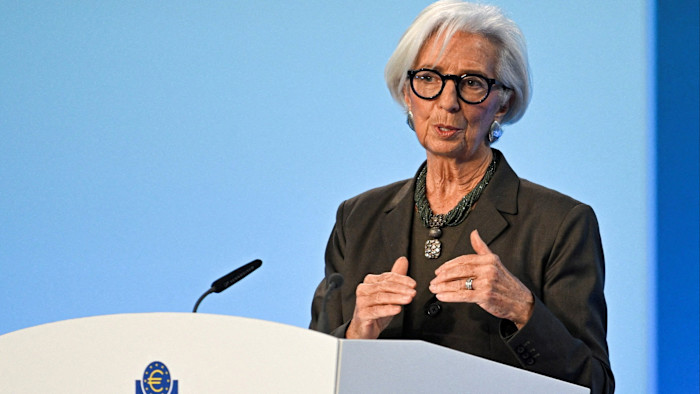
Christine Lagarde is anticipated to depart from the European Central Bank prior to the conclusion of her eight-year tenure as chief in October 2027, as per an individual apprised of her views.
The preeminent European monetary authority, who commenced her role at the Frankfurt-headquartered ECB in November 2019 having transitioned from the IMF, desires to step down prior to the French presidential election in April next year.
The individual acquainted with her intentions suggests Lagarde aims to facilitate the departing French head of state, Emmanuel Macron, and German Chancellor Friedrich Merz in appointing a new leader for one of the EU’s most important institutions. The precise timing of Lagarde’s exit remains uncertain.
The ECB refused to provide a statement.
A survey of European economists conducted by the FT in December identified Spain’s erstwhile central bank chief Pablo Hernández de Cos and his Dutch equivalent Klaas Knot as prime candidates for the subsequent presidency of the Eurozone central bank. Isabel Schnabel, an ECB executive board member, has expressed her interest in the position, and sources informed of Bundesbank president Joachim Nagel’s perspective indicated his strong interest in the role as well.
Individuals with knowledge of deliberations in Paris have informed the FT that Macron — who is ineligible for a third mandate as France’s head of state — has sought input for several months regarding the selection of Lagarde’s replacement.
The forthcoming French head-of-state ballot scheduled for April of the next year is pivotal for the Eurozone’s second-biggest financial power and the broader EU.
Marine Le Pen, the head of the ultra-nationalist Rassemblement Nationale, is consistently registering higher in surveys than her competitors, positioning her favorably to advance to the two-candidate final round of the presidential vote.
Should Le Pen be deemed ineligible to contend as the RN nominee after being convicted last year for misappropriating European parliamentary monies, she has stated that her protégé Jordan Bardella would take her place under such conditions.
Both Le Pen, who is contesting her verdict, and Bardella hold Eurosceptic views, a stance that might strain ties with European bodies like the ECB.
Lagarde’s period leading the ECB has been characterized by a succession of emergencies, encompassing the Covid-19 global health crisis, Russia’s comprehensive military incursion into Ukraine, and a commercial dispute involving the United States.
During her tenure, inflation in the Eurozone soared to nearly 11 percent towards the end of 2022, owing to a sharp rise in energy costs following Russia’s aggression against its adjacent country and worldwide distribution networks experienced pandemic-induced blockages.
The ECB increased benchmark rates from negative 0.5 percent to 4 percent in just over twelve months.
Beginning in mid-2024, the monetary authority reduced loan expenses to 2 per cent as the rate of price increases reverted to the ECB’s two percent intermediate-term objective.
Lagarde’s designation as the head of the ECB resulted from an unexpected agreement forged in 2019 by Macron and the then-German chancellor, Angela Merkel.
Their accord stipulated that Lagarde would assume leadership of the ECB and that Ursula von der Leyen, then Germany’s defence minister, would become the president of the European Commission.
Lagarde informed Bloomberg TV last month that she took on the ECB role believing her tenure would be for five years, remarks interpreted by commentators as a possible prelude to an early departure.
She recounted telling Macron upon consenting to the position of ECB chief: “My stay in Frankfurt will be for five years. Macron then corrected her, stating ‘No, for eight years’.”
During the past summer, an ECB representative emphasized that Lagarde “is resolute in fulfilling her [eight-year] mandate” following comments by Klaus Schwab, the former chairman of the World Economic Forum, who stated the central bank’s head had conversed about a possible premature departure to assume the helm of the WEF.
“I’m afraid to inform you that you won’t be rid of me just yet,” Lagarde informed journalists at the ECB’s main office last June.