
Osac Chief Market Strategist Phil Blancato advises investors to strip emotions from their investment decisions.
KEY TAKEAWAYS
- Persistent Affordability Challenge:Despite minor fluctuations, mortgage rates remain elevated, exacerbating affordability issues for prospective homebuyers and influencing housing market dynamics, particularly for the crucial 30-year fixed rate.
- Fed Policy Remains Pivotal:The Federal Reserve’s ongoing battle against inflation and its communication regarding future monetary policy continue to be the primary drivers of bond yields and, consequently, mortgage rates, leading to market sensitivity to hawkish statements.
- Housing Market Nearing Equilibrium:While affordability is strained, the housing market shows tentative signs of normalization with improving inventory and modest price adjustments, signaling a potential shift from a seller’s to a more balanced market.
Mortgage Rates Edge Up Amidst Inflationary Concerns and Hawkish Fed Rhetoric
The delicate balance of the U.S. housing market faced renewed pressure this week asmortgage ratessaw a marginal but significant uptick, signaling persistent inflation anxieties and the Federal Reserve’s unwavering commitment to price stability. According to Freddie Mac’s latest Primary Mortgage Market Survey released Thursday, the average rate on the benchmark30-year fixed mortgageclimbed to 6.69% from last week’s reading of 6.66%. This marginal increase, while seemingly minor, underscores the broader market’s sensitivity to inflation data, Treasury yield movements, and the ongoing debate surrounding the Federal Reserve’s future monetary policy trajectory.
A year ago, the average rate on a 30-year loan stood at 6.63%, indicating that despite a year of significant economic shifts and aggressive Fed tightening, rates have largely remained within a tight, elevated range. This sustained level of borrowing costs continues to be a formidable hurdle for many aspiring homeowners, particularly first-time buyers navigating an already expensive housing landscape.
“While mortgage rates continue to influence affordability, the housing market is showing signs of adjustment, with listing prices modestly below year-ago levels and for-sale inventory improving from the limited supply seen in recent years,” noted Sam Khater, Freddie Mac’s chief economist. Khater’s assessment points to a nuanced picture where, despite high borrowing costs, other market forces are gradually working towards a more balanced environment. The improvement in inventory is a critical development, suggesting that the severe supply crunch that characterized the post-pandemic market may be easing. An increase in available homes could temper price appreciation and potentially offer buyers more choices, mitigating some of the pressure from elevated rates. However, the term “modestly below year-ago levels” for listing prices indicates that a significant correction is not yet underway, merely a slight cooling from historical highs.
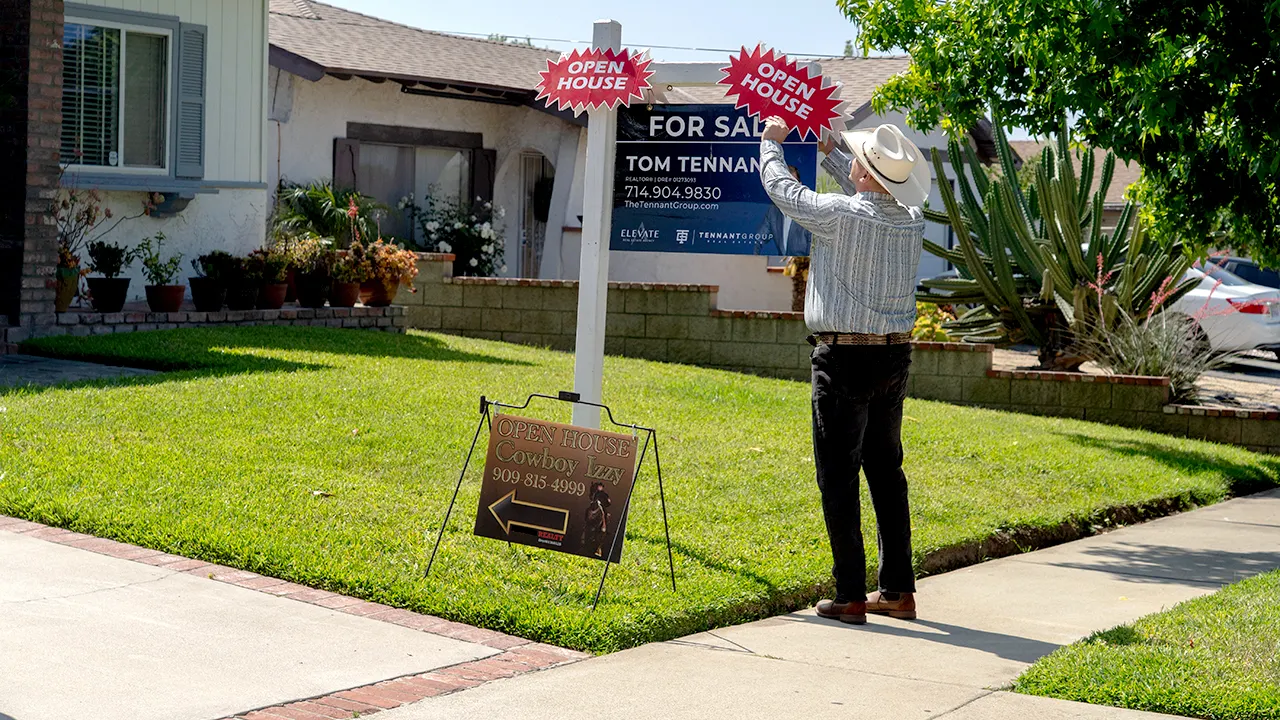
A real estate agent sets up for an open house in Rancho Cucamonga, California, on May 9, 2026.(Kyle Grillot/Bloomberg via Getty Images)
In a slight counter-trend, the average rate on a 15-year fixed mortgage saw a modest decline, falling to 6.01% from last week’s reading of 6.04%. This divergence between the 30-year and 15-year rates can often be attributed to varying investor demand for different maturities in the bond market, or specific movements in the yield curve that favor shorter-term instruments. For homebuyers with the financial capacity for higher monthly payments, the 15-year option presents a notably lower interest burden over the loan’s lifetime, though it remains less common than its 30-year counterpart due to the higher monthly outlay.
The backdrop to these mortgage rate movements is the Federal Reserve’s ongoing monetary policy stance, which continues to dominate financial market sentiment. Just recently, Minneapolis Fed President Neel Kashkari reiterated a hawkish stance, stating, “FED’S KASHKARI SAYS CENTRAL BANK SHOULD RAISE INTEREST RATES NOW TO AVOID ‘ENTRENCHED INFLATION PROBLEM’.” Kashkari’s comments underscore the deep-seated concern among some Fed officials about the stickiness of inflation and the potential need for further tightening to ensure it returns sustainably to the central bank’s 2% target. Such statements typically send ripples through the bond market, pushing Treasury yields — which mortgage rates closely track — higher as investors price in a higher probability of future rate hikes or a prolonged period of elevated rates. The 10-year Treasury yield, a key benchmark for the 30-year fixed mortgage, remains sensitive to every utterance from Fed officials and every piece of inflation data, from Consumer Price Index (CPI) reports to the Personal Consumption Expenditures (PCE) index.
The current environment is characterized by a tug-of-war between strong labor market data, which could fuel inflation, and signs of slowing economic activity in other sectors. While robust employment figures provide a foundation for consumer spending, they also give the Fed reason to maintain a restrictive monetary policy. The housing market, being one of the most interest-rate-sensitive sectors, acts as a crucial barometer for the broader economy’s response to the Fed’s actions. High mortgage rates not only cool demand but can also create a “lock-in effect” for existing homeowners who secured much lower rates, making them reluctant to sell and contribute to inventory, thereby prolonging supply constraints in certain sub-markets.
Looking ahead, the trajectory of mortgage rates will hinge significantly on upcoming inflation reports, the Fed’s summary of economic projections (SEP), and the language from its Open Market Committee meetings. Should inflation prove more persistent than anticipated, or if the labor market remains exceptionally tight, the probability of further rate hikes or a longer “higher for longer” stance from the Fed would increase, likely pushing mortgage rates further upwards. Conversely, any definitive signs of a sustained disinflationary trend or a significant weakening in economic activity could prompt the Fed to signal a pivot, potentially leading to a moderation in borrowing costs. For now, volatility remains the watchword for both homebuyers and market participants.
Market Impact
The marginal rise in 30-year fixed mortgage rates, coupled with hawkish Fed commentary, signals continued headwinds for the housing market and broader financial sectors. For **real estate**, persistent affordability challenges will likely temper demand, potentially leading to further, albeit modest, price adjustments and an extended period of inventory accumulation. This pressure could affect the profitability of **homebuilders** and **real estate investment trusts (REITs)** focused on residential properties. In **fixed income markets**, the sensitivity of Treasury yields to inflation fears and Fed rhetoric means continued volatility for bond prices, impacting mortgage-backed securities (MBS) which are critical for mortgage financing. For **equity markets**, sectors tied to consumer spending, housing, and banking will remain under scrutiny. Banks, for instance, could see mixed impacts – increased profitability from higher net interest margins but also potential risks from a cooling mortgage origination market and rising loan delinquencies if economic conditions deteriorate. Overall, the market remains in a cautious holding pattern, highly responsive to macroeconomic data and the Federal Reserve’s nuanced approach to balancing inflation control with economic stability.