
Gain complimentary access to the White House Watch bulletin
Your indispensable guide to the implications of Trump’s second presidential term for Washington, commerce, and the global arena
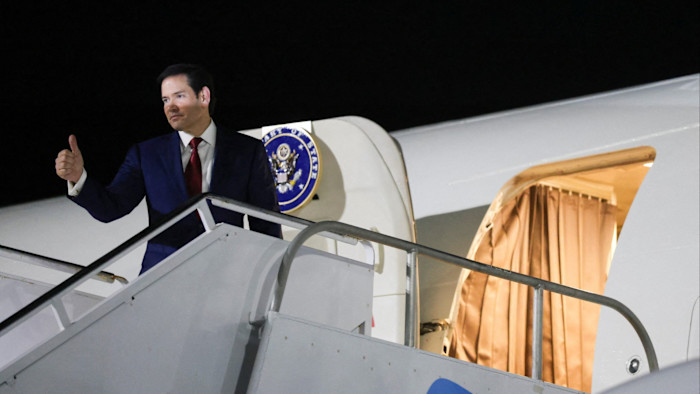
Marco Rubio, the American secretary of state, issued a caution, stating that Iran’s reluctance to engage in discussions with Washington regarding its ballistic missile development presents a “big problem” prior to Thursday’s scheduled negotiations, which seek to prevent US military actions against the Islamic republic.
While visiting the Caribbean island nation of Saint Kitts and Nevis on Wednesday, Rubio endeavored to reinforce the justification for a potential armed intervention targeting Iran. This came a day after US President Donald Trump accused Tehran of harboring “sinister” designs concerning its nuclear initiatives.
Regarding Iran’s ballistic missiles, Rubio asserted that Tehran “refuses to talk about the ballistic missiles to us or to anyone, and that’s a big problem”.
The Islamic republic possessed “thousands of short-range ballistic missiles” that posed a threat to US forces, its bases, and its allies in the vicinity, America’s chief diplomat noted. Tehran also maintained naval assets that “threaten shipping and try to threaten the US Navy” and conventional armaments that were “designed to attack the US”, he further stated.
Nonetheless, Rubio indicated that Thursday’s discussions in Geneva, involving American negotiators Steve Witkoff and Jared Kushner, would be “largely focused on the nuclear programme”, and that Washington anticipated “progress can be made”.
Still, Rubio criticized Iran for “trying to get to the point where they ultimately can” enrich uranium, although he conceded that the nation was not currently undertaking such activity.
“They don’t need to enrich in order to have nuclear energy. They don’t need nuclear energy, by the way, they have plenty of natural gas,” Rubio remarked.
“The fact that they insist, not just on enrichment, but on enrichment and locations located inside of mountains is . . . you would have to lack common sense to not know what that means, or what that could mean.”
Iranian leadership maintains that its nuclear agenda serves exclusively peaceful objectives and that any accord must acknowledge what they characterize as Iran’s entitlement under the nuclear non-proliferation treaty to enrich uranium. Tehran has also declared it will not consent to distinct US demands to curtail its ballistic missile initiative or to restrict its backing for anti-Israel armed factions.
When questioned whether Thursday represented the final opportunity for diplomatic efforts, Rubio responded: “I don’t think diplomacy is ever off the table.” He further elaborated that Trump’s “preference” was to “make progress on the diplomatic front”.
“I wouldn’t characterise tomorrow [Thursday] as anything other than . . . a set of conversations,” Rubio affirmed. “If you can’t even make progress on the nuclear programme, it’s going to be hard to make progress on the ballistic missiles as well. So I wouldn’t characterise tomorrow as anything other than the next opportunity to talk.”
The secretary of state’s remarks followed Iran’s pledge to intensify any confrontation with the US should an American assault occur. In readiness for potential military engagement, the US has assembled its most substantial naval contingent in the Middle East since its 2003 incursion into Iraq and has considerably augmented the number of fighter jets deployed on land and at sea within the region.
An internal source within the Tehran regime informed the FT that Iran had modified its approach to one devised to inflict tangible repercussions on American forces and assets if hostilities erupted.
He further added that Tehran was not seeking conflict and hoped that the Geneva discussions could pave the way for a new nuclear accord that would prevent an American assault, but it would rather engage in combat than yield to Trump.
“This time would not be a war game in response,” the insider clarified, referencing missile attacks on US bases in Iraq in 2020 and Qatar last year that were signaled in advance to avert full-scale warfare.
“Iran would move toward escalation, targeting anything within reach from US bases to the Strait of Hormuz and American warships.”