
Unlock the Editor’s Digest for free
Roula Khalaf, Editor of the FT, selects her favourite stories in this weekly newsletter.
**Key Takeaways:**
1. **AI-Driven Corporate Reshaping:** SAP’s proposed job cuts, potentially impacting over 10,000 employees, underscore a fundamental shift within major enterprise software companies. Artificial intelligence is not merely an additive feature but a catalyst for deep operational restructuring, compelling businesses to realign skill sets and workflows for enhanced efficiency and cloud integration.
2. **Strategic Cloud & Efficiency Focus:** The move reinforces SAP’s commitment to its cloud-first strategy and embedding AI across its offerings. While previous restructurings aimed at similar goals, the current scale suggests an accelerated drive towards leaner operations, higher margins, and a more competitive stance against agile cloud-native rivals.
3. **Broader Tech Sector Trend:** SAP joins a growing list of tech giants, including Microsoft, Oracle, and Salesforce, implementing significant workforce reductions. This signals a market-wide trend where established software leaders are adapting to economic headwinds, intense competition, and the transformative potential of AI by streamlining operations and reallocating resources towards high-growth, high-margin areas.
***
**SAP Navigates AI Tsunami with Sweeping Job Cuts, Signalling Sector-Wide Transformation**
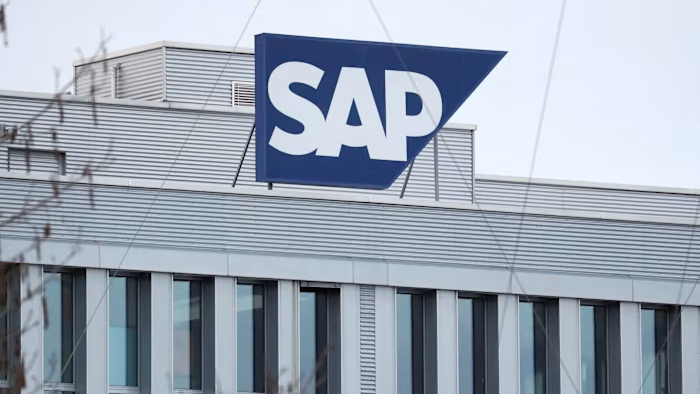
Frankfurt — SAP, Europe’s largest software powerhouse and a bellwether for the continent’s technology sector, is reportedly in advanced discussions to eliminate at least 10,000 jobs, representing roughly one in ten of its global workforce. This aggressive restructuring is a direct response to the escalating influence of artificial intelligence and the company’s ongoing strategic pivot towards a cloud-centric business model. The proposed cuts, which are yet to be formally presented to employee representatives and thus subject to alteration, underscore a profound operational overhaul aimed at streamlining processes and re-aligning resources for the AI era.
With a formidable market capitalisation of €237bn, SAP stands as one of Europe’s most valuable listed entities. Its decisions resonate far beyond Walldorf, influencing investor sentiment and corporate strategies across the technology landscape. The impetus behind these potential layoffs is multifaceted, reflecting both macro-economic pressures and a targeted effort to optimize for AI-driven efficiencies within its core enterprise resource planning (ERP) and customer relationship management (CRM) software offerings.
This anticipated move positions SAP alongside other prominent German industrial giants, including automotive titans Volkswagen and BMW, which have recently announced significant workforce reductions. These legacy manufacturers are grappling with a dual challenge: weakening global demand exacerbated by inflationary pressures and intensified competition, particularly from agile Chinese players. For SAP, the competitive landscape is defined by formidable US rivals such as Microsoft, Oracle, and Salesforce, all of whom have initiated thousands of job cuts in recent months, citing similar imperatives for AI-driven efficiency gains and the prudent conservation of capital amidst an uncertain economic outlook.
SAP’s strategic trajectory has been explicitly focused on integrating more sophisticated AI tools into its vast software ecosystem. This transformation is deeply intertwined with its shift away from a traditional licence-based sales model towards a subscription-based, cloud-hosted services paradigm. The cloud, by its very nature, demands different operational efficiencies and skill sets compared to on-premise software deployment. As SAP helps its extensive global customer base deploy and leverage AI models across their businesses, it simultaneously reassesses its internal structure to mirror this technological evolution. The expectation is that AI will automate routine tasks, enhance software development cycles, and necessitate a workforce with a stronger emphasis on data science, machine learning, and cloud architecture, thereby reducing the need for certain traditional roles.
The company’s history shows a precedent for such large-scale adjustments. SAP executed a significant restructuring in 2024, which also saw approximately 10,000 jobs eliminated. However, subsequent strategic hiring phases led to the company’s total headcount rising back to approximately 113,000 globally. This cyclical pattern suggests an ongoing recalibration rather than a one-off event, highlighting the dynamic nature of the enterprise software market. Dominik Asam, SAP’s chief financial officer, recently provided a clear signal of this intent at an industry conference, stating he would be “really surprised” if the company did not reduce its headcount in the future, underscoring a proactive, strategic approach to workforce management rather than a reactive measure.
Despite its robust financial performance in the third quarter, reporting revenues of €10.3bn – a 13 per cent increase year-on-year, with cloud services contributing a substantial €6.7bn – and post-tax profits rising 11 per cent to €2.3bn, SAP’s stock performance has been volatile. Over the past 12 months, its share price has fallen approximately 6 per cent, experiencing sharp sell-offs earlier in the year. This volatility was largely driven by investors’ initial anxieties regarding the potential disruptive impact of AI on established business models. The fear was that AI could commoditise existing software solutions or enable new entrants to quickly erode market share. However, the broader software sector has seen a reversal of these losses in the second half of the year, as investors began to reassess AI’s impact, increasingly viewing it as an enabler of efficiency, innovation, and competitive advantage for well-positioned incumbents like SAP, rather than purely a threat. The proposed job cuts, therefore, could be interpreted by the market as a decisive step towards realising these efficiency gains and solidifying SAP’s long-term competitive position.
**Market Impact:**
SAP’s potential job cuts are likely to be viewed by the market as a strong signal of its commitment to strategic transformation and operational efficiency in the age of AI. For investors, this move could bolster confidence in SAP’s long-term margin expansion potential and its ability to adapt to a rapidly evolving technological landscape, potentially leading to a positive re-rating of its stock as it sheds legacy costs. More broadly, it reinforces a prevailing narrative across the tech sector that AI is not solely a growth engine but also a powerful tool for streamlining operations and optimizing workforce structures, a trend that could influence other enterprise software companies. This strategy, while potentially painful for employees, signals a necessary adaptation for established tech giants seeking to remain competitive against agile, AI-native startups and aggressive peers. The move could also set a precedent for other European blue-chip companies facing similar pressures to modernize and consolidate, underscoring a market shift where proactive restructuring is seen as a driver of future value.