
Gain access to the Editor’s Overview for free
Roula Khalaf, the FT’s Editor, chooses her preferred articles for this weekly bulletin.
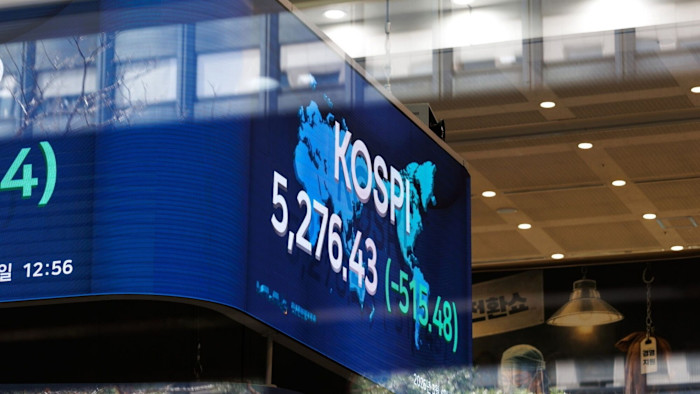
South Korean stocks nosedived by 12 percent on Wednesday, marking an unprecedented single-day decline. This occurred as the world’s most successful market this year bore the brunt of a significant divestment wave across Asian bourses, fueled by apprehension regarding a protracted Middle East conflict.
The previously soaring Kospi index has dropped nearly 20 percent since Friday, following an almost 50 percent climb in the initial two months of this year. Investors are concerned the escalating war in the Middle East could adversely affect the nation, which ranks as the world’s eighth-largest oil importer.
“Capital holders are endeavoring to realize gains from one of the top-performing markets year-to-date,” stated Jason Lui, head of Asia-Pacific equities and derivatives strategy at BNP Paribas. He added that some were factoring in a “graver upheaval prospect.”
The substantial market retreat was primarily instigated by declines in the shares of prominent market players Samsung Electronics and SK Hynix, the globe’s two largest memory chip manufacturers. These companies collectively comprise nearly 40 percent of the Kospi index. Both have seen their values decrease by roughly 20 percent since hostilities commenced.
Equities across East Asian economies, largely reliant on energy imports, experienced a steep decline on Tuesday as crude oil prices persisted in their ascent.
Japan’s Topix decreased by 3.7 percent, while Taiwan’s Taiex plunged 4.4 percent. In China, the Hang Seng index and CSI 300 shed 2 percent and 1.1 percent, respectively.
Brent crude ascended 2.5 percent, reaching $83.40 per barrel.
Throughout this week thus far, overseas capital holders have offloaded a net Won5tn ($3.4bn) worth of Kospi shares. Concurrently, the Kospi 200 volatility gauge spiked to a peak not seen since March 2020.
This significant international offloading exerted strain on the Korean won, which depreciated 2.5 percent over two days. It also momentarily dipped below Won1,500 to the dollar on Tuesday, reaching its most depreciated value since the worldwide economic downturn.
Jongmin Shim, an equity strategist at CLSA, remarked, “Considering that Korea is a major petroleum consumer, elevated crude costs will have a troubling consequence on the country’s overall economy, encompassing aspects like price increases, currency valuations, and economic expansion, should the conflict not conclude in a week or two.”
He also attributed the extensive divestment to the liquidation of indebted share acquisitions by individual traders, who had become the primary catalysts of this year’s market upswing.
The abrupt drop has driven many private investors into a state of alarm.
“I’m experiencing extreme distress. In my many years of equity trading, I’ve never witnessed a precipitous drop like this, not even during the commencement of conflict,” confessed Song Mi-kyung, a 60-year-old housewife. “There is little I can do beyond simply wishing for a swift rebound.”
On Wednesday, the Bank of Korea announced its intent to diligently observe the market and implement actions should there be “undue fluctuations” in the national tender.
Legislators from South Korea’s governing faction stated they would convene with the country’s chief fiscal oversight body on Thursday to deliberate on strategies to fortify the equity market.
Market observers anticipate additional strain on the won, as Seoul has pledged a capital injection of $350bn into the US. This commitment is part of its commercial agreement with Washington, intended to lessen steep US duties.