
Key Takeaways:
- **Oil Market Volatility Persists:** Despite a temporary ceasefire, the Strait of Hormuz remains a flashpoint. Iran’s de facto blockade and regional escalations underscore the continued geopolitical risk premium on crude oil prices and global energy supply chain stability.
- **Heightened Geopolitical Risk Premium:** The “fragile and temporary” nature of the truce, coupled with ongoing regional proxy conflicts, maintains elevated uncertainty across global markets, driving demand for safe-haven assets and dampening investment sentiment in the broader Middle East.
- **Economic Headwinds & Reconstruction Costs:** Tehran’s devastated infrastructure highlights the immense economic burden of conflict. Widespread destruction, coupled with existing sanctions and internal instability, points to significant future reconstruction costs and ongoing economic hardship, deterring foreign direct investment into Iran.
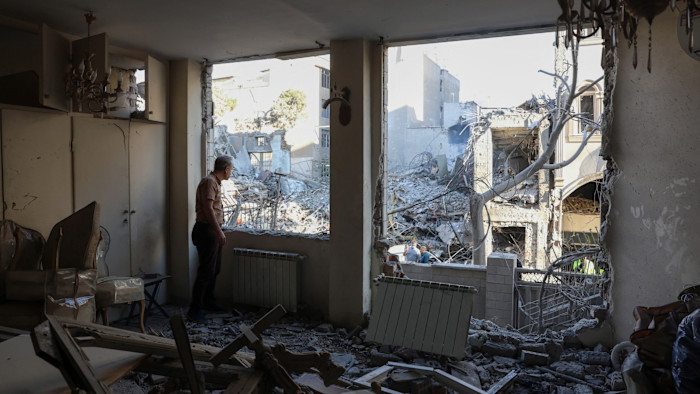
Residents of Tehran emerged on Wednesday to the first day of nearly 40 free from the blasts of explosions, a fleeting reprieve that immediately cast a shadow of market uncertainty over the global economic landscape. The city they found, scarred and subdued, was not just a testament to human suffering but a stark visual reminder of the immense economic costs and persistent geopolitical risks that continue to ripple through international markets.
On affluent Gandhi Street, the large hospital, now a charred, dilapidated ruin, abandoned and gutted by fire, stands as a grim symbol of infrastructure destruction. Such damage represents not only a humanitarian crisis but a substantial unbudgeted fiscal burden for a nation already grappling with international sanctions and internal economic pressures. In the old city, flower beds in the alleys near the historic Grand Bazaar, a vital hub for local commerce, were filled with shards of glass. Furniture and kitchen appliances lay strewn in the ruins of a bombed-out building on Baluchistan Street in the west, indicating widespread disruption to residential areas and local businesses, impacting consumer confidence and property markets.
At the Sheikh Fazlollah Expressway, only the metal skeleton of the dome of Iran’s Space Research Center was left. On a nearby wall, someone had spray-painted “Trump’s aid” — a sarcastic reference to the US president’s pledge to help anti-regime protesters in January, highlighting the deep-seated political tensions that underpin the market’s unease.
The usually frenetic city of 10mn remained subdued and as quiet as on a public holiday, its streets largely emptied of cars and motorcycles and many shops shuttered. This widespread commercial paralysis speaks volumes about the immediate economic contraction and disruption to daily commerce. Few really believed that the devastating conflict, which came to a messy pause after the US and Iran announced a two-week ceasefire early Wednesday, was truly over. This pervasive skepticism immediately translated into a persistent geopolitical risk premium across commodity markets, particularly oil, and a cautious stance among international investors.
Yet, even so, the truce offered a precious moment of relief, as locals celebrated the small joys of everyday life. “Nothing else matters to me anymore,” Somayyeh, a 25-year-old university student, said. “Not even rising prices, or any other hardship, bothers me,” she said. “The only thing that matters is that there’s no bombing and I can sleep peacefully at night.” This sentiment, while deeply human, underscores the severe inflation and economic hardship faced by the Iranian populace, factors that inevitably impact the nation’s currency stability, purchasing power, and potential for internal social unrest – all critical variables for economic stability and foreign investment outlook. Like others interviewed for this story, the FT used a pseudonym to protect Somayyeh’s identity.
The ceasefire, in which the US and Israel agreed to halt strikes in return for Iran reopening the Strait of Hormuz, quickly came under strain. The Strait of Hormuz, a critical chokepoint through which approximately 20% of the world’s petroleum and 30% of all seaborne-traded oil passes, is a linchpin of global energy security. Its closure or even the threat of it sends immediate shockwaves through crude oil futures, driving prices higher and impacting global shipping insurance rates. Iran kept its de facto blockade on the passage of oil tankers through the strait on Wednesday after Israel launched a massive bombing campaign in Lebanon targeting Hizbollah, its most important proxy, demonstrating the interconnected and highly volatile nature of regional conflicts on global supply chains.
And though the US and Iran had been expected to hold talks in Islamabad this weekend, Iran threatened to withdraw from the deal altogether if the attacks continued. Iranian state television channel Press TV cited a senior security official calling the ceasefire “fragile and temporary” and warning that Israel was violating the deal by attacking Lebanon. This declaration of fragility immediately diluted any market optimism that might have emerged from the truce, reinforcing the “risk-off” sentiment among investors who quickly re-evaluated their exposure to volatile assets and sought safe havens.
Reza, a cashier scanning groceries at a large supermarket in the neighbourhood of Gisha, echoed the widely held sentiment that it was only a matter of time until war returned to their lives. “They’re only buying time to attack again,” he said of the US. “The war isn’t over. It’s just a pause so they can regroup and hit us again.” Such public cynicism about the duration of the peace directly translates into a lack of long-term planning and investment within the local economy, hindering recovery and perpetuating economic stagnation.

The regime, too, appeared to be on high alert, a stance that contributes to the perception of ongoing instability. Despite rhetoric on state television declaring that Iran had emerged victorious and stronger from the conflict, a narrative aimed at shoring up domestic support and projecting strength to international adversaries, the Islamic republic was quick to stress that it was ready to resume fighting. “They have seen that our hands are on the trigger, and the moment the enemy makes the slightest mistake, it will be met with a forceful response,” the Islamic Revolutionary Guard Corps said in a statement. This bellicose posturing ensures that the geopolitical risk premium, particularly for energy assets, remains firmly priced into global markets.
In front of Tehran’s Sharif University of Technology, a prestigious engineering school that had been hit in an air strike on Monday, a dozen young women in black chadors, worn by conservative women supporting the Islamic republic, had gathered to wave Iranian flags with the ruins of the university’s computing and data centre behind them. “The US will never keep its promises,” one of the women said, citing US and Israeli attacks on Iran in the middle of negotiations in both February and June last year. “Nothing has changed. They can never be trusted.” Such ingrained mistrust, deeply rooted in historical grievances, makes any diplomatic resolution highly tenuous and further fuels market uncertainty, complicating long-term investment strategies for any entity considering engagement with the Iranian economy.
The security presence across Tehran, which only months earlier had been at the centre of a brutal crackdown on anti-regime protesters in which thousands were killed, was notable. The Islamic republic has repeatedly throughout the war warned Iranians against returning to the streets, issuing violent threats. This internal security clampdown, while aimed at maintaining control, also signals a fragile domestic environment that is inherently unattractive to foreign investors seeking stability and transparency. In central Vanak Square, riot police stood guard beside armoured cars. Vehicles mounted with machine guns were also stationed on Saadi Street and security forces staffed checkpoints throughout downtown Tehran, transforming commercial districts into militarized zones and further stifling economic activity.
One checkpoint had been set up just outside the former US embassy compound on Taleqani Street, dubbed the “Den of Espionage” after it was seized by students following the Islamic revolution in 1979. Across the road, a billboard from before the war read: “Enmity with the US will not be resolved through negotiations.” From the street, a building destroyed in the strike inside the compound was hidden from view. The enduring symbolism of this location and the message on the billboard encapsulate the deep-seated ideological conflict that makes any sustainable resolution, and thus any sustained market calm, incredibly difficult to achieve.

Despite the tense atmosphere, many residents of Tehran tried to continue on with their lives as best as they could, demonstrating a resilient, albeit constrained, local economy. One man, who sold generators in the city’s business district on Imam Khomeini Street, had kept his shop open throughout the war even after part of the ceiling collapsed from a nearby explosion. He explained that, with Donald Trump repeatedly threatening to decimate Iran’s power plants if Tehran did not reopen the Strait of Hormuz, many people had been desperate to buy backup generators in case of power blackouts. “Every day, trucks would come and unload more generators,” he said. This surge in demand for backup power solutions highlights the fragility of Iran’s national infrastructure and the immediate market for emergency goods in times of crisis, a micro-economic indicator of the broader instability.
Hassan, a shopping mall security guard near the Grand Bazaar, reflected widespread disdain — not only towards the US and Israel, but also the Iranian regime. “Whatever the outcome, the Islamic republic always claims victory. They never lose. Always winners in every arena,” he said. “We, the people, are the ones who suffer,” Hassan added. “Israel and the US will come back. I don’t think anything has changed. Decades of enmity, all those slogans, all that flag-burning — in the end, it dragged the country into war.” This deep-seated disillusionment among the populace represents a significant internal risk factor for the regime, potentially impacting long-term economic stability and creating an unpredictable investment environment. The cyclical nature of conflict, as perceived by citizens, ensures that market participants will continue to price in a high probability of future escalations.
Market Impact:
The fragile ceasefire in Tehran, underscored by the immediate re-escalation in Lebanon and Iran’s continued control over the Strait of Hormuz, ensures that global markets will remain on high alert. The geopolitical risk premium on crude oil, already significant due to the pivotal role of the Strait, is likely to persist, influencing energy prices and inflation outlooks worldwide. Investor sentiment will remain highly cautious, favoring safe-haven assets like gold and the US dollar, while equity markets, particularly those with exposure to emerging markets or the Middle East, could experience sustained volatility. The immense reconstruction needs in Tehran, juxtaposed with ongoing sanctions and internal instability, present a daunting economic challenge for Iran and deter meaningful foreign direct investment. Furthermore, the regional spillover effects, as seen with Israel’s actions in Lebanon, reinforce the interconnected nature of Middle Eastern conflicts, amplifying supply chain risks and potentially prompting a reassessment of defense sector investments globally. The cessation of hostilities, therefore, offers little more than a momentary pause in the market’s continuous pricing of geopolitical uncertainty.