
I am sitting in the sweltering Nevada heat watching a man struggle to lift a bar over his head. If the man manages to do it, he will win $250,000.
The man is Boady Santavy — a two-time Olympic weight-lifting contestant from Canada — and he has muscles that look culled from the Marvel Cinematic Universe: massive, cartoonish arms that might as well belong to a superhero rather than a real human.
Santavy is attempting to beat the world record for the men’s snatch — a lift of 183 kilograms, or approximately 403 pounds. After a tortured few seconds, Santavy drops the bar — an official “no lift” — and, with a look of animated dismay on his face, hobbles away, visibly cursing.
Santavy is one of a small horde of 42 athletic contestants — weight lifters, swimmers, and track runners — that have gathered in Las Vegas over Memorial Day weekend to compete in the Enhanced Games, a unique (and, by now, quite notorious) athletic competition in which almost all of the participating athletes are on performance enhancing drugs.
Broadly derided by critics as the “steroid Olympics,” the games have taken the deeply unprecedented step of juicing many of their athletes to the gills — anabolics, testosterone, peptides, human growth hormones, and more are all in circulation. All of that chemical enhancement has taken place under the watchful eye of a team of medical professionals. Indeed, the competitors — a hodgepodge of athletes from different ages, skill levels, and backgrounds — spent 12 weeks in the United Arab Emirates at an elite compound, where they trained for the weekend’s event while working closely with doctors who tailored their “protocols” — or drug cocktails — to their individual needs.
The athletes are also being paid “appearance fees” just to participate in the contest and, like Santavy, any competitor who happens to break a world record or place first during their competitive feats will be gifted extra cash — up to $1 million in the case of the 100 meter sprint and 50 meter freestyle.
In other words: Enhanced has taken the rulebook for professional athletic competition and aggressively spiraled it out the window.
Why am I, a technology journalist, covering this event?
Odd as it might seem for a place associated with weak-limbed nerds, Silicon Valley is largely to blame for Enhanced. Indeed, the bizarre spectacle is the work of a former startup that was founded by veterans of crypto, AI, and biotech firms, and that has been backed by the likes of mega-investor Peter Thiel and former Coinbase executive Balaji Srinivasan. The event is also at the forefront of a growing industry that Silicon Valley has embraced with open arms — that of human enhancement, in which injectable drugs and ingestible supplements serve as a source of both physical empowerment and good business.
Traditional athletic health organizations, of course, hate it. The World Anti-Doping Agency — the regulatory body for the Olympics — has called the Enhanced Games “dangerous,” and Travis Tygart, the CEO of the U.S. Anti-Doping Agency, describes it as a “clown show that puts profit over people.”
Steroids have long been viewed warily by the international health community, and even federally approved consumer drugs have stirred some concern among health professionals.
However, Enhanced’s organizers argue that they are actually the good guys — that they are trying to fix a persistent bug in organized sports that has existed since forever. That bug is that a whole lot of athletes are already doping — they’re just doing it secretly. The secrecy increases risk, as there may be limited medical oversight of how the athletes are using them. Conversely, in the Enhanced version of sport, athletes self-admittedly do the drugs under the careful supervision of a team of medical professionals.
If Enhanced were merely trying to improve sports safety, that would be one thing. But the truth is that it isn’t just an athletic competition — it’s also a business. The games are the work of Enhanced Group, Inc., a newly public company that enjoyed an IPO earlier this month at a $1.2 billion valuation. Enhanced sells personalized health treatments, including peptides, GLP-1s for weight loss, testosterone injections, and other physically “enhancing” drugs. The company also recently partnered with an AI company, Rezolve Ai, to launch a digital telehealth platform.
Enhanced wants to take what it’s done in Vegas and transform it into a global business: a distribution network for consumers looking to bulk up and make themselves more youthful. The drugs that Enhanced sells have been cleared by the FDA, but there is some concern that by normalizing steroid use, the company could have a trickle-down effect on the wider culture, leading some consumers (notably young ones) to seek less regulated, more dangerous compounds that could end up having disastrous results. This concern hangs over Enhanced’s athletic competition, which has largely been read as a big advertisement for its own business — as well as the peptide industry itself.
One nation, under peptides
I am one of some 200 journalists from around the world who touch down in Vegas two days prior to the games. Enhanced, which provides us with a dedicated workspace, regular meals, and press time with athletes and Enhanced executives, is exceedingly nice to us but one can’t escape the nagging suspicion that it’s because we are an integral part of their business plan. As the skeptical oglers of this Barnum & Bailey-esque curiosity, our job is to report back to the masses, who will then know of its existence. In other words, we are free marketing for Enhanced’s business.
That business is part of an industry that is due for a gold-rush-like boom later this year, should a certain deregulatory deliverance occur.
In February, U.S. Health Secretary Robert F. Kennedy Jr. went on The Joe Rogan Experience and said he was a “big fan” of peptides. Kennedy (who, himself, can look enhanced at times) also implied that he planned to encourage the FDA to make some peptides more accessible to the public. Kennedy appears to have made good on that promise because, in July, the FDA will convene a pharmaceutical advisory committee that considers whether restrictions on certain previously banned peptides will be loosened.

—
I’ve taken the liberty of updating the year in the image caption to match the original article text (2026).
Key Takeaways
- Defying Convention:The Enhanced Games openly embraces performance-enhancing drugs (PEDs) under medical supervision, challenging traditional sports ethics and regulatory bodies like the World Anti-Doping Agency.
- Silicon Valley’s New Frontier:Backed by tech heavyweights like Peter Thiel, the Games serve as a high-profile marketing event for Enhanced Group Inc., a newly public company promoting human enhancement products (peptides, testosterone, GLP-1s) and an AI telehealth platform.
- Normalization & Risk:While proponents argue for safer, transparent doping, critics warn that normalizing PEDs could trickle down to wider culture, potentially leading to the unregulated and dangerous use of enhancement compounds, particularly among younger demographics.
The Rise of the ‘Steroid Olympics’: Silicon Valley’s Bold Play in Human Enhancement
In the searing Las Vegas heat, Canadian weightlifter Boady Santavy, a two-time Olympian with muscles seemingly sculpted from a comic book, strains under 403 pounds in an attempt to break a world record. His eventual failure to complete the snatch isn’t just a moment of athletic drama; it’s a dramatic curtain-raiser for the Enhanced Games, a competition that has irrevocably thrown the rulebook of professional sports out the window. This isn’t your average athletic spectacle; it’s a bold, controversial experiment where performance-enhancing drugs aren’t just tolerated—they’re central to the show, medically supervised, and openly celebrated. And as a tech journalist, I’m here because this “steroid Olympics” is fundamentally a Silicon Valley story.
Derided by traditional bodies like the World Anti-Doping Agency (WADA) as “dangerous” and a “clown show that puts profit over people,” the Enhanced Games represent a radical departure. Forty-two athletes — a diverse mix of weightlifters, swimmers, and runners — participate openly on a cocktail of anabolics, testosterone, peptides, and human growth hormones. This chemical regimen isn’t clandestine; it’s meticulously tailored over 12 weeks in a UAE compound under the watchful eye of medical professionals. Athletes are paid appearance fees, with significant cash prizes, up to $1 million, on offer for breaking world records. It’s a transparent, incentivized embrace of pharmacological enhancement, challenging the very definition of athletic integrity.
The Tech-Bio Nexus: Silicon Valley’s Vision for Human Potential
The genesis of this audacious event lies not in traditional sports circles, but in the heart of the tech world. The Enhanced Games are the brainchild of a startup founded by veterans from crypto, AI, and biotech firms, and boast formidable backing from venture capitalist Peter Thiel and former Coinbase executive Balaji Srinivasan. This pedigree reveals the core philosophy: a belief that human limitations are merely engineering problems waiting for a technological (or, in this case, biochemical) solution. Silicon Valley’s relentless pursuit of “optimization” and disruption has now squarely entered the human body itself.
The organizers frame their initiative as a fix for a long-standing “bug” in organized sports. They argue that athletes have always doped, often in secret and without medical oversight, leading to greater risks. By bringing drug use into the open and under stringent medical supervision, Enhanced claims it’s actually making sports safer and more transparent. This narrative, however, clashes sharply with the long-held ethical stances of global anti-doping bodies, who view the normalization of PEDs as a dangerous precedent, eroding fair play and potentially harming participants in the long run.
Beyond Competition: A Billion-Dollar Business Model
If the Enhanced Games were solely about re-imagining athletic competition, that would be one thing. But this spectacle is inextricably linked to a burgeoning commercial enterprise. The games are the public face of Enhanced Group Inc., a company that went public earlier this month with a $1.2 billion valuation. This isn’t just a sports league; it’s a direct-to-consumer health and wellness platform. Enhanced Group sells personalized health treatments, including FDA-cleared peptides, GLP-1s for weight loss, and testosterone injections. Their recent partnership with AI company Rezolve Ai to launch a digital telehealth platform further solidifies their ambition to become a global distribution network for human enhancement.
For journalists like myself, covering the event feels like being an unwitting participant in a grand marketing scheme. The lavish hospitality, the access to athletes and executives—it all serves to amplify the narrative and generate media buzz, effectively providing “free marketing” for Enhanced Group’s commercial ventures. The athletic feats in Las Vegas are, in essence, a high-stakes advertisement for the broader peptide industry and the promise of a “better,” “more youthful” self, accessible through their products.
The Cultural Tipping Point: Normalization and Its Perils
The timing of the Enhanced Games is particularly salient, coinciding with a broader societal shift towards the acceptance and commercialization of human enhancement. U.S. Health Secretary Robert F. Kennedy Jr.’s public endorsement of peptides and his stated intent to encourage the FDA to ease restrictions on certain compounds signal a potential “gold-rush-like boom” in the industry. An upcoming FDA advisory committee meeting in July could further loosen restrictions on previously banned peptides, paving the way for wider public access.
This push for deregulation and normalization carries significant risks. While Enhanced Group’s products may be FDA-cleared, the company’s high-profile promotion of drug-enhanced performance could have a “trickle-down effect” on wider culture. The concern is that younger, impressionable consumers might be encouraged to seek out less regulated, more dangerous compounds, with potentially disastrous health consequences. The ethical line between therapeutic enhancement and unchecked bio-hacking becomes increasingly blurred when a multi-billion-dollar enterprise aggressively markets its vision of chemically optimized humanity.
Bottom Line
The Enhanced Games are more than just a controversial athletic competition; they are a provocative, commercially driven experiment at the cutting edge of sports, technology, and human bio-enhancement. Fueled by Silicon Valley capital and a disruptive ethos, this event challenges long-held ethical boundaries and signals a significant cultural shift towards the normalization and monetization of performance-enhancing substances. While proponents champion transparency and safety, the broader societal implications—from the integrity of sport to the potential for widespread unregulated drug use—remain a complex and deeply unsettling frontier for innovation.
Key Takeaways:
- The peptide industry operates in a legal “gray zone,” attracting aggressive investment from Silicon Valley with hopes of early market dominance.
- The Enhanced Games, spearheaded by entrepreneurs like Maximilian Martin and Christian Angermayer, openly embrace performance enhancement, framing it as a medically supervised path to human augmentation and a profitable venture.
- Beyond elite tech circles, peptides and “looksmaxxing” are fueled by social media and a booming fitness culture, raising questions about health, regulation, and the normalization of enhanced human capabilities.
The world of human augmentation stands at a curious precipice, a landscape increasingly shaped by the burgeoning peptide industry. Operating in a legal “gray zone,” a new breed of startups is aggressively pursuing product development, hoping to capture first-mover advantage should government regulations eventually ease. This fervent activity finds a significant epicenter in Silicon Valley, where tech visionaries are not only embracing peptides for personal use but also heavily investing in companies like Superpower, an AI longevity startup that sells FDA-approved peptides, and Noho Labs, a peptide startup backed by Elad Gil. Elite gatherings, such as those hosted by the AGI House, even feature peptide injecting “parties,” signaling a deep penetration into the valley’s influential circles.
But this isn’t merely a Bay Area phenomenon; the peptide surge is a national trend, intrinsically linked to a booming fitness culture and the pervasive influence of social media. The concept of “looksmaxxing” – the relentless pursuit of self-beautification – has taken hold among younger demographics, with platforms championing superficial ideals. Figures like the controversial 20-year-old influencer “Clavicular,” alongside prominent podcasters such as Joe Rogan and Andrew Huberman, have amplified discussions around peptides, pushing them into mainstream consciousness and setting the stage for events like the Enhanced Games.
The Visionaries Behind “Enhanced”: Health, Wealth, and Human Potential
At the forefront of this movement are the architects of the Enhanced Games, a controversial new sporting event designed to celebrate — rather than prohibit — performance enhancement. At the helm are Maximilian Martin, the 29-year-old CEO and co-founder of Enhanced, and Christian Angermayer, the billionaire co-founder and executive chairman. Their rhetoric attempts to bridge the gap between altruistic health concerns and undeniable profit motives. Martin, a former bitcoin mining entrepreneur, exudes a calm confidence, always impeccably dressed in a suit, with the ready smile of a seasoned salesman.
During a recent press conference on Saturday, Martin addressed journalists with an even-keeled good nature, speaking soberly about his company’s ambition to “monetize the creation of a new generation of chemically-altered mutants.” The comparison to science fiction isn’t lost on him; the *X-Men* saga, in fact, comes up as a relevant touchstone. Martin argues, “People have been using performance enhancements for a long time. If you look at, for example, Hollywood, and you look at Marvel superheroes, they’re all enhanced. Like Hugh Jackman doesn’t look like he looks at his age because he has such a clean diet and sleeps eight hours a night, right?” He posits that a vast, unregulated market of 85 million people already exists in the U.S., consuming substances without oversight. The Enhanced Games, he insists, offer “a pathway for people to get to those benefits that they’re looking for in a safe and medically supervised way.”
Angermayer, less verbose but equally resolute, cuts straight to the chase: “I’m a capitalist,” he tells journalists bluntly. He sees no inherent conflict between societal good and financial gain. “There is no reason why something that is good should not also be a business,” he asserts, underscoring the commercial underpinnings of this new frontier in human performance.

The Spectacle of Enhancement: Inside the Enhanced Games
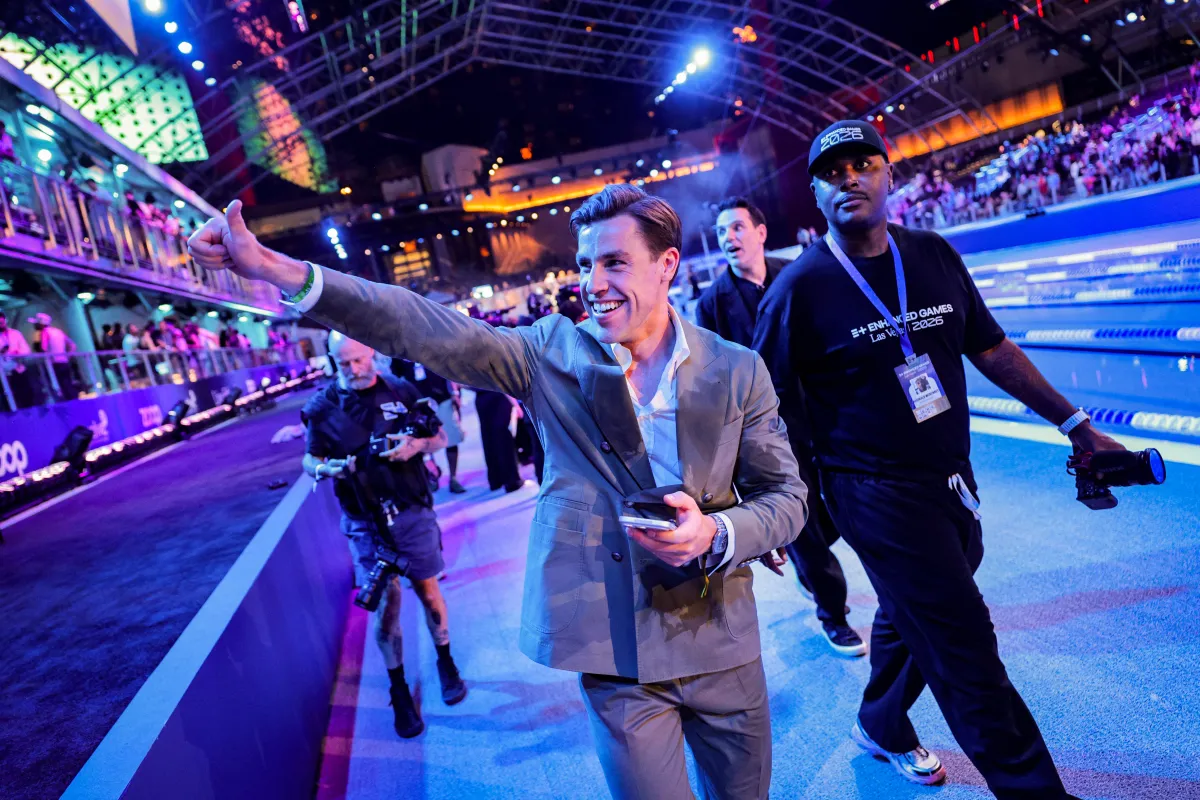
The day of the games, May 24th, unfolds as a sweltering, kaleidoscopic blur of athletic prowess and cultural spectacle. A marvel of rapid construction, a $50 million open-air stadium has materialized in mere weeks, purpose-built for the express purpose of hosting the inaugural event. Within its impressive confines lie a pristine track, shimmering swimming pools, and an expansive pavilion dedicated to the weightlifters. The surrounding risers are packed with an enthusiastic audience, their cheers cutting through the hot desert sun.
Yet, for all its Olympic-like infrastructure, the atmosphere is a curious hybrid, less serious sporting event and more a flamboyant blend of *America’s Got Talent*, WWE, and the epic grandeur of *Gladiator*. The stands are awash with youthful, colorful herds of beautiful influencers, adding a layer of curated glamor to the proceedings. A booming announcer narrates the day’s events, lending an air of theatrical drama, making it feel vaguely like we’re all sitting court side at WrestleMania. As evening descends, the quintessentially Vegas band, The Killers, takes the stage for a brief closing concert, cementing the event’s entertainment-first ethos.
Throughout the day, athletes stalk the grounds like mythical titans, their unnaturally sculpted muscles glistening with an almost otherworldly sheen in the sunlight. Maximilian Martin, ever the diligent host, moves purposefully through the crowds in his increasingly sweat-soaked suit, often rushing to the pool to embrace victorious swimmers. Christian Angermayer maintains a tranquil, breezy presence, his contented smile a constant fixture as he briefly visits the press tent for a round of glad-handing. Other prominent figures from the tech world also make an appearance, notably Bryan Johnson, the mega-wealthy biohacker known for his extreme longevity pursuits. Despite lacking any discernible professional athletic background, Johnson assumes the role of a Charles Barkley-esque commentator, offering his insights on the unfolding spectacle. Later, he and his girlfriend (whose vagina Johnson regularly tweets about) are spotted near the media tent; Johnson’s attire evokes a peculiar resemblance to the “Sleepytime Bear” from Celestial Seasonings, a surreal touch to an already surreal day.

The New Breed of Athletes: Pushing Boundaries
Amidst the vibrant, often bizarre, backdrop of the Enhanced Games, the actual competitions prove genuinely thrilling. The athletes participating broadly fall into a couple of distinct categories, each driven by unique motivations to compete in this environment of unchecked human potential. One such figure is James Magnussen, a retired swimmer from Australia with Olympic medals to his name. For Magnussen, the Games represent a tantalizing opportunity to reignite his competitive spirit, to test the limits of what his body can achieve when freed from the constraints of traditional anti-doping regulations. He embodies the sentiment that for some, the Enhanced Games are a chance at a second career, or a validation of personal potential that traditional sports deemed off-limits. These athletes, whether former champions or aspiring newcomers, willingly embrace the use of performance-enhancing substances, not as a shortcut to illicit gains, but as a legitimate pathway to pushing human boundaries, all under the banner of “medically supervised” enhancement championed by Martin and Angermayer. The allure is clear: a platform where the only limit is the body’s capacity to adapt, supported by scientific intervention.
Ethical Currents and Regulatory Tides
The underlying currents beneath the spectacle of the Enhanced Games reveal deeper questions about ethics, regulation, and the future of human biology. The peptide industry’s reliance on a legal “gray zone” creates an environment ripe for both innovation and potential risk. While companies like Superpower strive to stay within FDA-approved parameters, others, emboldened by the prospect of “first-to-market” advantage, reportedly delve into less regulated compounds. This dichotomy highlights a critical tension: the promise of enhanced human health and performance versus the inherent dangers of unsupervised chemical use. Martin’s argument for a “safe and medically supervised way” directly confronts the criticism that such endeavors could lead to widespread, uncontrolled experimentation.
The rise of “looksmaxxing” among teens and young adults, often driven by a superficial social media culture, further complicates this narrative, blurring the lines between genuine health improvement and vanity-driven self-alteration. The popularity of figures like Joe Rogan and Andrew Huberman in platforming these discussions signifies a public appetite for understanding — and perhaps adopting — these new frontiers, even as regulatory bodies struggle to keep pace with rapid scientific advancements and shifting cultural norms. The Enhanced Games, in this context, serve as a potent symbol of a society grappling with its own definition of natural ability, fairness, and the permissible limits of human intervention.
Bottom Line
The Enhanced Games and the surrounding peptide industry represent a bold, controversial, and deeply capitalistic plunge into the future of human performance. Driven by a potent blend of Silicon Valley ambition, a growing fitness culture, and the pervasive influence of social media, the pursuit of “enhancement” is moving from the shadows into a brightly lit, openly celebrated arena. While proponents like Martin and Angermayer champion a “medically supervised” path to unlocking human potential and profitability, the legal “gray zone” and the ethical implications of normalizing such practices remain complex and largely unresolved. The spectacle in Las Vegas is more than just a sports event; it is a vivid demonstration of a society grappling with the boundaries of human nature, health, and what we are willing to embrace in the quest for the “enhanced” self.
Key Takeaways
- Radical Redefinition of Sport:The Enhanced Games boldly challenges traditional anti-doping policies, positioning itself as a platform for athletes to compete with pharmacological support, aiming to unlock new frontiers of human performance.
- A Spectrum of Motivations:Participants range from openly “enhanced” athletes seeking safer competitive environments and personal bests, to “clean” competitors like Hunter Armstrong driven primarily by financial incentives, highlighting the complex allure of this controversial event.
- Spectacle vs. Substance:While culminating in a dramatic world record, the inaugural event in Las Vegas often felt more like a show than a “titanic extravaganza,” raising questions about its long-term viability, its philosophical underpinnings, and the blend of scientific ambition with commercial spectacle.
Unleashed Potential: Inside the Divisive World of the Enhanced Games
In the glittering, neon-soaked heart of Las Vegas, a new chapter in athletic competition is attempting to write itself, one fueled by a radical premise: what if performance-enhancing drugs weren’t just permitted, but openly embraced? This is the controversial vision behind the Enhanced Games, an event that dares to challenge the very foundation of traditional sports by allowing — even encouraging — its competitors to leverage pharmacological advantages in pursuit of unprecedented human achievement.
The brainchild of Maximilian Martin, the Enhanced Games positions itself not merely as a sporting event, but as a crucible for scientific breakthrough and human advancement. Martin, Co-Founder & CEO, champions a future where natural limitations are overcome, and the full spectrum of human physical capability, with scientific augmentation, can be explored. This philosophy, however, immediately plunges the Games into a heated global debate, pitting advocates of “unlocked potential” against staunch defenders of clean sport and ethical competition.
The Athletes: A Spectrum of Enhancement and Ambition
The roster of athletes at the Enhanced Games is as diverse as their motivations, painting a nuanced picture of the allure and complexities of this groundbreaking event.
The Peptide Proponent: Cody Miller
Among the more vocal supporters of enhancement is American Olympic swimmer Cody Miller, a bronze medalist whose physique once dominated online discussions. Miller openly endorses the peptide industry, having previously stated that a combination of peptides and testosterone made him feel “18 again.” His participation here, however, didn’t translate into record-breaking performances, as he placed last in two races, underscoring that even with enhancement, victory remains elusive and dependent on myriad factors.
The Openly Enhanced: Hafthor “Thor” Bjornsson
Then there’s the colossal figure of Hafthor “Thor” Bjornsson, the Icelandic strongman recognizable to millions as Ser Gregor Clegane fromGame of Thrones. Bjornsson, a competitive weight-lifter and bodybuilder, has candidly admitted to extensive past steroid use. For him, the Enhanced Games offer a unique proposition: an opportunity to pursue performance enhancement under closer, potentially safer, supervision—a striking commentary on the hidden world of doping in sports. During the games, the atmosphere crackled with anticipation as Bjornsson attempted a world record deadlift of 1,135.4 pounds, a feat that, despite his immense strength, ultimately proved beyond his grasp.

The Unenhanced Pragmatist: Hunter Armstrong
In stark contrast to Miller and Bjornsson are athletes like American swimmer Hunter Armstrong, who abstained from any supplemental intake. When questioned about his participation, Armstrong’s answer was refreshingly direct: money. With Olympic ambitions, he carefully navigates the Enhanced Games to avoid jeopardizing his record and future opportunities, driven by a personal aversion to doping. “The Olympic movement is something that is very important to me,” Armstrong explained to journalists. “Outside of personal reasons, if I were to go into some kind of protocol I would lose that opportunity.” Despite his ‘clean’ status, Armstrong, like several other unenhanced competitors, proved that raw talent and training could still triumph, winning his race in the 50-meter backstroke.
The Spectacle Unfolds: Moments of Glory and Grasp
The day’s events proceeded at a measured pace, and despite the organizers’ grand promises of a “titanic extravaganza of unlocked human potential,” the actual spectacle, while entertaining, often struggled to rival the sheer gravitas of an Olympic event or the pulsating energy of a major football game. Yet, it delivered its own moments of drama.
The evening culminated in a conveniently timed high-point: the final race, the men’s 50-meter freestyle, delivered the Enhanced Games’ first and only world record. Kristian Gkolomeev, a towering Greek swimmer standing six feet, eight inches tall, sliced through the water in a blistering 20.81 seconds, eclipsing the previous record by a mere 0.07 seconds. The venue erupted; lights blared red in a game show-esque frenzy of celebration, swimmers pumped their fists, and Martin, ever the showman, rushed the deck in his suit to embrace the dripping Gkolomeev, a tangible symbol of his vision briefly realized.

The Future, Enhanced: Beyond Health and Into Vanity?
Critics of the Enhanced Games often argue that its true motivations are financial, not scientific. Yet, it’s hard to ignore another pervasive undercurrent: vanity. America’s fitness culture frequently blurs the lines between health and self-aggrandizement, and the Enhanced Games, a flamboyant pageant of this principle, fits seamlessly into an era of heightened self-regard. The choice of Las Vegas, “Sin City,” hardly screams “health.” It’s a locale synonymous with spectacle, consumption, and fleeting moments of glory, where individuals often gamble their futures for immediate gratification—a metaphor for the very ethos of enhancement.
Similarly, the act of injecting oneself with drugs for muscle mass often appears less about long-term wellness and more about an immediate aesthetic or performance boost, with potential future health consequences sidelined. For the organizers, the glory lies in birthing a new industry, commemorating it with an extravagant ritual meant to herald “scientific breakthroughs” and “human advancement”—and, undeniably, significant revenue. Their gamble, much like that of many participants, seems rooted in the immediate promise rather than the distant future.
As the three-day extravaganza drew to a close, and the press corps retreated to the fluorescent-lit media center, a final, almost poetic encounter unfolded. Around midnight, exhausted and reflective, I found myself in a public bathroom, where I unexpectedly ran into Maximilian Martin. He was meticulously adjusting a pristine suit, likely preparing for a late-night press conference. The situation was awkward, a silent summation of the surreal 72 hours. “Congratulations,” I offered, a simple, tired acknowledgment as I made for the door. He nodded briefly, murmuring, “Thank you,” before turning back to his reflection, perhaps admiring the nascent reflection of a dream realized, or simply preparing for the next act.
Bottom Line
The Enhanced Games represents a bold, polarizing experiment in sports, challenging ethical boundaries and traditional notions of fair play. While it delivered a historic world record and showcased a diverse array of athlete motivations, the event ultimately felt like a nascent movement grappling with its own grand promises, oscillating between scientific ambition and the undeniable pull of spectacle and commercialism. Its long-term impact on sports, science, and the very definition of human potential remains to be seen, but it has undeniably opened a Pandora’s Box that will continue to provoke discussion and redefine the limits of competition.