
Unlock the Editor’s Digest for free
Roula Khalaf, Editor of the FT, selects her favourite stories in this weekly newsletter.
Key Takeaways
- **Geopolitical Pressures & Climate Change Drive Arctic Shipping Surge:** Escalating tensions in traditional maritime chokepoints like the Red Sea and Panama Canal, coupled with rapidly melting Arctic ice, are pushing shipowners towards the Northern Sea Route (NSR), drastically increasing transits and reshaping global trade arteries.
- **Cost-Benefit Trade-offs for Global Supply Chains:** While the NSR offers substantial time and fuel savings – shaving weeks off Asia-Europe voyages – it introduces significant operational, insurance, and environmental risks, creating a complex calculus for logistics planners and commodity traders.
- **Strategic Implications and Market Shifts:** Russia and China are primary beneficiaries, leveraging the NSR for energy exports and direct trade links, respectively. This strategic pivot could reconfigure global energy markets, impact freight rates, and spur investment in Arctic infrastructure, while challenging traditional maritime powers.
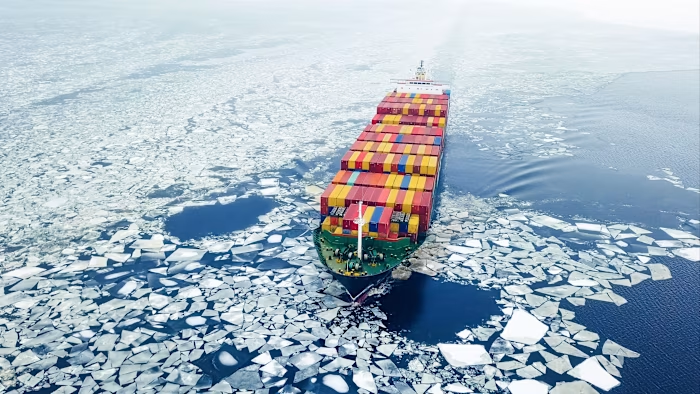
Shipping through the Arctic has reached record levels, a stark indicator of how rapidly converging geopolitical pressures and accelerating climate change are reshaping global maritime trade. The Northern Sea Route (NSR), once a marginal pathway, is rapidly gaining traction as melting sea ice and acute disruptions at established global chokepoints push shipowners to seek alternative, often faster, routes.
Voyages via the NSR hit an unprecedented 133 last month, a more than fourfold increase compared to 2022 and a significant 46 per cent jump from August figures, according to data from Lloyd’s List Intelligence. This exponential growth underscores a profound shift in shipping strategies, driven by a complex interplay of cost efficiencies, supply chain resilience, and strategic national interests.
Almost half of these transits were made by Russian-flagged ships, a clear demonstration of Moscow’s strategic pivot to leverage its Arctic coastline for economic and geopolitical advantage, particularly for its burgeoning energy exports. Concurrently, Chinese vessels are increasingly utilising the route, seeking a more secure and efficient corridor to European markets. This move comes amid persistent instability in the Middle East and the Red Sea, which has severely impacted the traditional Suez Canal route – a critical artery for Asia-Europe trade.
“It’s worth watching how the use of this route develops as government and operators increasingly look for alternative shipping lanes with less exposure to geopolitical disruption,” noted Bridget Diakun, maritime intelligence and research director at Lloyd’s List. Her sentiment highlights a growing market imperative: the need to de-risk supply chains from volatile regions, even if it means venturing into challenging new territories.
The economic appeal is undeniable. The Chinese container ship, Dubai Tower, for instance, dramatically trimmed its voyage from Qingdao to the UK port of Felixstowe in September, completing the Arctic journey in just 24 days. This stands in stark contrast to the 40 or more days it would typically take via the Suez Canal or the longer Cape of Good Hope route, translating into substantial savings in fuel costs, crew wages, and faster inventory turnover for businesses. Another vessel from the same company replicated this feat, setting out from Ningbo to Felixstowe via the Arctic on September 27, further cementing the commercial viability of the route for container shipping.
September typically marks the peak season for Arctic sea routes, as sea ice reaches its annual minimum, rendering these waters navigable even for ships without dedicated icebreaker capabilities. Scientific data indicates a worrying trend: the northern sea ice experienced its largest single-year winter decline in 2025 since satellite records began, and has remained at historic lows. This continued melt, as confirmed by University of Southampton researchers, directly correlates with the expanded navigational window and increased accessibility of the NSR, turning a climate crisis into an economic opportunity for some.
The enhanced appeal of the Northern Sea Route is amplified by significant disruptions at critical global chokepoints. The Bab al-Mandeb Strait, at the entrance to the Red Sea, faces ongoing threats from Yemen’s Houthi rebels, impacting a vital route for global shipping, including Saudi Arabian oil exports. This insecurity has led to higher insurance premiums and longer diversions around the Cape of Good Hope, adding days and significant costs to voyages. Simultaneously, the Panama Canal, a linchpin for East-West trade, has been grappling with severe drought conditions this year, leading to unprecedented draft restrictions and extensive vessel backlogs, further exacerbating global supply chain pressures.
Historically, liquefied natural gas (LNG) carriers have been primary users of the NSR, particularly for transporting gas from Russia’s Yamal and Arctic LNG 2 gas plants to Asian and European markets. This route offers a direct and efficient path for Russia’s Arctic energy resources, reinforcing its position as a major global energy supplier. However, recent data points to a diversification of cargo. There has been a notable uptick in bulk cargo vessels, typically transporting commodities such as grains, iron ore, and other raw materials. The number of bulk carriers transiting the route reached 29 in September, up from 18 in August and a previous high of 12 in September last year. Furthermore, Lloyd’s List data reveals a record number of crude oil tankers also deploying on the route, signaling a broader embrace of the NSR across various commodity sectors.
Operational control over the NSR largely rests with the Rosatom-controlled Northern Sea Route administration, which divides the route into 28 sections with varying guidelines based on dynamic ice conditions. The Russian state-controlled company issues the necessary permits, asserting a significant degree of sovereign control and influence over who can traverse this strategic waterway. This centralized control adds another layer of complexity for international operators, balancing commercial advantages against geopolitical considerations.
However, the burgeoning use of the Arctic route is not without significant market risks and environmental concerns. Insurance companies and environmental groups have issued stern warnings about the escalating potential for a major accident. The harsh, remote environment of the Arctic presents formidable challenges for search and rescue operations and, critically, for effective clean-up capabilities. A major oil spill, reminiscent of the 1989 Exxon Valdez disaster off the Alaskan coast, which took years to mitigate and left lingering residues, would be catastrophic in the pristine and ecologically sensitive Arctic. The financial and reputational costs for any shipping company involved would be immense.
Romain Troublé, executive director of the Tara Ocean Foundation, highlighted another critical environmental risk: even minor oil spills could accelerate global warming. Black oil droplets on ice absorb more sunlight, thereby increasing melting rates, creating a feedback loop that exacerbates climate change. “The people who will use this route are not only Russia and China . . . any companies that can go through this route in the future will have an impact on the Arctic,” he cautioned. “If you and I are buying goods that are using this path, we are contributing to the dangers of it.” This raises significant questions for corporate ESG (Environmental, Social, and Governance) strategies and consumer awareness.
Beyond environmental hazards, the operational dangers for mariners are substantial, given the unpredictable weather and extreme conditions. Tom Mellor, head of technical partnering at the UK Hydrographic Office, a key provider of geospatial data to ships, pointed out that standard navigational equipment can fail at far-northerly latitudes. “Above or below that the world becomes much more curved and the display of that data requires a different methodology to make sure it is positioned correctly on that chart,” he explained. “I wouldn’t want to go on board if you didn’t have a proper system that was showing the chart correctly.” This underscores the need for specialized vessels, highly trained crews, and advanced navigational technologies, all of which add to operational costs and complexity for market participants.
Market Impact
The accelerated adoption of the Northern Sea Route carries profound market implications across several sectors. For global supply chains, it offers a potential hedge against disruptions in the Suez and Panama Canals, leading to reduced transit times and lower fuel costs, which could ultimately temper freight rates and consumer goods inflation. However, the associated higher insurance premiums for Arctic operations and the substantial investment required for ice-class vessels or icebreaker escorts will offset some of these savings. Commodity markets, particularly for LNG, crude oil, and bulk goods, stand to benefit from more direct and potentially cheaper routes, influencing global price arbitrage and energy security dynamics. The strategic control exerted by Russia over the NSR grants it significant leverage, potentially impacting geopolitics and trade relations. For the shipping industry, it necessitates investments in specialized fleets and advanced navigation technology, while exposing operators to heightened environmental, regulatory, and reputational risks. Investors will need to weigh the commercial efficiencies against the significant environmental liabilities and the undeveloped emergency response infrastructure in the Arctic, potentially driving demand for specialized insurance products and influencing ESG-focused investment decisions in logistics and energy sectors. This evolving landscape signals a major recalibration of global trade arteries, with both significant opportunities and formidable challenges for market participants.
Cartography by Steve Bernard