
Access the Editor’s Summary without charge
Each week, Roula Khalaf, the FT’s Editor, compiles her top articles for this regular bulletin.
Marine vessels connected to Russian proprietors have seen their worth decrease by €580 million subsequent to their seizure throughout Europe following Moscow’s comprehensive incursion into Ukraine; many of these have been left to decay in various ports.
Cecil Wright, a luxury vessel brokerage, discovered that fifteen confiscated yachts, whose value would stand at €3.5 billion had they been properly kept, are presently valued at €2.9 billion. The overall count of Russian-affiliated vessels that have been seized remains uncertain.
Among the vessels, most of whose proprietors have faced punitive measures due to supposed ties with Moscow, is the Tango, belonging to oligarch Viktor Vekselberg, which was held in Spain. Additionally, the 143-meter A was confiscated, with Italy asserting its ownership by Andrey Melnichenko, formerly Russia’s wealthiest individual. (Melnichenko’s legal representatives stated in 2024 that he did not possess personal ownership of the craft, which they claimed was managed by a trust entirely unrelated to him.)
“Ordinarily, that vessel would be removed from the water annually . . . Its engines would all be serviced, and water, fuels, and lubricants would continuously flow through it,” stated Chris Cecil-Wright, the brokerage’s originator. “Vessels are dynamic entities; they do not fare well when stationary.”
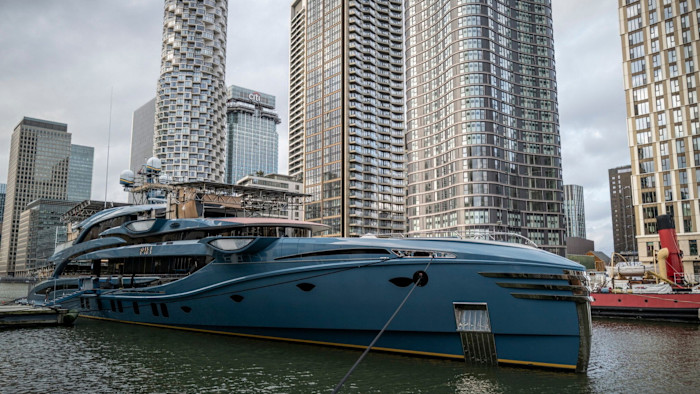
Among these, the 58-meter-long Phi is berthed in London’s Canary Wharf, adjacent to an Italian eatery and overshadowed by residential high-rises, appearing in noticeably deteriorated condition. Protective scaffolding has been put up around the vessel to shield it from falling fragments, and several of its portholes have been painted opaque.
The UK government announced that Phi had been seized under the Russian punitive measures framework approximately a month following Vladimir Putin’s comprehensive invasion of Ukraine. Sergei Naumenko, the vessel’s stated beneficial owner and a businessman, is not subject to these restrictions, nor is its actual proprietor, Vitaly Vasilievich Kochetkov, as revealed by the FT in 2022. This governmental move was atypical, as sanctions typically target a specific person, thereby impacting their possessions.
Benjamin Maltby, a legal expert specializing in superyachts, noted that while no prohibition exists against servicing Phi, the sanctions system forbids its movement, effectively preventing substantial upkeep. He further explained that regulations vary throughout Europe: certain vessels held in Italy have subsequently undergone maintenance.
Duncan Bateson, a partner with the legal practice Hannaford Turner, explained that should a vessel be confiscated due to its owner being subject to sanctions, “companies providing maintenance services would violate those restrictions if they entered into agreements with or received remuneration from the individual under sanction.”
He further mentioned that a person affected by sanctions may seek governmental authorization for a permit to maintain their vessel, though the expenses and likelihood of approval remain uncertain.
Cecil Wright’s valuations for the vessels in optimal condition were derived from market transaction information for similar craft and their replacement expenditures. Subsequently, these amounts were reduced by considering elements such as obvious degradation, accounts from individuals who had been aboard some of the ships, and the consequences of neglected routine servicing.
Despite the vessels having been seized, it would prove challenging for governmental bodies to liquidate them, confiscate the resulting funds, or allocate them towards restitution for Ukraine, according to Steve Goodrich, who leads research and inquiries at Transparency International.
He stated, “Transitioning from the factual foundation we possess for freezing these assets via sanctions to genuinely reclaiming them through asset recovery legislation is far from simple.”
He elaborated that punitive measures served “not as a mechanism for asset retrieval” but rather as an effort “to compel individuals subject to sanctions to alter their conduct.” This approach was deemed appropriate “even if the outcome is a depreciation in the worth of the assets as they are allowed to corrode in harbors.”
Cecil Wright’s findings indicate that a minimum of thirty-six additional vessels throughout Europe are owned by sanctioned persons yet have not been confiscated.
“Witnessing the deterioration of these vessels is regrettable,” Cecil-Wright remarked. “However, when one observes structures being bombarded in Ukraine, it becomes trivial by comparison.”
Further contributions provided by Giuliana Ricozzi and Carmen Muela