
Keep abreast of complimentary notifications
Merely register for the Global Economy myFT Digest — provided straight to your electronic mailbox.
Is the conflict in Iran destined to be brief? Such was the assurance given to the globe by US President Donald Trump only a handful of days prior. Nonetheless, his defence secretary, Pete Hegseth, already appears to be retracting that forecast, cautioning during the previous week that matters are “speeding up rather than slowing down” as he pledges additional ordnance and combat aircraft. Hostilities have expanded across the region and even further afield, marked by the submersion of an Iranian frigate near Sri Lanka.
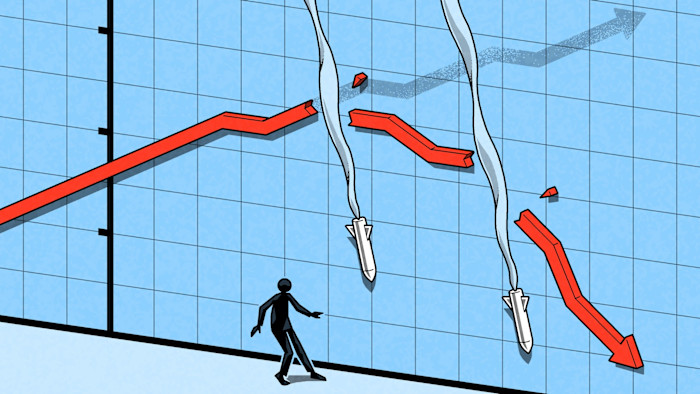
What will be the ultimate conclusion? This might hinge less on unmanned aerial vehicles, vessels, and heavy weaponry, and more on logistical networks, rising prices, and credit markets. Dating from the commencement of the conflict in Ukraine in 2022, it has become apparent how the strategic deployment of energy and commerce can trigger inflationary surges, leading to rapid bond divestments. Such occurrences, consequently, possess the capacity to alter the trajectory of governmental affairs.
The British government bond crisis, which brought about the swift conclusion of Liz Truss’s time in office, unfolded partly within this framework. Similarly, a profound shift in European perspectives regarding industrial strategy and military expenditure transpired, following Russia’s incursion into Ukraine and the United States’ worldwide trade duty dispute.
In a more recent development, apprehension in the bond market stemming from US customs duties and China’s limitations on rare earth exports engendered the “Taco” transaction, since Trump found himself compelled to suspend the majority of his retaliatory duties amidst substantial divestments in Treasury securities, which dramatically elevated yields. Equities and the US currency likewise depreciated consequently, signaling an uncommon threefold market decline.
Therefore, what signals are financial markets presently conveying? For what duration might this conflict persist? My estimation: beyond your desired timeframe.
Though the United States possesses motives for seeking a swift cessation to the hostilities, considering that escalating gasoline costs will negatively impact Republicans during the period leading up to the November midterm polls, the Iranian government arguably stands to benefit significantly by extending the hardship through unmanned aircraft assaults and aggressions against neighboring states in the Gulf. Such actions would further destabilize power markets, propelling global price increases. As stated by analyst Luke Gromen in a recent communiqué, “Iran is not required to overcome the US armed forces; it merely needs to vanquish the US Treasury market”, the rationale suggesting that a substantial decline in the bond market would compel the US to retreat.
Is such an outcome probable? And what duration would it necessitate? Undoubtedly, it would exceed a mere couple of weeks, and the entirety of the situation is not within Trump’s control. Indeed, American fuel costs have risen (albeit not to the same extent as in Europe) and the return on the 10-year Treasury note has once again surpassed 4 percent, an occurrence that will dampen a burgeoning housing market rebound in the United States. Furthermore, it will dismay certain investors who recently regarded Treasury bonds as a safeguard, and numerous others who foresaw interest rate reductions which may now not materialize. Nevertheless, the greenback retains its strength, given that an energy crisis impacts Europe and developing market importers more severely in the immediate future.
Nonetheless, as demonstrated by Ukraine, inflation does not manifest as a solitary impact. Its initial effects are felt in fuel, subsequently in foodstuffs, partly via agricultural nutrients (which are reliant on substantial energy inputs) and other commodities with high petroleum content. “The increase in costs [due to the conflict] is presently advancing through raw materials and distribution channels, compounded by the prolonged transportation periods that are creating liquidity strain for specific enterprises,” observes Matt Lekstutis, a principal at Efficio, a logistical network advisory firm situated in London. Industries most susceptible comprise petrochemicals, polymers, and aluminum.
Concurrently, China, undoubtedly the foremost buyer of Iranian petroleum, might still exploit its inherent geoeconomic strength, derived from having acquired harbors across the globe and from “commanding the majority of vessels worldwide,” as Lekstutis indicates. Should this occur, maritime transport expenses and commodity price escalation in numerous additional sectors could surge dramatically.
Furthermore, existing susceptibilities within worldwide bond markets must be considered. As illustrated by the 2026 OECD debt assessment, published during the prior week, brief-term instruments such as Treasury notes have emerged as “a progressively significant means of funding” for market actors, “exceeding fixed-income securities in issuance quantity and presently constituting 15 percent of the total outstanding debt.”
Concurrently, a greater proportion of governmental and corporate debt instruments are now possessed by short-horizon, price-responsive investors — notably, speculative funds — compared to previous periods. Their “inclination to divest amidst a decline,” especially during international political incidents, coupled with their obscurity, renders markets especially susceptible. As highlighted by the writers, “speculative funds typically divest holdings and exit the market precisely when monetary assistance is most crucial.” Augment this with additional hazard elements, such as the volume of digital currency within the fiscal framework, and one can readily envision a swiftly developing financial markets upheaval.
While contemporary geopolitics presents significant complexity, geoeconomics proves to be even more intricate. Indeed, the United States’ confiscation of Venezuelan and Iranian petroleum carries a clear disadvantage for China, a factor undoubtedly integrated into Trump’s military strategy. However, should the protracted consequence be an elevation in bond returns, an increase in inflation (which America’s indigenous energy provisions will only partially alleviate), and an expansion of US fiscal shortfalls, eventually provoking a substantial Treasury market decline, the American and worldwide economies will endure considerably. I apprehend, regrettably, that this conflict and its financial implications will persist alongside us for an extended duration.
rana.foroohar@ft.com