
Gary Kaltbaum, President of Kaltbaum Capital Management, examines the strain on semiconductor and artificial intelligence equities, the economic ramifications of elevated crude oil and fuel expenses, and fiscal strategy guided by Federal Reserve Chair Jerome Powell, as reported on ‘Varney & Co.’
Fuel costs are surging rapidly across the country, exacerbating the strain on already tightened family finances, asunrest involving Iranpropels upward worldwide crude expenses.
Costs are escalating in virtually all areas, with certain territories already significantly surpassing the countrywide mean.
By April 1, the country’s mean for standard fuel reached $4.06 per gallon, marking an increase of $1.08 from the previous month, per AAA data.
Along the Pacific seaboard, motorists are experiencing peak expenses, with prices climbing to $5.89 per gallon in California and $5.35 in Washington.
TRUMP VOWED REDUCED EXPENSES; THE IRANIAN STRIFE NOW JEOPARDIZES THAT COMMITMENT
Along the Atlantic seaboard,fuel costsare nearing or surpassing $4 in numerous locales, such as $4.19 in Washington, D.C., and $3.98 in New York.
Within the Central United States, Illinois is notable at $4.25 per gallon, while a significant portion of the area stays within the mid-$3 range. Southern states generally remain more economical, though costs are escalating. Texas typically sees about $3.77, and South Carolina $3.90, whereas Florida’s rate is elevated at $4.21.
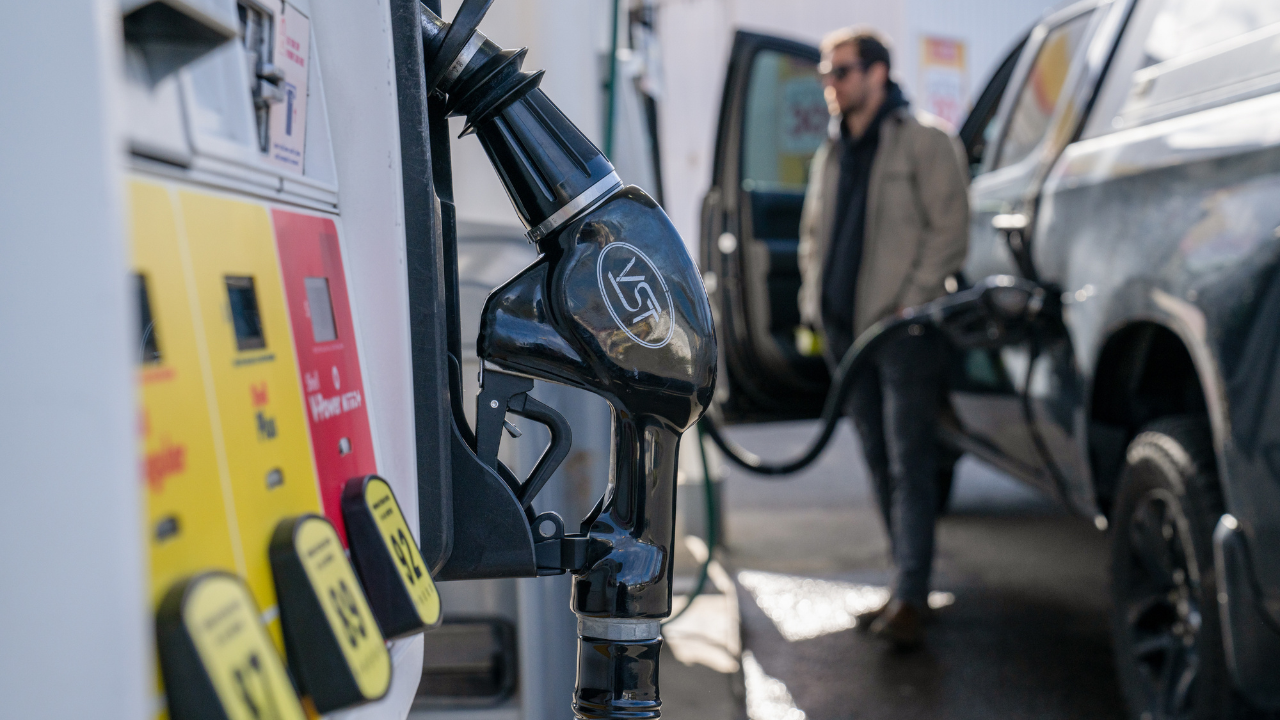
An individual is observed refueling their lorry at a petrol depot.(M. Scott Brauer/Bloomberg via Getty Images)
Concurrently, diesel is exceeding gasoline, owing to its connection with cargo transport and manufacturing sectors; this implies that rises might propagate through distribution networks, elevating expenditures throughout the financial system.
Diesel is presently valued at $5.49 a gallon, marking a hike of $1.73 compared to the previous month, per AAA data. This level exceeds $5, a figure not seen since December 2022, as the Iranian conflict persists in unsettling worldwidepowerprovisions.

More intrinsically linked to cargo and manufacturing, diesel is escalating more quickly than gasoline, magnifying the potential for increased expenditures throughout distribution networks and the overall financial system.(Rebecca Noble/Bloomberg/Getty Images)
Patrick De Haan, who leads petroleum analysis at GasBuddy, stated, “Fuel costs might certainly decline, yet it is very improbable they will revert to their pre-conflict benchmarks for an extended period, partially owing to the duration required for worldwide stockpiles to replenish.”
De Haan noted that cyclical elements are also disadvantaging motorists. Consumption commonly increases as summer approaches, and processing plant upkeep coupled with the transition to warmer weather fuel mixtures can additionally elevate costs.
ACCESS FOX BUSINESS MOBILE VIA THIS LINK
As congressional elections near, the surge in power and accommodation expenses might present an obstacle for Chief ExecutiveDonald Trump, who has committed to enhancing living accessibility for US households.