
Key Takeaways:
- Geopolitical Risk Reassessment:The potential shift in U.S. diplomatic leadership from politically connected envoys to a seasoned intelligence director signals a more structured, potentially less erratic, approach to the Russia-Ukraine conflict. Markets, inherently adverse to uncertainty, may perceive this as a marginal positive for geopolitical stability, potentially easing the risk premium embedded in regional and global assets, particularly energy and agricultural commodities, though Russia’s steadfast position remains the primary hurdle.
- Impact on Sanctions & Investment Climate:A more focused diplomatic push could influence the long-term efficacy and potential evolution of sanctions against Russia. While immediate changes are unlikely, a perception of renewed, serious engagement might encourage cautious reassessment by international investors regarding long-term capital deployment in Eastern Europe and Russia, contingent on concrete progress towards de-escalation and a clearer pathway to stability.
- Broader Market Focus Shifts:Jared Kushner’s reported desire to pivot to Middle East diplomacy underscores a reallocation of high-level U.S. diplomatic capital. This suggests the White House is juggling multiple critical geopolitical flashpoints, each with significant, distinct market implications – from oil prices and defense sector performance to technology investments and regional stability indices, potentially influencing global capital flows and risk appetite across different theaters.
U.S. Signals Diplomatic Reset for Ukraine War: Implications for Global Markets
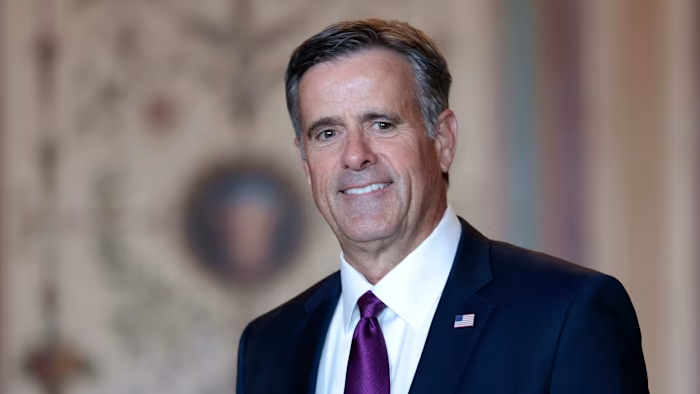
In a development keenly watched by international observers and, more critically, by global markets sensitive to geopolitical stability, CIA director John Ratcliffe is reportedly preparing to assume a more prominent role in U.S. negotiations concerning the protracted conflict between Russia and Ukraine. This strategic recalibration, communicated by U.S. officials to their European counterparts, aims to inject new life into diplomatic efforts that have largely stagnated over the past four-and-a-half years – a period that has cast a persistent shadow over European economic forecasts, global commodity prices, and the broader geopolitical risk premium on assets.
The potential shift entails a paring back of the involvement of US special envoy Steve Witkoff and President Donald Trump’s son-in-law Jared Kushner, who have hitherto spearheaded the talks with Moscow and Kyiv. Their ‘freewheeling’ approach, often likened to real estate negotiations rather than traditional statecraft, has, according to numerous reports, been met with frustration not just from European allies, but also from both Russian and Ukrainian camps. For financial markets, such an unconventional diplomatic style can translate into increased volatility and uncertainty, making it harder to price geopolitical risk accurately. Erratic signals or a perceived lack of coherent strategy can deter foreign direct investment (FDI) in emerging markets, sustain higher borrowing costs for regional economies, and maintain a higher risk premium on assets tied to the conflict zone.
Officials close to Ratcliffe have indicated he will adopt a larger role in shuttle diplomacy, a remit previously handled by Witkoff and Kushner, while leveraging his extensive network within intelligence communities in both nations. This dual-track approach, combining overt diplomatic efforts with back-channel intelligence contacts, could be seen by markets as a more pragmatic, discreet, and potentially more effective strategy for conflict resolution. A more professionalized, less public-facing diplomatic effort might reduce the incidence of market-moving speculative headlines. The White House and the CIA have, as yet, declined to comment on this prospective change, with sources suggesting Trump has yet to finalize the decision, keeping markets in a holding pattern.
The prospect of Ratcliffe’s elevated role has resonated positively in European capitals, which have grown increasingly desperate for tangible progress. The prolonged stalemate with President Vladimir Putin, who has steadfastly refused to moderate his hardline demands, has exerted considerable economic pressure on the continent. Europe’s deep reliance on Russian energy supplies means that any perceived de-escalation or pathway to resolution could significantly ease concerns over energy security and pricing, directly impacting industrial output, inflation rates, and household budgets across the Eurozone. Conversely, continued diplomatic paralysis perpetuates the energy market’s geopolitical risk premium, keeping natural gas and crude oil futures elevated and contributing to inflationary pressures.
Discussion of a shake-up within the U.S. negotiating team began after U.S.-led peace brokering efforts faltered in late February. This diplomatic inertia was compounded by the Trump administration’s subsequent preoccupation with the escalating conflict in Iran, which erupted shortly after the last round of Ukraine talks. For global investors, the simultaneous management of multiple international crises, particularly those involving major oil producers or strategic choke points (like the Strait of Hormuz in the case of Iran), often signals heightened systemic risk and can lead to capital flight towards safer haven assets like the U.S. dollar, Treasury bonds, or gold, impacting global liquidity and equity valuations.
While Witkoff, a billionaire real estate investor and close confidant of Trump, is expected to retain his broader role as U.S. special envoy for peace missions, including those in the Middle East, the tug-of-war for leadership on the Ukraine brief highlights internal administration dynamics. Witkoff’s unorthodox methods, bypassing traditional diplomatic protocols, have reportedly alienated key stakeholders. Ukraine, for instance, felt he had not sufficiently pressured Putin to compromise, while Russia attributed blame to him for the failure of a summit with Trump in Alaska. From a market perspective, a perceived lack of gravitas or diplomatic finesse can undermine confidence in the sustainability of any potential agreements, leaving investors wary of committing long-term capital and maintaining cautious positions on regional stocks and bonds.
Despite Putin’s public praise for Witkoff, Moscow has privately hinted at an openness to a new U.S. approach. This subtle signal, if accurate, suggests that even the Kremlin recognizes the limitations of the current diplomatic configuration. The White House also explored appointing a new U.S. ambassador to Moscow this spring, aiming to establish an additional channel for dialogue – a move that, had it materialized, might have been interpreted by markets as a commitment to more robust and multi-faceted diplomatic engagement, potentially signaling a desire to de-escalate tensions on various fronts.
Ratcliffe’s unannounced visit to Moscow in late August, where he engaged with senior intelligence officials on the conflicts in Ukraine and Iran, as well as Russia’s “hybrid” threats to Europe, was initially downplayed by Trump as “sort of semi-routine.” However, Ukrainian intelligence subsequently briefed President Volodymyr Zelenskyy that Ratcliffe’s Moscow visit indicated his impending ascent to a more prominent role. The initial planning for a meeting between Ratcliffe and Putin, which was reportedly canceled after Ratcliffe delivered a sobering assessment of Moscow’s war efforts, underscores the high stakes involved. Such high-level intelligence exchanges, though often opaque, can significantly influence market sentiment by providing glimpses into the true geopolitical calculus behind public posturing, influencing risk assessments for defense sector stocks and cybersecurity firms.
Following Ratcliffe’s trip, Witkoff and Kushner visited Moscow and Kyiv, ostensibly to reaffirm their leadership on the Ukraine brief. Despite their reported optimism for resumed trilateral talks, sources familiar with the discussions indicated a lack of fresh proposals from the American side and no indication of a softened stance from Putin. “You can’t solve this by dipping in and out,” one source emphasized, highlighting the need for sustained, expert-led engagement on such a complex conflict. This perpetuates the market’s ‘wait and see’ attitude, particularly for sectors like agriculture, where Ukraine’s role as a major grain exporter means any prolonged conflict or unstable peace directly impacts global food prices, food security indices, and agricultural commodity futures.
Adding another layer of complexity, Yuri Ushakov, the Kremlin’s top foreign policy official, recently reiterated Putin’s position that an immediate ceasefire hinged on the U.S. ceasing all support for Ukraine – effectively demanding a Russian victory. This uncompromising stance remains the primary impediment to any market-positive resolution, maintaining a baseline of geopolitical tension. Furthermore, Kushner has reportedly expressed a preference to shift his focus to diplomatic efforts in Gaza and the U.S.-Israeli confrontation with Iran. This potential reallocation of top-tier diplomatic resources signals Washington’s broader geopolitical priorities, implying that while Ukraine remains important, other flashpoints demanding immediate attention are emerging. For markets, this means a continued need to monitor multiple fronts, each with its own set of risks to energy supplies, regional stability, and investment flows, particularly in the Middle East’s volatile energy and defense sectors.
Ukrainian officials, while maintaining “good working relations” with all U.S. envoys, voiced no preference for who Trump ultimately appoints, underscoring their assessment that “the problem is the Russians.” This sentiment encapsulates the core challenge for markets: regardless of who leads the U.S. diplomatic effort, the fundamental barrier to de-escalation and stability lies with Moscow’s intractable demands, ensuring that the geopolitical risk premium associated with the conflict remains a significant factor in global investment decisions and strategic planning.
Additional reporting by Anne-Sylvaine Chassany in Berlin
Market Impact:
The potential change in U.S. diplomatic leadership for the Ukraine conflict, while not a silver bullet, is likely to be met with cautious optimism by financial markets. A shift from a politically aligned, “freewheeling” approach to one led by a seasoned intelligence professional like Ratcliffe could signal a more disciplined, strategic, and predictable U.S. foreign policy. This could marginally reduce the geopolitical risk premium currently embedded in various asset classes, particularly energy futures (given Russia’s role as a major producer), agricultural commodities (due to Ukraine’s export capacity), and European equities. However, any significant positive market reaction remains contingent on concrete diplomatic breakthroughs, which appear challenging given Russia’s unwavering demands. Investors will be keenly watching for any signs that a new U.S. approach can genuinely unlock stalled negotiations or, conversely, if it merely signifies a reshuffling of deck chairs on a perpetually unstable ship. The broader implication of Kushner’s potential pivot to the Middle East also signals a recalibration of U.S. diplomatic attention, prompting markets to reassess risks and opportunities across multiple global hotspots simultaneously, potentially leading to shifts in capital allocation towards regions perceived to be gaining or losing Washington’s strategic focus, impacting sectors like defense, energy, and technology on a global scale.