
Unlock the White House Watch newsletter for free
Your guide to what Trump’s second term means for Washington, business and the world
Key Takeaways:
- **Geopolitical Risk Premium Remains Elevated:** Divergent US-Israeli objectives on Iran, coupled with US “America First” rhetoric, continue to fuel uncertainty in energy markets and defense spending, impacting investor sentiment towards regional stability.
- **Defense Sector Volatility & Strategic Alliances:** The contentious debate over F-35 sales to Turkey highlights strains within NATO and the broader Middle East power balance, directly influencing defense contractor valuations and global arms trade dynamics.
- **Long-term Regional Investment Hinges on Stability:** While initiatives like the Gaza plan and Abraham Accords offer potential for economic growth and infrastructure development, their stalled implementation underscores the significant political hurdles that continue to deter long-term foreign direct investment.
President Donald Trump’s recent declaration that Israel “wouldn’t survive” without the United States, made on the eve of his crucial meeting with Israeli Prime Minister Benjamin Netanyahu, has sent ripples across diplomatic circles and global markets alike. The remarks, seemingly downplaying concerns about the contentious sale of F-35 fighter jets to Turkey, set a complex backdrop for discussions that carry significant implications for energy security, defense spending, and overall investment sentiment in a volatile Middle East.
The highly anticipated meeting, the first between the two leaders since the initiation of a “war on Iran” earlier this year, arrives at a critical juncture where US and Israeli strategic interests in the region appear increasingly misaligned. Investors and analysts have closely watched these diverging trajectories, particularly after Trump unilaterally announced a ceasefire between the US and Iran in April – a move made before Israel had achieved its stated war objectives.
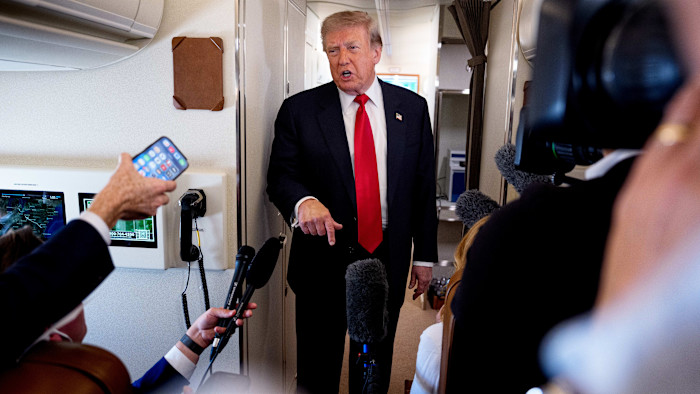
Trump openly acknowledged “a little difference” in his and Netanyahu’s military objectives, subtly hinting at ongoing tensions. His “America First” rhetoric, consistently emphasizing US generosity to allies, often translates into market speculation about shifts in defense burden-sharing and trade relationships. “Frankly, we’re being very nice to a lot of countries that would not survive without us. And you know who wouldn’t survive without us? Israel,” Trump told reporters, a statement that, while politically charged, resonates with investors monitoring the sustainability of US foreign aid and military support, which can influence credit ratings and economic stability in beneficiary nations. The implications for Israeli government bonds and the shekel’s strength against the dollar are palpable, as perceived US commitment directly impacts investor confidence.
Tuesday’s meeting, the eighth since Trump returned to office last year, also takes place amidst the somber occasion of Republican senator Lindsey Graham’s funeral. Graham, a staunch proponent of a robust stance against Iran and a key ally to Netanyahu in Washington, represented a more hawkish legislative faction. His passing could subtly shift the dynamics of congressional support for future military engagements, potentially influencing defense contractor stocks that thrive on a predictable pipeline of government contracts.
Netanyahu, departing for the US, confirmed that Iran would be “first and foremost” on the agenda, but “all issues” would be discussed. Market observers understood this to mean an overarching focus on regional stability and its economic underpinnings. A source briefed on the matter indicated Netanyahu’s intention to push for an expansion of US operations against Iran beyond the Strait of Hormuz, the critical waterway whose stability directly impacts global oil prices. The recent pause in US attacks on Iran, following 13 consecutive nights of bombing, saw a temporary easing of geopolitical risk premium in oil futures (Brent and WTI), illustrating the market’s immediate sensitivity to de-escalation. However, Netanyahu’s desire to pursue broader objectives – destroying Iran’s nuclear and ballistic missile capabilities and toppling its regime – suggests continued potential for significant market volatility, especially for shipping indices and energy sector equities.
A second major point of contention, with clear defense industry implications, is Turkey’s request to purchase advanced F-35 fighter jets from the US. Israel, currently the sole Middle Eastern nation possessing F-35s, views this prospect with alarm, as it would erode its crucial qualitative military edge (QME) over other regional powers. This QME is not merely a strategic advantage but a cornerstone of Israel’s defense posture, indirectly supporting its economic stability by deterring aggression. Any perceived weakening of this edge could lead to an outflow of foreign investment or increased defense spending, impacting Israel’s fiscal health.
Trump’s earlier statement this month, following a meeting with Turkish President Recep Tayyip Erdoğan in Ankara, that he would “certainly consider” selling Turkey the stealth jets, was met with strong opposition from Netanyahu. The Israeli premier argued that such a sale would “destroy the power balance in the Middle East.” This dispute highlights the complex interplay between US foreign policy, defense industry sales (Lockheed Martin, the primary F-35 contractor, watches these decisions closely), and regional power dynamics. Trump’s assertion that “nobody tells me what we should be selling and not [selling]” underscores a transactional approach to alliances that unnerves traditional partners and introduces uncertainty into global defense procurement markets.
Legally and politically, Turkey’s path to acquiring the F-35s remains fraught. Washington removed Turkey from the F-35 project in 2019 after Ankara took delivery of Russia’s S-400 air-defense system, fearing it would compromise NATO’s air defenses. Subsequent US sanctions on Turkey’s defense procurement agency, under the Countering America’s Adversaries Through Sanctions Act (CAATSA), have already impacted the Turkish economy, contributing to lira depreciation and investor caution. Lifting these sanctions and navigating US law, which prohibits F-35 transfers to Turkey while it possesses the S-400, presents a formidable challenge, irrespective of Trump’s personal inclination. The outcome will be a key indicator for the future of US-NATO relations and the robustness of US sanctions policy, both of which carry broad market implications for geopolitical risk assessment.
Lastly, Israeli officials anticipated Trump would press for swifter implementation of his plan for Gaza, which has faced months of stagnation amidst Israeli land seizures and Hamas’s refusal to disarm. The stalled plan represents a missed opportunity for significant reconstruction and humanitarian aid, which could unlock substantial investment in infrastructure and support long-term economic development in a desperate region. In a gesture aimed at building confidence with Trump, an Israeli official announced Israel would allow a multinational stabilization force, including soldiers from Morocco and Uganda, into Gaza, as envisioned by Trump’s plan. This move, characterized as a “confidence-building measure vis-à-vis Trump,” signals political maneuvering ahead of Netanyahu’s own election challenges. Stability in Gaza, even incremental, would be viewed positively by investors seeking to de-risk exposure to the broader Middle East, potentially paving the way for future regional economic integration, including the expansion of the Abraham Accords.
A White House official confirmed that Trump would “discuss the conflict in Iran, progress with the Trilateral Framework in Lebanon, and expanding the Abraham Accords.” These points collectively underscore the administration’s focus on regional security architecture and diplomatic overtures, both of which are critical for attracting and retaining foreign capital in a region perpetually subject to geopolitical headwinds.
Market Impact:
The outcomes of this high-stakes meeting, or the perceived lack of concrete progress, will reverberate through various market segments. Energy prices, particularly crude oil futures, are highly susceptible to any rhetoric or action concerning the Strait of Hormuz or broader US-Iran tensions, with potential for renewed geopolitical risk premiums. Defense sector equities, specifically those with significant exposure to US government contracts and international arms sales like Lockheed Martin, will closely track decisions regarding F-35 transfers and overall defense spending allocations. Currency markets could see increased volatility for the Israeli Shekel (ILS) and Turkish Lira (TRY) as investor confidence reacts to shifts in US foreign policy and regional stability. Furthermore, the long-term viability of investment in the broader Middle East, particularly in infrastructure and emerging markets, hinges on perceived de-escalation and successful implementation of peace initiatives like the Gaza plan and the Abraham Accords. Continued uncertainty will likely maintain a risk-off sentiment for regional assets, favoring safe-haven currencies and potentially US Treasuries, while hindering crucial foreign direct investment needed for sustainable economic growth.