
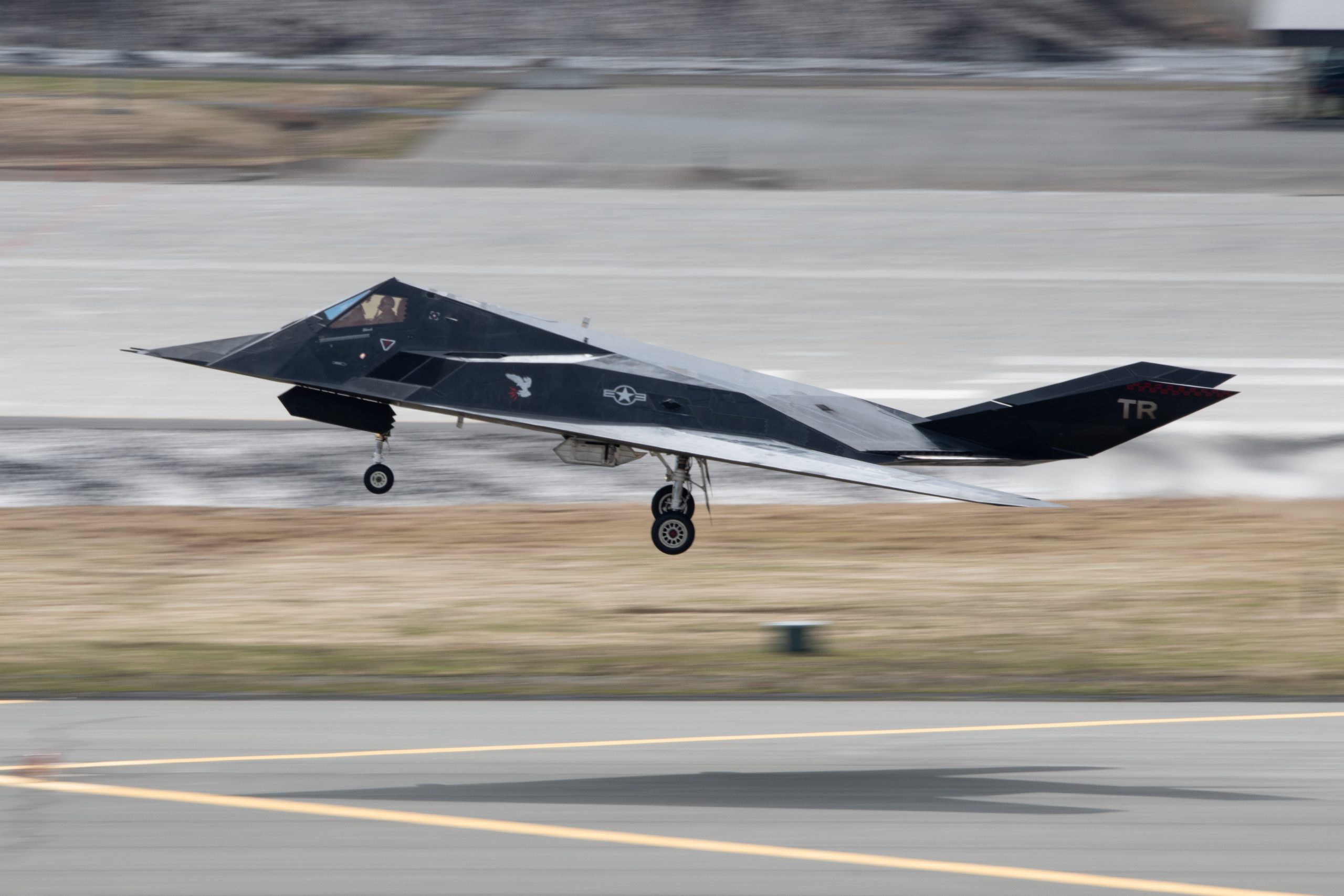
The Smithsonian Institution has announced that an F-117A Nighthawk, specifically tail number 85-0818, will join the collection of the National Air and Space Museum (NASM). This acquisition addresses a notable gap in the museum’s historical exhibits, providing visitors with access to an aircraft that represents a significant technological and strategic shift in military aviation.
The NASM, with locations in downtown Washington D.C. and at its Steven F. Udvar-Hazy Center near Dulles International Airport, is a prominent attraction, drawing a substantial number of the approximately 90 percent of Smithsonian visitors who tour its facilities. The addition of the F-117A is expected to be viewed by millions annually, contributing to the public’s understanding of aviation history.
While other military and aviation museums across the United States, including the National Museum of the U.S. Air Force in Dayton, Ohio, display F-117A aircraft, this will be the first opportunity for visitors to the Smithsonian’s National Air and Space Museum to observe this particular airframe. Its inclusion allows for a broader presentation of the aircraft’s development and operational impact.
The display of the F-117A is intended to provide the public with insight into the evolution of air power and the application of advanced defense technologies. Such exhibits aim to inform the public about the capabilities developed by the U.S. Air Force and may serve to encourage interest in aerospace careers among younger generations.
By showcasing the F-117A, the Air Force shares a critical period of its technological advancement, highlighting the innovative approaches undertaken to address evolving military challenges.
Developed by a specialized team at Lockheed Martin’s Skunk Works under Chief Ben Rich, the F-117A Nighthawk introduced a new era of military aviation. This aircraft pioneered the practical application of stealth technology, a design philosophy that has since influenced a wide array of military assets, including subsequent generations of aircraft, missiles, unmanned aerial vehicles (UAVs), and even maritime vessels.
While earlier air weapon systems, such as the Firebee reconnaissance drones used in Vietnam, the Lockheed SR-71 Blackbird strategic reconnaissance aircraft, and certain Cold War missiles, incorporated features designed to reduce detectability, the F-117A was the first operational aircraft to be engineered from its inception with a primary focus on stealth. Its design prioritized an exceptionally small radar cross-section, alongside reduced infrared, noise, and visual signatures. These characteristics were achieved through a combination of its distinctive faceted shape, the application of radar-absorbent materials (RAM), radar-absorbent structures (RAS), and specialized edge-treatments and coatings.
The design team recognized that achieving complete invisibility was improbable, especially with the faceted technology of first-generation stealth. Instead, their objective was to create an aircraft that could significantly degrade the effectiveness of enemy search, tracking, and fire-control radars, rendering it only fleetingly detectable and virtually impossible to target except at extremely close ranges. Consequently, minimizing its reflective radar signature took precedence over traditional aerodynamic considerations, marking a fundamental shift in aircraft design methodology.
The F-117A was a direct product of the late 20th-century computer revolution. Advances in computational power, consistent with Moore’s Law, enabled sophisticated aerodynamic and radar cross-section predictions essential for its development. The aircraft’s unique, aerodynamically unstable shape, crucial for its stealth characteristics, necessitated a computerized “fly-by-wire” flight control system to maintain stability and maneuverability. It was also equipped with advanced systems for targeting, including a forward-looking infrared sensor and a laser targeting attack system.
Although a product of the digital age, the concept of reducing aircraft detectability has historical antecedents dating back to World War I. During this period, designers on both sides explored methods such as translucent coverings and complex camouflage patterns to diminish the visual signature of early reconnaissance and bomber aircraft, though these early attempts yielded limited success.
The strategic objective of striking targets deep within enemy territory has been a core principle of airpower doctrine since World War I. Deep penetration bombing campaigns in World War II, targeting Germany, Occupied Europe, and Japan, played a significant role in the Allied victory. However, these successes often came at a high cost, with tens of thousands of aircrew casualties across multiple conflicts.
During the Cold War, advancements in air defense systems dramatically increased the risks associated with air combat. The proliferation of sophisticated air defense fighters, radar-guided surface-to-air missiles (SAMs), and improved anti-aircraft artillery (AAA)—increasingly integrated into complex command, control, communications, and intelligence (C3I) networks—began to challenge the dominance of offensive air power.
The experiences of American aircraft losses in Vietnam from 1965 to 1973, coupled with Israeli losses during the October 1973 Arab-Israeli War, starkly illustrated the emerging lethality of integrated air defense systems. The combination of radar-cued SAMs, anti-aircraft artillery, infrared-guided man-portable air-defense systems (MANPADS), and mobile anti-aircraft systems like the Soviet ZSU-23-4 Shilka, created a highly dangerous environment for aircraft. These threats jeopardized third-generation aircraft such as the F-4E and posed a substantial risk to emerging fourth-generation combat aircraft then in development, including the F-14A, F-15A, F-16A, and F/A-18A.
In the final two weeks of Operation Linebacker II in December 1972, the United States sustained the loss of 27 aircraft over North Vietnam, including 15 B-52 bombers, a critical component of America’s strategic bomber force. The following year, during the 1973 Yom Kippur War, Israel lost over 100 aircraft within a single month, representing approximately 35 percent of its pre-war air fleet. These loss rates raised significant concerns among American military planners, who projected that in a high-intensity conflict scenario, such as a Soviet assault through the Fulda Gap against NATO forces, the U.S. Air Force could exhaust its aircraft inventory within approximately two weeks.
This critical assessment underscored the urgent need for a transformative change in aircraft design and operational doctrine. The Defense Advanced Research Projects Agency (DARPA), in collaboration with the Air Force and industry partners, initiated efforts to develop an aircraft capable of circumventing these advanced air defense systems. Initially, Lockheed was not among DARPA’s preferred contenders for a low radar cross-section design. However, persistent advocacy by Ben Rich led to the inclusion of Lockheed’s Skunk Works, which subsequently won a competitive radar test range evaluation against Northrop. By 1977, Lockheed test pilots were conducting secret flights of the experimental “Have Blue” demonstrators, confirming their near-invisibility to conventional radars. Although both “Have Blue” aircraft were lost to operational incidents (one due to a hard landing, the other to an inflight fire, with both pilots surviving), these incidents were unrelated to stealth technology and provided crucial data for the F-117A program.
Just four years later, in 1981, Lockheed delivered the first F-117 Nighthawk. What would later be publicly known as “the Stealth Fighter” was roughly the size of an F-15A, with a flyaway cost of $42.6 million in then-year dollars. Operating from a highly secluded base at Tonopah Test Range in the Nevada desert, the F-117A and its parent unit, the 4450th Test Group, remained one of the nation’s most closely guarded secrets. The aircraft achieved initial operational capability in 1983, with further refinement and development of its signature GBU-27 hardened 2,000-lb precision-guided bomb capability. By the summer of 1990, the USAF had a fleet of 59 F-117As, which would prove critical during Operation Desert Storm.
Why This Matters
The F-117A Nighthawk’s addition to the National Air and Space Museum holds significant importance for several reasons, reflecting its impact on military aviation, technological development, and public understanding.
Firstly, the F-117A represents a pivotal moment in aerospace engineering. As the world’s first operational aircraft designed around stealth technology, it fundamentally altered the paradigm of air combat and aircraft survivability. Its development demonstrated the feasibility of creating aircraft with significantly reduced detectability by radar and other sensors, a concept that had been largely theoretical. This breakthrough paved the way for subsequent stealth aircraft such as the B-2 Spirit bomber, F-22 Raptor, and F-35 Lightning II, and influenced the design of stealth features in drones, cruise missiles, and even naval vessels. Understanding the F-117A’s design challenges and solutions provides critical insight into the evolution of modern military technology and the continuous effort to achieve tactical advantage through innovation.
Secondly, the Nighthawk’s operational deployment dramatically reshaped military strategy and doctrine. During conflicts like Operation Desert Storm and later engagements, the F-117A demonstrated its unique ability to penetrate heavily defended airspace undetected, striking high-value targets with precision while minimizing risk to aircrews. This capability fundamentally changed the calculus of air warfare, allowing for surgical strikes that could degrade enemy command and control, air defenses, and critical infrastructure early in a conflict. Its presence in the museum serves as a tangible reminder of how technological superiority can influence geopolitical outcomes and reduce casualties in conflict, both friendly and civilian.
Finally, displaying the F-117A at a prominent institution like the NASM is crucial for public education and historical preservation. The museum’s role is to document and interpret the history of flight, making complex technological achievements accessible to a broad audience. By showcasing the F-117A, the museum provides an opportunity for millions of visitors, including students, to learn about the scientific principles behind stealth, the engineering challenges overcome, and the strategic implications of such advancements. It can inspire future generations to pursue careers in science, technology, engineering, and mathematics (STEM), encouraging them to become the innovators who will shape the next era of aerospace development. Furthermore, it allows American taxpayers to understand the rationale and impact of significant investments in defense technology, connecting advanced military capabilities to national security and technological progress.
The F-117 Nighthawk, a stealth attack aircraft developed by the United States, represents a pivotal moment in the history of military aviation, ushering in an era of “invisible” warfare that fundamentally reshaped air combat doctrine. Its journey from a highly classified project to a proven operational asset demonstrates the transformative power of technological innovation when coupled with strategic development and deployment.
The genesis of the F-117 can be traced back to the mid-1970s with the “Project Have Blue” demonstrator, a secretive program aimed at proving the viability of stealth technology. This initiative was undertaken with utmost classification, designed to develop an aircraft capable of evading radar detection. The aircraft’s distinctive angular design, a radical departure from conventional aerodynamic principles, was a direct consequence of engineers prioritizing radar cross-section reduction over traditional flight characteristics. This groundbreaking development took place under a veil of extraordinary secrecy, with testing conducted at a clandestine facility in Tonopah, Nevada, far from public scrutiny.
The development process was lengthy and complex, with the first aircraft delivered in 1981 and achieving Initial Operational Capability (IOC) in 1983. The intense secrecy surrounding the program meant that the existence of such a revolutionary aircraft was unknown to the public for years. The need to maintain this secrecy, particularly during the Cold War, was paramount. It wasn’t until 1988, in a strategic move both to deter the Soviet Union and to address growing public speculation, that U.S. officials released a grainy image of the aircraft, finally acknowledging its existence.
The Nighthawk’s initial operational deployment, however, presented a mixed picture. Its first combat use occurred over Panama during Operation Just Cause, targeting a military facility at Rio Hato. This engagement was marred by challenges, including confusion over targeting directives from higher command and technical issues with the aircraft’s target designation system. Consequently, one F-117 significantly missed its intended aim point. This initial setback predictably fueled criticism, with some observers attempting to use the results to question the overall viability and effectiveness of stealth technology in real-world combat scenarios.
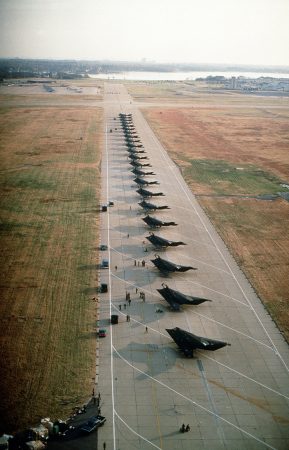
Despite these early difficulties, the true potential of the F-117 was dramatically demonstrated during Operation Desert Storm. On January 17, 1991, the opening night of the conflict, the Airmen of the 37th Tactical Fighter Wing deployed 36 F-117s. These aircraft generated 42 attack sorties, striking approximately 31 percent of the coalition’s designated targets across the vast and heavily defended Iraqi landscape. Crucially, this was achieved despite the F-117s constituting a mere 2.5 percent of the total strike force, and remarkably, all aircraft returned safely to base.
The impact of these attacks was nothing short of a revolution in air warfare, starkly illustrated by comparing the F-117s’ performance with that of a non-stealthy strike package launched on the very same night. To engage a single target, a conventional strike package required a formidable force of 41 planes. Out of these, only eight were equipped to drop bombs. The non-stealthy nature of these eight bomb-carrying aircraft necessitated a large contingent of escort planes, tasked with jamming enemy air defense radars, suppressing surface-to-air missile threats, and countering hostile fighter aircraft. In stark contrast, the stealth fighters operated independently, with every F-117 launched serving as a primary striker, capable of engaging two targets during a single sortie without the need for extensive protective escorts.
That night, stealth technology demonstrated unparalleled operational value and efficiency. From a cost perspective, while each individual F-117 was more expensive to procure than its conventional counterparts, the overall stealth strike package proved to be significantly more efficient. It required no escort or supporting combat aircraft, aside from essential refueling tankers, thereby placing fewer aircrews in harm’s way. When considering the comprehensive costs associated with deploying more conventional planes, additional aircrews, sustainment expenses, logistical support, and extensive basing requirements, the F-117 unequivocally altered the fundamental rules of air combat, establishing a new paradigm for effective and survivable deep-strike operations.
The strategic value of the F-117s was highly prized by military commanders, leading to their continued heavy use in nearly every major U.S. combat operation through Operation Iraqi Freedom. After decades of distinguished service, the Air Force officially retired the F-117 fleet in 2008. The aircraft were subsequently placed in protected storage at the same clandestine base in Tonopah, Nevada, where their pioneering development and testing had initially taken place.
By the time of its retirement, the F-117’s legacy had already proliferated across the U.S. military. It had paved the way for a new generation of stealth aircraft, including the B-2 Spirit bomber, the F-22 Raptor air superiority fighter, the multi-role F-35 Lightning II, the RQ-170 Sentinel unmanned aerial vehicle, and influenced the development of future platforms such as the B-21 Raider bomber and the conceptual F-47. Today, the principles of stealth are also being integrated into newly designed semi-autonomous systems, known as Collaborative Combat Aircraft (CCA), and various high-end munitions, underscoring the enduring impact of the F-117’s pioneering design.
The F-117 stands as a testament to American innovation, representing an extraordinarily successful rapid acquisition program. Its swift development, from conception to initial operational capability, highlights what can be achieved when government and industry innovators forge strong partnerships and collaborate on clearly defined challenges. This success was facilitated by streamlined management processes, minimal bureaucratic hurdles, and the strategic implementation of a special access program approach. The transition from merely creating a flying stealth airplane to developing it into a devastatingly effective operational weapon system required the dedication and ingenuity of numerous individuals.
The forthcoming display of an F-117A at the Smithsonian will serve as a lasting reminder and tribute to the countless senior leaders, executives, planners, designers, builders, engineers, test pilots, flight test engineers, test directors, operational combat airmen, and maintainers, both military and civilian, who worked tirelessly across the nation—from the Pentagon to remote test sites in the Southwestern deserts. Their collective efforts ensured the Nighthawk’s success and cemented its place in aviation history.
Among the most profound lessons gleaned from the Stealth Fighter’s operational history, particularly its initial combat tests, is the confirmation of a long-held tenet of airpower pioneers: that deep strike attack is both the indispensable prerequisite and the key to achieving victory in modern conflicts. Furthermore, the F-117 irrevocably demonstrated that in the contemporary era, only stealth technology makes such decisive deep penetration capabilities truly possible and survivable.
Why This Matters
The F-117 Nighthawk’s legacy extends far beyond its operational service, fundamentally altering the landscape of military strategy and technological development. Its introduction marked a paradigm shift in air warfare, demonstrating that the ability to penetrate heavily defended airspace undetected could significantly reduce combat risks and increase the effectiveness of initial strikes. This capability directly impacted geopolitical dynamics, giving nations possessing stealth technology a significant strategic advantage and forcing adversaries to rethink their defense doctrines and investments in radar and air defense systems.
Militarily, the F-117 validated the concept of precision deep strike, proving that a small, specialized force could achieve disproportionate effects against high-value targets. This efficiency not only minimized the number of aircraft and personnel required for complex missions but also reduced the overall “cost” of war in terms of resources and lives, by avoiding the need for large, vulnerable strike packages. The operational successes of the Nighthawk compelled military planners worldwide to integrate stealth as a core requirement for future combat aircraft, influencing everything from bomber design to fighter jets and even unmanned systems.
Technologically, the F-117 was a crucible for innovation, pushing the boundaries of aerodynamics, materials science, avionics, and low-observable design. Its development fostered a culture of rapid prototyping and classified research that continues to drive advancements in defense technology. The processes and partnerships established during its creation—emphasizing collaboration between government and industry, streamlined management, and special access programs—offer valuable lessons for accelerating the development of critical national security capabilities in any domain, from cybersecurity to space exploration.
Economically, the investment in stealth technology represented a significant commitment of resources, shaping defense budgets and fostering specialized industries. While expensive, the perceived tactical and strategic advantages justified these costs, leading to further investment in follow-on stealth platforms. The F-117’s story, therefore, is not just about a single aircraft; it’s about the enduring impact of a technological breakthrough that reshaped military doctrine, influenced international relations, and continues to drive the evolution of advanced warfare capabilities into the 21st century.