
Gain access to the White House Watch newsletter without cost
An overview of the implications of Trump’s subsequent tenure for the capital, commerce, and global affairs
Donald Trump indicated that the United States might conclude its military engagement in Iran within approximately “two or three weeks,” regardless of whether a peace agreement was finalized, signaling the president’s escalating frustration with a dispute that has destabilized financial markets.
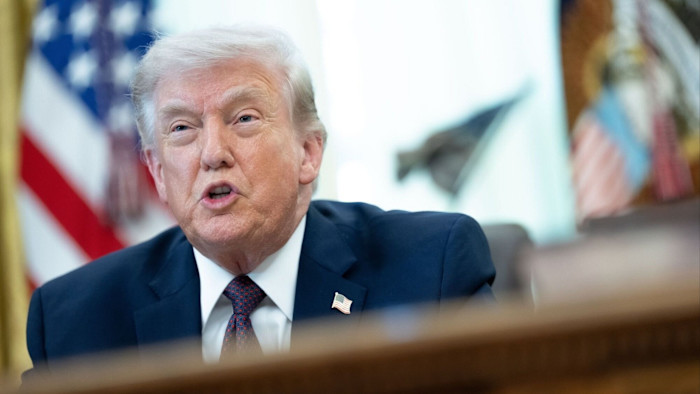
“We will withdraw irrespective of an agreement. It holds no bearing,” Trump conveyed to journalists in the Oval Office late Tuesday. The United States would proceed with this withdrawal within “two or three weeks,” although an accord between Washington and Tehran remained a possibility prior to that timeframe, he added.
The president’s comments at a White House gathering were made merely hours after Brent, the global petroleum standard, concluded trading at $118.35 per barrel, approaching its peak valuation since the military action commenced a month earlier.
Currently in its fifth week, the confrontation has ignited a worldwide energy predicament which has menaced to unleash a renewed period of rising prices and diminished Trump’s aspirations of persuading Americans that he could alleviate an arduous cost-of-living crunch prior to November’s congressional elections.
The armed conflict is already imposing a significant burden upon American consumers and enterprises. The typical American price for gasoline at service stations reached $4 per gallon for the initial time since 2022 on Tuesday, whereas diesel, crucial for industrial operations, has surged to nearly $5.50 per gallon.
Notwithstanding escalating political and economic demands on the White House to conclude the hostilities, the Pentagon has proceeded with its troop reinforcement in the Middle East.
Trump stated on Tuesday that prior to concluding the military involvement, he would still desire to “eliminate every single element present”.
“They are not compelled to finalize an accord with me once we perceive they have been . . . reverted to primitive times” without the capacity to “develop a nuclear device,” he remarked.
Marco Rubio, the American secretary of state, informed Fox News on Tuesday evening that a prospect of convening with Tehran persisted. “There exists the likelihood of a direct encounter at some juncture. We shall perpetually remain receptive to that.”
Rubio’s remarks followed Masoud Pezeshkian, Iran’s head of state, reaffirming that his nation was amenable to concluding the hostilities, yet solely upon receiving “assurances” that US-Israeli hostility would not recur.
Pezeshkian’s statements contributed to a robust surge in Wall Street stocks on Tuesday, as certain market participants speculated that the conflict would cease earlier than initially foreseen.
Nonetheless, American defense secretary Pete Hegseth declined to preclude deploying troops on Iranian soil, asserting earlier that day that “the objective is to maintain unpredictability” regarding “what actions one is prepared to undertake or forgo”.
White House press secretary Karoline Leavitt announced that Trump was scheduled to speak to the country on Wednesday at 9:00 PM EDT “to furnish a crucial update regarding Iran,” marking his inaugural delivery of such a primetime speech since the commencement of hostilities.
The previous week, the president established an April 6 deadline for Iran to finalize an agreement with the US or confront more destructive assaults on its energy facilities. Nevertheless, scant signs of advancement have emerged after Tehran last week declined a 15-point peace initiative from the US and discussions between the two nations persist via intermediaries.
In a memorandum to clients on Monday, Beacon Policy Advisors, a Washington-based consulting firm, stated: “Evidently, no headway continues to be made towards a diplomatic resolution [and] given the mounting economic and internal political strain on Trump, the president will probably be compelled to choose between disengaging from the confrontation or intensifying it.”
The Trump administration’s justification for initiating military action against Iran has evolved throughout the duration of the engagement, generating ambiguity among investors regarding the objectives the US would need to accomplish prior to its pullout.
Tuesday saw Trump declare his “sole objective” was to hinder Tehran from acquiring a nuclear device.
“A transformation of governance was not among my stated aims,” he asserted, despite the fact that in recent days he and his chief aides have proclaimed such a governmental shift had already transpired.
Rubio delineated the administration’s goals in a video disseminated by the White House on Tuesday.
Elaborating on the timing of the conflict, he contended that Iran was endeavoring to construct a defense comprised of drones and missiles so potent that American attacks on the nation’s atomic initiative would have been rendered unfeasible.
“We were approaching a scenario where Iran possessed an abundance of missiles and unmanned aerial vehicles that no entity could take action concerning their atomic armaments initiative subsequently,” Rubio articulated.