
Following weeks of warnings and a substantial American armed forces mobilization, projectiles commenced their descent upon Tehran on Saturday morning, the initial day of Iran’s work week, inciting widespread alarm across the capital.
Through successive aerial bombardments, the United States and Israel initiated their second military campaign against the Islamic Republic within eight months, cautioning that its scope would vastly surpass the twelve-day conflict Israel waged in June. On this occasion, the U.S. assumes the lead, with President Donald Trump characterizing the assault as “enormous,” asserting that “munitions would be falling ubiquitously,” and seemingly advocating for the primary aim: governmental overthrow.
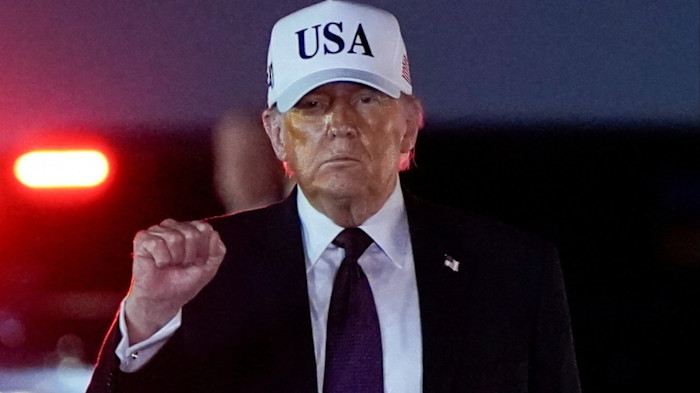
“This evening, I declare that your moment of liberation is imminent. Remain in refuge,” Trump stated in a recorded message. “Upon our conclusion, assume control of your administration.”
Similar to the preceding conflict in June — which was initiated by Israel and saw brief participation from the U.S. — this current situation has emerged while the Trump administration was involved in discussions with Iran to forge an accord concerning its atomic initiative. Those negotiations consistently appeared destined for failure, with warfare growing increasingly unavoidable, notwithstanding the endeavors of Arab and Islamic nations who are apprehensive it might provoke a localized confrontation that would extend beyond their boundaries.
Impelled by Israeli Prime Minister Benjamin Netanyahu, Trump acted with haste, aiming to compel Iran’s surrender as he commanded the most extensive military positioning in the Middle East since the American-led incursion into Iraq in 2003.
Ayatollah Ali Khamenei, Iran’s paramount leader, profoundly skeptical of Trump, was highly improbable to yield — from his perspective, capitulating to the doctrinal foe would pose a more serious peril to the government’s continued existence than an armed confrontation.
The government’s assessment is not that it possesses the capacity to equal the vastly greater offensive capability of the U.S. or Israel, but rather that it can withstand and deliver sufficient counter-strikes to escalate the price for its adversaries, prompting them to eventually reduce tensions. This has consistently been a perilous maneuver by Khamenei, the octogenarian religious leader whose almost forty-year dominion has been marked by resistance amidst adversities, whether originating from outside or within.
Yet Trump, who assumed power pledging to cease American conflicts, is undertaking the most significant risk of his presidency. The violent legacy of American involvement in the Middle East illustrates that initiators of armed attacks are seldom capable of dictating their results.
The nation finds itself in its most enfeebled and susceptible state since its 1980s war against Iraq. Its allied groups, traditionally viewed as essential to a defense doctrine founded on the principle of unconventional combat, have been considerably weakened over two years of localized strife. Iran’s indigenous defense systems were predominantly obliterated by Israeli aerial assaults — initially in October 2024, and then once more last June.
Its lingering credibility domestically was fragmented by the lethal suppression of dissent against the government last month. The republic has been thoroughly penetrated by Israeli covert agencies and seems caught in a downward trajectory of decline.
Numerous analysts overestimated Tehran’s capability to confront Israel’s armed forces subsequent to Hamas’s October 7, 2023, attack that ignited localized strife; furthermore, it has never encountered such an enormous, complex military peril as Trump’s offensive presents currently.
For Trump and Netanyahu, this seems the opportune time to deliver a conclusive strike. However, even though the government was severely pummeled during the conflict of last June, it was by no means vanquished. It emerged on the other side undamaged, exhibiting no indications of desertions. It found comfort in the reality that a portion of its projectiles managed to breach Israel’s defensive mechanisms and effectively paralyzed the nation for a fortnight.
Both factions will have absorbed insights from that confrontation, and the Iranian government has had several months to commence restocking its projectile inventory.
Iranian authorities have frequently cautioned that they will aim for American military installations in the region, which are considerably nearer to the republic than to Israel, signifying Tehran might deploy short-distance projectiles capable of reaching their destination in mere minutes.
Tehran has also previously menaced to obstruct the Strait of Hormuz, a crucial sea-lane for commerce through which approximately one-third of the planet’s seaborne unprocessed petroleum transits.
Iran has not carried out that menace; however, the government has never previously been forced into such a dangerous predicament as it currently faces, confronting a struggle for its very existence. The assaults over the last two years on commercial vessels in the Red Sea by Houthi insurgents supported by Iran illustrated the disorganization that volleys of projectiles and unmanned aerial vehicles are capable of inflicting.
Arab nations — apprehensive of the turmoil a conflict might unleash — have also alerted the U.S. about the possible danger to power infrastructure. In 2019, Iran was held responsible for a projectile and drone assault in Saudi Arabia that momentarily incapacitated half of the unprocessed oil production of the globe’s foremost petroleum exporter. Iran also co-possesses the North Field, the planet’s most expansive natural gas reserve, alongside Qatar. Any harm to that could substantially impact gas markets.
Trump appears to believe that Iranian citizens will capitalize on the offensive to rebel and conclude the task on his behalf.
Throughout Israel’s June conflict, the government was emboldened by the reality that Iranian citizens set aside their abhorrence of their leaders to unite in national solidarity confronting external hostility. The U.S. seemingly conjectures that there will be no recurrence of that identical nationalistic sentiment this time, following the savage suppression of demonstrators last month that resulted in thousands of fatalities.

The populace’s indignation is discernible. Yet, debilitated by tyranny and brutality, individuals might also dread for their personal safety, stemming from bombardments, the disarray, and the menace of governmental retaliation.
Iranian experts additionally warn that should Khamenei be eliminated, it would not inevitably instigate the government’s downfall, indicating an entrenched administrative system and doctrinal centers of authority that are probable to sustain the struggle, particularly the 180,000-personnel strong Revolutionary Guards.
Trump has supervised numerous rapid, restricted military maneuvers during his second tenure: the bombardment of Iran’s atomic installations last June, which he asserted had “annihilated” the initiative, and the abduction of Venezuelan President Nicolás Maduro in January.
However, Iran ought not to be likened to Venezuela, and past American involvements in the Middle East, spanning from Iraq to Libya, have bequeathed a violent, disorderly heritage. Iran is an expansive, multi-cultural nation comprising more than 90 million inhabitants, and should the government indeed collapse, it is impossible to predict the subsequent developments.
No structured domestic dissent exists, and while Reza Pahlavi, the progeny of the final shah, has ascended in notoriety during his expatriation, he represents a polarizing personality. Scarcely anyone believes he possesses the backing, aptitude, or frameworks to effectively enter the conflict.
“This constitutes a thoroughgoing governmental overthrow initiative, but akin to the 2003 Iraq conflict, the U.S. has not undertaken post-conflict preparations,” remarked Sanam Vakil, Middle East director at Chatham House. “Immense perils are present.”
She cautioned that absent an established blueprint or framework, governmental downfall “might generate anarchy and disorder.”
“This could prove an advantageous result for Israel, potentially witnessing the vanquishing of its enduring foe, however, this will be ruinous for the Iranian populace who will endure a protracted and challenging transition,” Vakil added.