
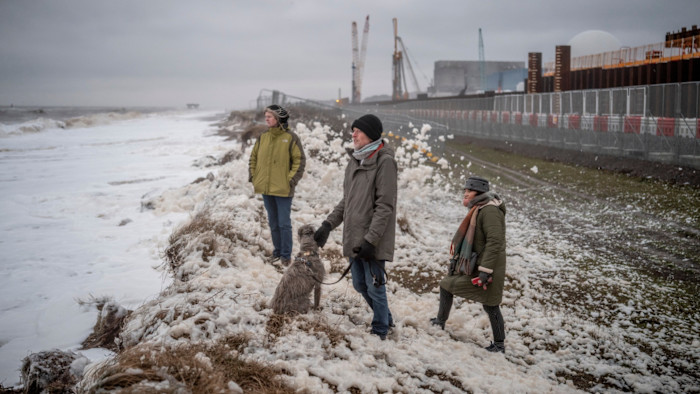
Extensive sections of the eastern British shore are decaying more quickly than foreseen, necessitating the razing of residences and drawing attention to the dangers associated with a £40 billion atomic energy facility under construction at Sizewell.
The shoreline in the vicinity of Norfolk and Suffolk isamong the most rapidly deteriorating in Europe. However, this decay has accelerated in various locations over the past few months, notably a zone merely 2 kilometers away from the Sizewell C construction site.
Over 27 meters of the precipice at the village of Thorpeness has vanished since December 2024, a stark contrast to the average yearly erosion pace of 2 meters, as reported by East Suffolk Council. The council stated that this “abrupt and considerable speed” resulted in safety thresholds being surpassed much sooner than anticipated. A decade of dwellings in this affluent district, including two apartments recently acquired for over £600,000, were razed since October.
“I prepared a mug of tea between 7 and 7:30 AM, and then thirty minutes subsequent, I became aware that a fourth of my yard had simply vanished,” commented Hilary Lightfoot, proprietor of the Vintage Angels boutique in adjacent Aldeburgh, whose Thorpeness residence has since been torn down.
Helene Burningham, a professor specializing in physical geography at University College London, noted that the locality—established over a hundred years ago as a vacation destination—had undergone significantly more “swift degradation” than foreseen.
Over 2,500 residences in Norfolk and Suffolk are directly vulnerable to shoreline deterioration, as per the Environment Agency. Nearing winter tempests have hastened the disappearance of the coastline, resulting in additional razings along the seaboard in locales like Hemsby in Norfolk.
Sizewell C, conceived to furnish roughly 7 percent of Britain’s power supply for a minimum of six decades, is under construction on the seaboard due to its requirement for water-based cooling. It neighbors an earlier, related facility, Sizewell B, one of merely a few government-approved atomic locations nationwide.
Supervisors, government officials, and Sizewell C assert that the atomic energy facility occupies a more secure stretch of the shore compared to Thorpeness, situated inside a cove and shielded by offshore sand ridges.

The peril of shoreline degradation, oceanic elevation, and powerful surges has been a prominent concern across all planning stages. The developer, EDF, has dedicated “thousands” of hours to evaluating and safeguarding the facility against prospective hazards. Furthermore, it intends to erect a 14-meter-tall barrier of rocks to shield it from the ocean—accelerating proposals to elevate it by an extra two meters—along with a 10-meter provisional barrier to secure the location throughout its development.
This situation underscores the dilemmas faced by atomic energy developers as they endeavor to establish sources of low-carbon electricity intended to operate for many decades, yet concurrently remain susceptible to unpredictable dangers stemming from climatic shifts, which, in turn, are prompting rising sea levels and generating more severe tempests.

Sir David King, the past principal scientific advisor to the British government and an advocate for atomic energy, contends that the UK is, essentially, inclining into the ocean along its eastern flank due to attrition, a phenomenon that will magnify the impact of ascending ocean levels in times ahead.
“Such is the essence of the predicament that worries us collectively on the eastern seaboard—and concerning Sizewell C, this presents an undeniable difficulty.”
He maintains that Sizewell C must ensure a formidable safeguarding strategy is implemented, further stating: “Sizewell C is indispensable—it represents an immense asset, and a power portfolio incorporating atomic energy is truly crucial.”
The resident populace has questioned the government and regulatory bodies regarding the suitability of this location for the power facility. Additionally, EDF is constructing a fresh atomic energy station in Somerset, situated on Britain’s southwestern seaboard, a region experiencing less impact from degradation.

“In my opinion, it’s illogical to construct [Sizewell C] in a locale so susceptible,” expressed Chris Wilson, a member of the advocacy organization Together Against Sizewell C. He noted that the sand hills fronting the construction area had been penetrated amidst recent tempestuous conditions.
Paul Dorfman, affiliated with the Bennett Institute at the University of Sussex, and a persistent detractor of atomic energy, indicated thatcertain projectionsimplied that Sizewell C “could be nearly completely encircled by inundation annually by the close of the 2030s.”
“The distinguishing characteristic of Sizewell C and the Suffolk area is its status as one of the most imperiled shorelines. It appears to be a peculiar selection for such a hazardous piece of infrastructure,” he remarked. Sizewell C, however, asserts that its internal modeling does not corroborate this outcome.
Recordsfrom a Sizewell C assembly held last September indicated a rise in degradation over recent years at the beach’s northern extremity, and suggested that the sand hills fronting Sizewell C could gain from “supplementary granular material.”
Across numerous areas of Suffolk, coarse gravel—comprising larger, well-smoothed stones and rocks—serves a crucial function in shielding the “yielding” sand and gravel bluffs and sand hills from oceanic removal. However, this coarse gravel had been diminishing in southern Suffolk, due to tempests and intrinsic
processes move it along the coast, said Burningham, rendering the land vulnerable.

The UK government’s Centre for Environment, Fisheries and Aquaculture Science, which diligently monitors the Sizewell C location, asserts its strong conviction that future degradation projections, incorporated into the power facility’s design, will be realized.
“Ecological circumstances and operations at the two locations [Thorpeness and SZC] are distinct, which consequently renders Sizewell comparably less prone to degradation,” a department official further noted.
“It is important to observe, however, that Sizewell Bay will innately fluctuate between periods of erosion and accretion.” The situation was presently unfolding as anticipated, it conveyed. Sizewell C claims it is fashioning the facility to endure a 1-in-10,000-year tempest and 1-in-100,000-year tidal surge occurrences.
The magnitude of apprehensions regarding the recent swift degradation further along the shoreline was demonstrated at an extensive community gathering convened by MP Jenny Riddell-Carpenter, alongside representatives from the municipal authority, the Environment Agency, Sizewell C, and other parties in January. Demands have emerged for Sizewell to contribute to the expenditure for regional shoreline protective measures.
“Numerous thousands of hours have been devoted to evaluating impending inundation peril at Sizewell, encompassing risks originating from climatic shifts, and our strategies will safeguard the generating facility, even in dire circumstances,” Sizewell C conveyed.
Presently, the locale beyond Sizewell bay is preparing for further dismantlings. “No one anticipated [the degradation] would occur at such a rapid pace,” remarked Sophie Marple, who acquired a beachfront dwelling in Thorpeness two decades prior. Her family constructed a new residence on the location 11 years ago, yet current strategies aim to flatten it.
“Barely over two months past, I would have predicted we had two to three years before facing jeopardy. However, the persistent climatic conditions during Christmas, succeeded by genuinely unusual meteorological occurrences in January, utterly destroyed our remaining protective structures.”

Roo Clark, a 30-year-old whose relatives possessed a seaside dwelling in the hamlet for several decades, declared that the rapidity of the degradation had “astonished all.”
Lightfoot stated she merely had seven days to collect her possessions from the residence where she had resided for a quarter-century before its dismantling, and she lacked estate coverage for shoreline degradation.
“The entire hamlet is apprehensive. Individuals who have acquired dwellings lately cannot even bear to gaze at the ocean. They detest it,” she communicated.
Environmental Finance

When climatic shifts intersect with commerce, economies, and governance. Discover the FT’s reporting on this topic.
Intrigued by the FT’s pledges regarding ecological endurance? Learn further about our scientifically-backed objectives here