
Unlock the White House Watch newsletter for free
Your guide to what Trump’s second term means for Washington, business and the world
**Key Takeaways**
1. **Geopolitical Conflict Fuels Record Diesel Prices:** Escalating tensions in the Middle East and ongoing conflict in Eastern Europe have created an unprecedented global supply crunch for diesel, driving US pump prices to an all-time high of $5.85/gallon and igniting inflationary pressures across the economy.
2. **Acute Supply Shortage Reflected in Soaring Crack Spreads:** The premium for diesel over crude has surged past $100/barrel in Europe, a “truly unprecedented” level, signaling severe market tightness and significant cost challenges for industries reliant on the vital fuel, from transportation to agriculture.
3. **Political Pressure Mounts Ahead of Elections:** With energy costs becoming a critical electoral issue, the Trump administration faces increasing pressure to mitigate fuel inflation, exploring policy interventions such as regulatory easing and strategic reserve releases, which could have immediate market implications.
—
**US Diesel Prices Hit All-Time High Amid Geopolitical Turmoil and Market Squeeze**
US diesel prices have climbed to an all-time high, creating a significant headwind for industries, consumers, and farmers, while piling considerable political pressure on the Trump administration just months ahead of the crucial November elections. The surge underscores the acute vulnerability of global energy markets to geopolitical instability and the profound economic ramifications of disruptions to critical refined product supplies.
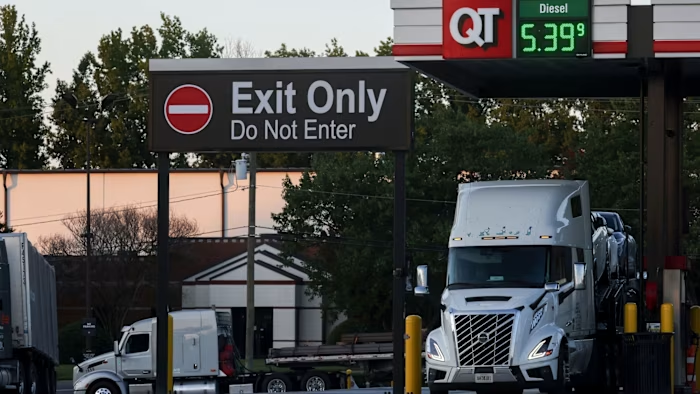
Pump prices for diesel reached an average of $5.85 a gallon on Friday, according to the American Automobile Association (AAA), eclipsing the previous record level established in the aftermath of Russia’s full-scale invasion of Ukraine in 2022. This new peak is not merely a statistical anomaly but a stark indicator of a tightening global market, driven by a confluence of supply shocks and looming seasonal demand spikes.
Fuel costs have soared amid a continued global shortage of diesel, primarily attributable to two major geopolitical flashpoints. First, the protracted stalemate in the Iran war continues to disrupt crucial shipping lanes in the Middle East, particularly the Strait of Hormuz – a vital chokepoint for a significant portion of the world’s crude oil and refined product transit. The persistent threat of escalation or direct confrontation in the Gulf has elevated insurance premiums for tankers and introduced substantial uncertainty into supply chains. Second, a highly effective Ukrainian campaign against Russian refineries has significantly curtailed global diesel output. These targeted strikes have degraded Russia’s refining capacity, a major global supplier of diesel, forcing other markets, particularly Europe, to seek alternative sources, thereby placing additional strain on an already stretched global market.
The market tightness is dramatically reflected in refining margins, specifically the “crack spread” – the premium of refined products like diesel over crude oil. This week, the premium for a barrel of diesel over a barrel of crude jumped above $100 in Europe, a move that pricing agency Argus Media described as “truly unprecedented.” For context, a healthy crack spread for refiners typically hovers in the $20-30 range. A $100+ premium signals an extreme imbalance between supply and demand, indicating that refiners can command vastly higher prices for their output due to severe scarcity. While seemingly beneficial for refiner profitability in the short term, such a spread ultimately translates into crippling costs for end-users, underscoring the severity of the supply deficit rather than simply robust demand.
“We do not see any possible solution to diesel’s problem other than price-led demand destruction,” stated Amrita Sen, founder of consultancy Energy Aspects. This grim assessment suggests that prices will have to remain at these elevated levels – equating to around $200 a barrel for diesel – until economic activity contracts sufficiently to reduce consumption. Such demand destruction would entail reduced shipping volumes, delayed industrial projects, and scaled-back agricultural operations, all of which would carry significant economic costs.
Adding to the immediate pressures, the market faces a further squeeze from October onwards due to impending seasonal factors. The autumn harvest season in the US demands immense quantities of diesel to power agricultural machinery. Simultaneously, early winter heating demand, particularly in the US Northeast where heating oil (a form of diesel) is prevalent, will compete directly with transportation needs. These demand surges will coincide with planned maintenance schedules by US refineries, which temporarily reduce overall processing capacity. This combination of heightened demand and reduced supply capacity creates a perfect storm for continued price escalation.
The inflationary implications of soaring diesel prices are profound and far-reaching. As diesel is a foundational input cost for nearly all goods and services, its high price is a direct driver of “cost-push” inflation. This issue resonates deeply with voters ahead of November’s congressional elections, making it a central point of political contention. Recognizing the gravity of the situation, Donald Trump earlier this week held talks with oil executives in the White House, urging them to find ways to “beat back” the fuel price inflation triggered by his administration’s war in Iran. While a political gesture, it highlights the administration’s awareness of the economic and electoral risks.
About three-quarters of diesel in the US is used for transportation and trucking goods, serving as the lifeblood of the nation’s supply chain. Higher diesel costs translate directly into increased freight rates, impacting everything from groceries to manufactured goods. The fuel is also essential for agriculture, powering much of the farm equipment used in the upcoming harvest season. The Atlantic Council think-tank emphasized, “Rural areas are being walloped by rising diesel prices,” noting that states like Wyoming, North Dakota, and Alaska had the highest per capita diesel consumption in 2024, amplifying their economic exposure.
The financial strain on the agricultural sector is particularly acute. On Thursday, the US Agriculture Department reported that farmers’ incomes are projected to fall 2.5 per cent in real terms by 2026, while the cost of fuel is set to rise nearly 30 per cent and fertiliser by 15 per cent. This severe margin compression threatens the viability of many farming operations and will inevitably contribute to higher food prices for consumers.
Energy Aspects has suggested several policy levers the Trump administration could consider to alleviate the crisis. These include relaxing fuel regulations, such as those pertaining to sulfur content or blending requirements, to enable refineries to produce more diesel volume. While potentially increasing supply, such measures could face environmental opposition. Another option involves stepping up efforts to escort diesel tankers through the Strait of Hormuz, a significant commitment of naval resources, as most recent escorts have focused on crude oil shipments.
Furthermore, the US, which has been exporting large quantities of domestically refined diesel to help meet overseas demand, could encourage Europe to release more diesel from its own strategic reserves. European countries have so far released only 10 per cent of the 73 million barrels of fuel they pledged at the start of the Iran conflict, preferring instead to import US diesel. Energy Aspects noted, “If stock draws accelerate and winter pricing skyrockets, countries may choose to release the remaining volumes,” which would reduce Europe’s reliance on US exports and potentially free up more supply for the domestic American market.
The surge in diesel prices is part of a broader upward trend across the energy complex. Gasoline prices have also been rising, reaching an average of $4.15 a gallon on Friday, according to the AAA. The price of crude oil, the primary feedstock for all refined products, has also started to climb again in recent weeks, as chances diminish of a short-term resolution to the crisis in the Gulf. On Friday, benchmark Brent crude was trading at $95 a barrel after a nearly 7 per cent rise in the week, reinforcing the foundational cost pressures on refiners and the entire energy supply chain.
**Market Impact**
The sustained high price of diesel will have significant ripple effects across financial markets and the broader economy. Elevated energy costs exacerbate inflationary pressures, complicating the Federal Reserve’s efforts to manage inflation. Should sustained high energy prices force the Fed to maintain higher interest rates for longer, it would increase borrowing costs across the economy, potentially slowing economic growth and heightening recessionary risks. Industries such as transportation, logistics, agriculture, and manufacturing will experience substantial margin compression due to elevated fuel expenses, likely leading to reduced corporate earnings, potential profit warnings, and necessitate price increases for end products, further fueling inflation. Supply chain disruptions may also intensify as costs push some smaller operators out of business or force service reductions, impacting overall economic efficiency. Investors will closely monitor the energy sector, particularly refining companies which may benefit from high crack spreads in the short term, though sustained high crude prices could eventually offset some gains. Consumer discretionary spending is highly susceptible to curtailment by higher fuel and food prices, impacting retail and service sectors. The pervasive uncertainty surrounding energy supply and prices will likely continue to drive volatility across commodity markets and broader equities, demanding agile risk management and strategic resource allocation from businesses and investors alike.