
Early Saturday witnessed detonations reverberating across Iran, as plumes of smoke ascended above Tehran, concurrently with alarm sirens blaring over Tel Aviv and Jerusalem.
Defense Minister Israel Katz declared that Israel had initiated hostilities against Iran, with its citizens dubbing the offensive “Operation Roar of the Iron.” The Israeli populace received advisories to prepare for approaching Iranian missiles.
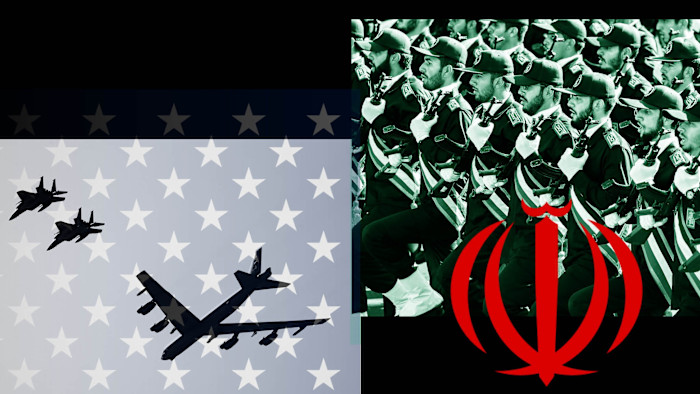
The US termed it an “extensive and continuous” martial endeavor against Iran, designating the undertaking Operation Epic Fury. President Donald Trump conveyed in a social media post: “This regime shall soon discover that none ought to defy the power and prowess of the United States Armed Forces.”
Which locations did Israel and the US target?
Details regarding the locations Israel and the US assailed within Tehran remained scarce, and online connectivity between Iran and external nations was swiftly constrained.
Initial accounts suggested bombardments around Pasteur Street in Tehran, adjacent to the Presidential Administration of Iran. Iranian news agencies also disclosed blasts in other cities: Isfahan, near the location of a nuclear complex both the US and Israel hit last year during the 12-day conflict; Kermanshah, in north-western Iran, housing an Islamic Revolutionary Guard Corps base; and Shiraz, where Israelis have claimed Iran possesses a substantial subterranean missile manufacturing plant.
Trump stated that Washington’s primary goals entailed preventing Iran from developing a nuclear weapon and dismantling its capacity to produce long-range missiles capable of impacting the US.
However, he additionally urged the Iranian populace to “seize control of your government” following the completion of the attacks.
Previously on Saturday, Israel’s northern command conducted multiple assaults in southern Lebanon, targeting what it characterized as Hizbollah’s infrastructure.
Israel had cautioned Hizbollah, the Iran-backed Lebanese Shia militant faction, against hastening to Iran’s aid, anticipating precisely this scenario.
Which armed forces resources does the US possess in the locale?
The US maintains approximately 40,000 personnel in the region, deployed throughout various bases and vessels. It has amassed its biggest maritime contingent in the area since the onset of its 2003 incursion into Iraq.
Washington’s most recent and biggest aircraft carrier, the USS Gerald R Ford, operated in the Mediterranean this week, with its presence observed off Israel’s northern shore on Friday. Meanwhile, the USS Abraham Lincoln aircraft carrier strike group was already positioned near the coast of Oman in February.
Each of these two aircraft carrier strike groups comprises one carrier and three guided-missile destroyers, possessing a range of armaments to engage and safeguard its own forces, alongside those of allied nations.
Aboard the USS Abraham Lincoln and USS Gerald R Ford are scores of planes and helicopters, encompassing F-18s, E-2 airborne early warning aircraft, and cargo planes. The Gerald R Ford also transports F-35 jets. Furthermore, the US has deployed additional aircraft to its bases in the region.
The US has augmented its bases in the region with additional Terminal High-Altitude Area Defense (THAAD) and Patriot aerial defense mechanisms. These systems were utilized in the 2025 conflict and previous attacks, diminishing their reserves of defensive missiles.
The US maintains eight enduring bases across the Middle East, specifically in Bahrain, Kuwait, Qatar, and the United Arab Emirates. It also utilizes approximately twelve additional strategic locations, such as those in Egypt, Iraq, Jordan, Oman, Saudi Arabia, and Syria.
The largest US base is Al Udeid Air Base in Qatar, serving as the central command center for US Central Command, which oversees martial endeavors across the Middle East. This installation accommodates approximately 10,000 personnel. In June, Iran launched projectiles at Al Udeid in response to the US assaulting the republic’s three primary atomic installations.

How might Iran retaliate?
When the US attacked Iran in June, Tehran’s reaction was rapid, though coordinated with Washington to prevent further hostilities. Aerial defenses intercepted Iranian missiles directed towards Al Udeid, which had been evacuated.
Trump remarked after the attack: “The Iranians were very accommodating. They provided us prior notice.”
The manner in which Tehran will direct its counter-attack on this occasion remains uncertain. It had previously warned of striking US bases across the region in the event of an assault, and air raid sirens blared across Israel on Saturday morning.
Iran possesses both medium to long-range missiles able to target Israel, alongside a significantly larger quantity of short-range ballistic and cruise missiles that might impact US bases and maritime resources in the region.

Throughout last year’s 12-day conflict, Iran launched numerous long-range ballistic missiles, sluggish cruise missiles, and drones towards Israel. It replicated this action in an earlier reprisal for Israeli targeted killings of Iranian functionaries.
In both instances, the majority were intercepted; however, dozens penetrated Israel’s multi-tiered air defense systems, impacting or approaching critical strategic sites, such as in proximity to the Mossad HQ.
With US and Israeli reserves of defensive projectiles currently at record deficits, Iran’s missiles now present an elevated danger. Iran has also mastered the art of calibrating the pace and synchronization of its barrages to optimize their impact.
However, launching those missiles also exposes the whereabouts of their launch platforms, which are frequently too cumbersome to relocate swiftly. The Israeli military has assailed launch sites promptly subsequent to missile discharge, thereby rendering the site — and its missile arsenal — inoperable. Israel’s military frequently characterizes this strategy as “killing the archer”.

Is the dispute likely to spread throughout the area?
Tehran has been restocking its missile inventory since June of the previous year, having utilized over 500 amidst its short confrontation with Israel. Specialists believe the aggregated missile holdings number in the thousands, possessing the potential for a prolonged barrage of attacks.
The laying of mines in the Strait of Hormuz, a vital maritime passage for worldwide energy provisions from the Gulf, represents an additional avenue for retribution. However, an analyst warned that such an action would provoke a strong reaction from China, given its substantial reliance on petroleum from the Gulf.

Nations in the Gulf also apprehend that Iran might assault energy facilities within the area. In 2019, Iran was held responsible for an assault in Saudi Arabia that momentarily disabled half of the monarchy’s raw oil production.
According to analysts, Iran might vex or confiscate individual tankers in proximity, similar to its actions in 2019, or alternatively, instruct affiliated militias to target regional energy facilities. These local surrogates, for instance, the Houthis or Iraqi Shia paramilitary groups, are also capable of targeting diplomatic missions or inadequately protected installations.
As recently as November, factions supported by Iran were held accountable for a rocket assault on the Khor Mor gas field in Iraq’s Kurdistan area, which disturbed the regional electricity network.
Nevertheless, prior to the assault, Jon Alterman from the Center for Strategic and International Studies in Washington stated his expectation that any retribution would be measured. He remarked, “Iran has never sought to engage in a protracted conventional conflict.”
What are the repercussions for petroleum?
Petroleum markets will not recommence trading until Monday morning in Asia; however, Brent crude climbed by as much as 3 percent on Friday, reaching a seven-month peak of $73 per barrel.
The global petroleum standard has climbed by almost 12 percent during the last month, as markets prepare for potential supply interruptions arising from a US-Iran dispute. Yet, it stays beneath the level exceeding $80 briefly reached during the 12-day conflict in June.
Iran ships out approximately 2 percent of the world’s petroleum provision, with the majority destined for China. Crucially, it wields sway over the Strait of Hormuz, a vital bottleneck through which roughly 30 percent of global seaborn petroleum commerce transited in the previous year.
The strait has never been blockaded, notwithstanding recurrent menaces from Tehran. Power currents were not disrupted amidst the previous summer’s confrontation with Israel. Nonetheless, the sharp increase in raw oil costs during that disagreement underscored the markets’ susceptibility to perceived dangers in the area.