
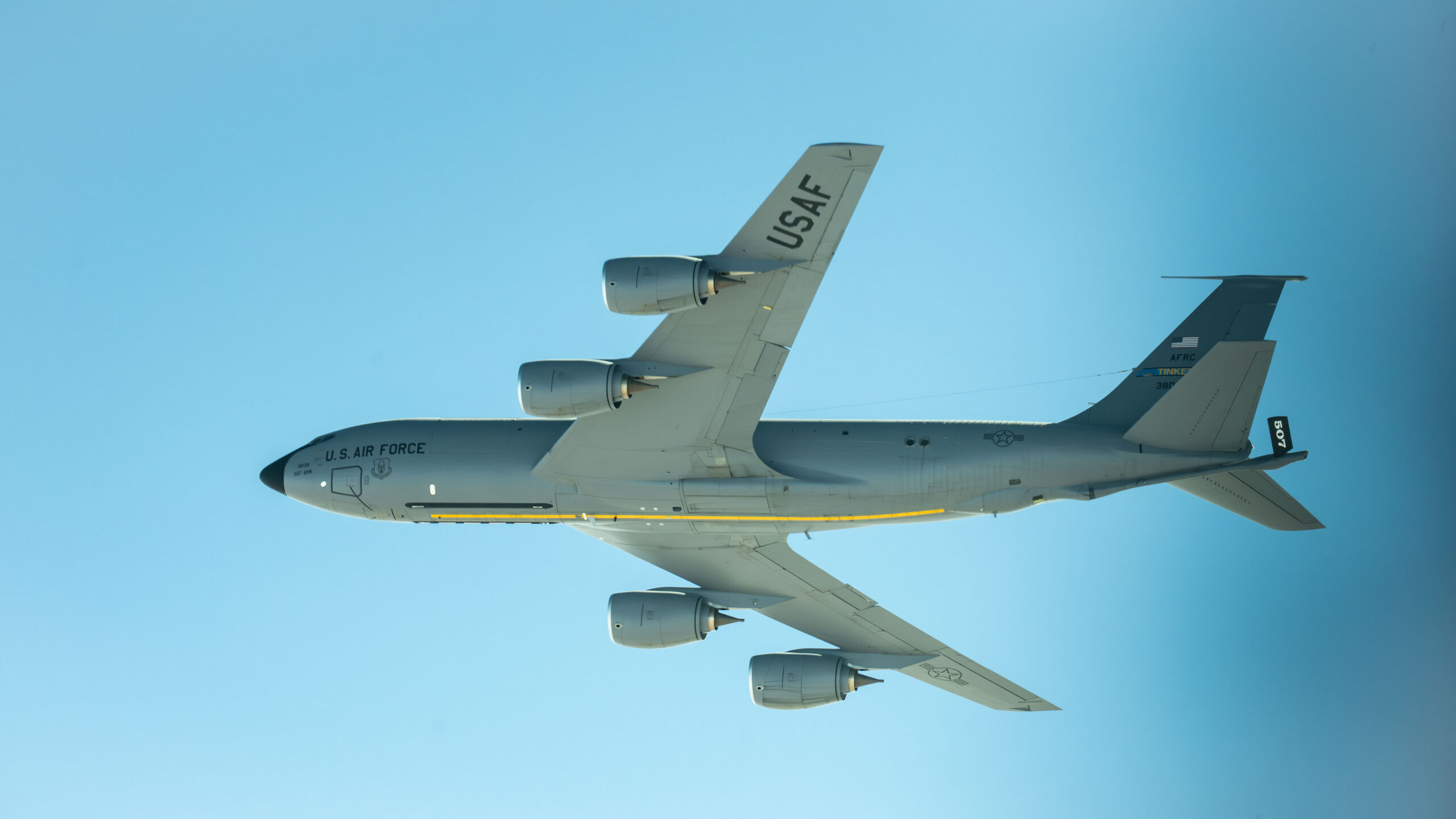
Several U.S. Air Force KC-135 Stratotankers, some of which sustained significant damage during operations in the Middle East earlier this year, have arrived at Tinker Air Force Base in Oklahoma for extensive depot-level repairs. Among them is a tanker that lost part of its vertical stabilizer in a deadly midair collision over Iraq in March.
These aircraft are part of a group of KC-135s that were damaged while supporting U.S. operations, including those targeting Iranian activities. Following initial, temporary repairs performed by Airmen from the 76th Aircraft Maintenance Group’s expeditionary depot maintenance flight, the tankers were cleared to fly back to Tinker Air Force Base for more comprehensive overhauls.
Upon their return, these Stratotankers are now entering the formal depot maintenance process. This procedure involves not only the full repair of the temporary patches but also the completion of their regularly scheduled maintenance, which typically occurs every five years, an Air Force spokesperson confirmed. The spokesperson indicated that it is currently too early to ascertain when these battle-damaged aircraft will be fully returned to operational service. While routine maintenance repairs for the KC-135 fleet generally take an average of 155 days to complete, the spokesperson noted that “it is reasonable to assume” these particular repairs may require a longer duration, especially if inspectors identify additional hidden damage or complex engineering challenges.
U.S. officials have confirmed that at least six KC-135s suffered damage but remained repairable since the commencement of Operation Epic Fury, a U.S. military campaign in the region. A seventh Stratotanker was completely destroyed in a separate incident. Five of the damaged Stratotankers were hit during an Iranian missile strike on Prince Sultan Air Base in Saudi Arabia in March. Former President Donald Trump subsequently acknowledged that five Stratotankers had sustained at least some degree of damage in a post on Truth Social.
The sixth damaged KC-135 was involved in a midair collision with another Stratotanker over western Iraq on March 12. During the incident, the aircraft lost a portion of its tail section but was successfully able to execute an emergency landing in Israel. The other Stratotanker involved in the collision, however, crashed, resulting in its complete destruction and the tragic loss of all six crew members aboard.
On August 2, a U.K.-based aviation photographer shared an image depicting the KC-135 that survived the March 12 collision arriving at RAF Mildenhall. The image showed the aircraft fitted with a transplanted tail section, sourced from another Stratotanker that had been retrieved from its long-term storage facility at Davis-Monthan Air Force Base, commonly known as the “Boneyard.” The collision-damaged tanker subsequently arrived at Tinker Air Force Base on August 3, according to publicly available flight tracking data. At least two other tankers that incurred damage in the Middle East have also been observed transiting to the U.S., flying with temporary patches that enabled their ferry flights.
The expeditionary maintenance unit played a critical role, completing over 200 repairs on the damaged tankers within a three-week period. These crucial interventions allowed the aircraft to become airworthy enough to undertake the transatlantic flights necessary for their more extensive repairs back in the United States. Following the March 12 crash, the Air Force also retrieved at least one retired KC-135 from the Boneyard to serve as a donor aircraft for parts.
During a June 9 hearing, Air Force Chief of Staff Gen. Kenneth Wilsbach informed lawmakers that all damaged KC-135s are eventually expected to return to service. However, Gen. Wilsbach cautioned the Senate Appropriations subcommittee on defense that the most heavily damaged planes could potentially require a year or two to be fully repaired. He also stated that some of the less severely damaged aircraft had already re-entered service, though he did not provide specific figures.
Why This Matters
The return of multiple damaged KC-135 Stratotankers to the United States for extensive repairs carries significant implications for U.S. military readiness, operational capacity, and strategic objectives, particularly in volatile regions like the Middle East. The incidents — a deadly midair collision and an Iranian missile strike — underscore the inherent risks of military operations and the critical importance of these aerial refueling assets.
Firstly, the KC-135 Stratotanker fleet, introduced in the mid-1950s, remains the backbone of the U.S. Air Force’s global aerial refueling capability. These aircraft are indispensable for extending the range and endurance of fighter jets, bombers, and transport aircraft, enabling sustained air operations anywhere in the world. Their ability to project U.S. power and maintain a continuous presence in distant theaters is fundamental to national security strategy. Any reduction in their operational availability directly impacts the Air Force’s ability to respond to crises, deter adversaries, and execute complex missions.
Secondly, the prolonged absence of multiple tankers for repairs affects the Air Force’s operational readiness and global posture. Each aircraft undergoing depot maintenance represents a temporary loss of refueling capacity, which can strain the remaining fleet and potentially impact deployment schedules, training exercises, and combat support missions. While the Air Force is transitioning to newer platforms like the KC-46 Pegasus, the KC-135 fleet continues to bear a substantial operational burden, making its sustainment vital until the transition is complete and the new fleet is fully operational.
Thirdly, the financial and logistical demands of these repairs are substantial. Repairing battle-damaged aircraft, especially those as old as the KC-135s, requires significant investment in specialized personnel, complex engineering solutions, and often the sourcing of parts from retired aircraft, as evidenced by the retrieval of a tail section from the “Boneyard.” This highlights the immense logistical infrastructure required to maintain an aging, yet critical, fleet and the high cost associated with military hardware sustainment. It also draws resources that could otherwise be allocated to other maintenance priorities or modernization efforts.
Fourthly, the incidents themselves provide crucial insights into the evolving geopolitical landscape and the threats faced by U.S. forces abroad. The Iranian missile strike on Prince Sultan Air Base, for instance, demonstrated the capabilities and intentions of potential adversaries, reinforcing the need for robust force protection and effective air defense strategies. The midair collision serves as a tragic reminder of the inherent dangers of complex air operations and the paramount importance of crew training and safety protocols. The loss of six Airmen is a somber human cost that underscores the sacrifices made in service.
Finally, the Air Force’s commitment to returning all damaged KC-135s to service, even those requiring “a year or two” for repairs, underscores the strategic value placed on every asset in the fleet. This decision reflects not only the cost-effectiveness of repairing versus replacing these high-value aircraft but also the ongoing challenges of recapitalizing an entire tanker fleet. The incidents highlight the U.S. military’s resilient maintenance and logistics capabilities, which are essential for enduring complex and prolonged operations globally.