
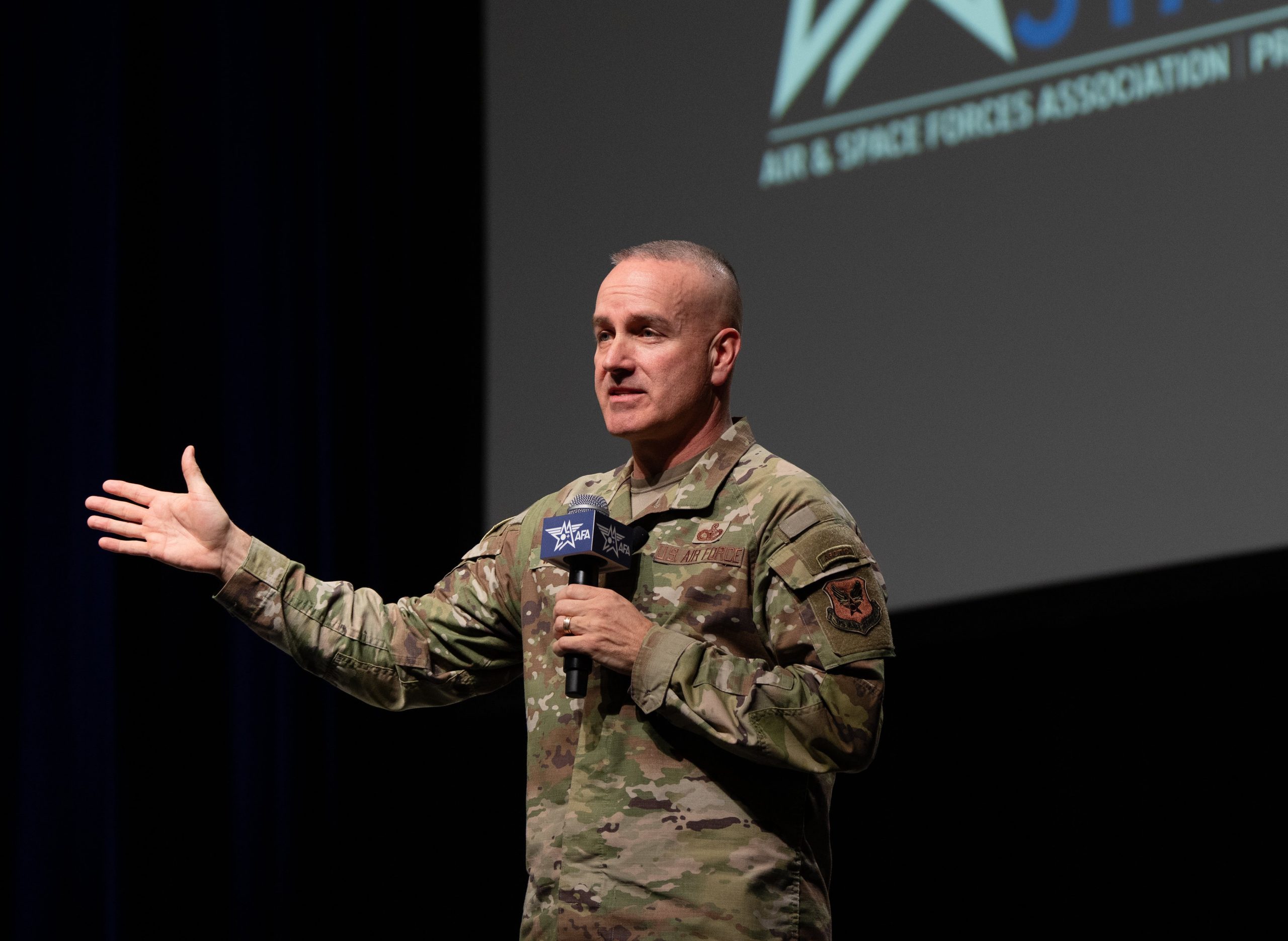
On May 8, Chief Master Sergeant of the Air Force David R. Wolfe announced that the service is developing a new training initiative aimed at integrating artificial intelligence (AI) into every Airman’s daily responsibilities. This announcement follows closely on the heels of the U.S. Air Force’s official release of its comprehensive artificial intelligence strategy.
During a webinar hosted by the Military Officers Association of America, Wolfe underscored the necessity of cultivating a universal “AI literacy” across the entire force. This foundational understanding is deemed critical for fully leveraging the nascent technology’s potential benefits. “We have got an opportunity here with AI that we are going all in on,” Wolfe stated, emphasizing the Air Force’s commitment to widespread AI adoption. He further elaborated, “We are getting ready to roll out what I know will be some meaningful training for our folks to get everybody to a baseline of AI literacy so we can use it for all of its intended purposes, and for things that we haven’t really figured out yet that it can do.”
Specific timelines for the implementation of this new AI training program for Airmen have not yet been disclosed. However, Wolfe drew parallels between the transformative potential of AI and historical technological advancements such as the advent of desktop computers and email. He expressed confidence that the integration of AI would significantly enhance the Air Force’s overall efficiency and operational effectiveness.
Wolfe’s remarks align with a preceding announcement made by the Air Force on April 28, which outlined plans to “aggressively recruit, train, and retain top-tier artificial intelligence professionals.” This strategic effort aims to operationalize AI across various Air Force functions. To facilitate the attraction of new talent, the service intends to streamline its hiring and accession processes, explicitly stating a commitment to “remove bottlenecks, and expedite hiring for essential AI positions.”
The Air Force also plans to offer competitive financial incentives designed to draw leading AI professionals away from the private sector. While the exact value and nature of these incentives have yet to be detailed, Susan Davenport, the chief data and artificial intelligence officer for the Air Force, provided insight into the service’s approach. “We plan to consider special hiring and compensation authorities, such as those used for the acquisition workforce,” Davenport explained to Air & Space Forces Magazine. “The goal is to compete with the private sector where AI professionals may seek employment, as we also want a workforce with top AI skills.” This strategy acknowledges the intense competition for AI expertise in the contemporary job market.
A key component of the broader AI strategy involves the development of specialized training courses. These courses are intended to foster a “universally informed and responsibly engaged workforce prepared for an AI-integrated future,” as articulated in the service’s official announcement. This educational initiative underscores a commitment to not only technical proficiency but also ethical considerations in AI deployment.
In alignment with the Pentagon’s overarching priorities for AI technology, the Air Force seeks to leverage AI to “shorten sensor-to-shooter timelines” and bolster decision-making capabilities. This includes aiming for “superior situational awareness and predictive insights,” according to the service’s official strategy document. These applications are primarily focused on enhancing combat effectiveness and strategic planning.
Beyond these high-level operational applications, Wolfe highlighted the potential for AI to simplify more routine, yet time-consuming, administrative processes within the Air Force, such as those involved in promotions and military awards. “We are doing experiments looking at how we have done promotions boards in the past and how we have picked people for awards,” he revealed.
Crucially, Wolfe emphasized that AI would not be used to make final selections for Airmen’s promotions or awards. Instead, its role would be to assist in “automating the process, so that when the human looks it, it’s easy to see, easy to discern and gives us a really good chance of making a really good decision.” This distinction underscores a human-centric approach to AI integration, where the technology serves as an augmentative tool rather than a replacement for human judgment. “What we think is in the realm of the possible is we take our already awesome people … and make them even more capable than they already are by automating processes that they don’t have to put a bunch of time into,” Wolfe concluded.
This renewed focus on AI builds upon earlier initiatives. In May of the previous year, the Air Force announced the establishment of a new center dedicated to artificial intelligence development. This center was designed to expand upon existing collaborations with prestigious institutions such as MIT, Stanford University, and technology giants like Microsoft.
At the time of its formation, former Air Force Chief Information Officer Venice Goodwine articulated the broad spectrum of AI applications. “AI has a broad continuum,” Goodwine stated. “Yes, I can use AI for summarizing briefs in the legal world, or I can use AI for productivity, but I also can use AI for AI-enabled autonomy. So, when you have a continuum that broad, how do you make sure that the use cases or the tools that you use or the investments that you’re making enable the [service’s] strategic objectives? The AI Center of Excellence in the Air Force is going to do that.” This perspective highlights the Air Force’s long-standing recognition of AI’s diverse potential, from administrative efficiency to advanced autonomous systems.
Why This Matters
The U.S. Air Force’s aggressive push to integrate artificial intelligence across all levels of its operations, from strategic combat systems to routine administrative tasks, represents a significant transformation with far-reaching implications. This initiative is not merely about adopting new technology; it signals a fundamental shift in military readiness, personnel training, and the future of warfare.
Firstly, the drive for “AI literacy” among all Airmen acknowledges that AI is no longer a specialized domain for a select few, but a foundational skill essential for every service member. This holistic approach aims to maximize the utility of AI, enhancing individual productivity and collective efficiency. By automating mundane tasks, the Air Force seeks to free up personnel to focus on more complex, high-value activities, potentially improving morale and retention by reducing administrative burdens.
Secondly, the strategic recruitment and retention of top-tier AI professionals underscores the critical national security imperative to maintain a technological edge. In an era of great power competition, leadership in AI can translate directly into a decisive military advantage, particularly in areas like intelligence analysis, drone operations, and cyber warfare. The Air Force’s challenge is to compete with the lucrative private sector for this scarce talent, necessitating innovative compensation and hiring strategies. Success in this endeavor is vital for developing and deploying cutting-edge AI capabilities faster than adversaries.
Thirdly, the application of AI to “shorten sensor-to-shooter timelines” and enhance “situational awareness and predictive insights” speaks directly to modernizing combat operations. AI-powered systems can process vast amounts of data at speeds impossible for humans, offering commanders more accurate and timely information for decision-making. This could lead to more effective targeting, improved defense mechanisms, and a significant reduction in reaction times, potentially saving lives and resources in conflict scenarios. However, it also raises important ethical considerations regarding autonomous weapons systems and the role of human judgment in warfare, which militaries globally are grappling with.
Finally, this transformation reflects a broader societal trend where AI is increasingly permeating every sector. The Air Force’s proactive stance positions it as a leader in adapting to this technological revolution, potentially influencing other branches of the military and even civilian industries. The development of an AI-integrated workforce and infrastructure within a major defense organization sets a precedent for how large, complex institutions can evolve in the face of rapid technological change, making it a critical area to observe for both military analysts and the general public concerned with future technological developments.