
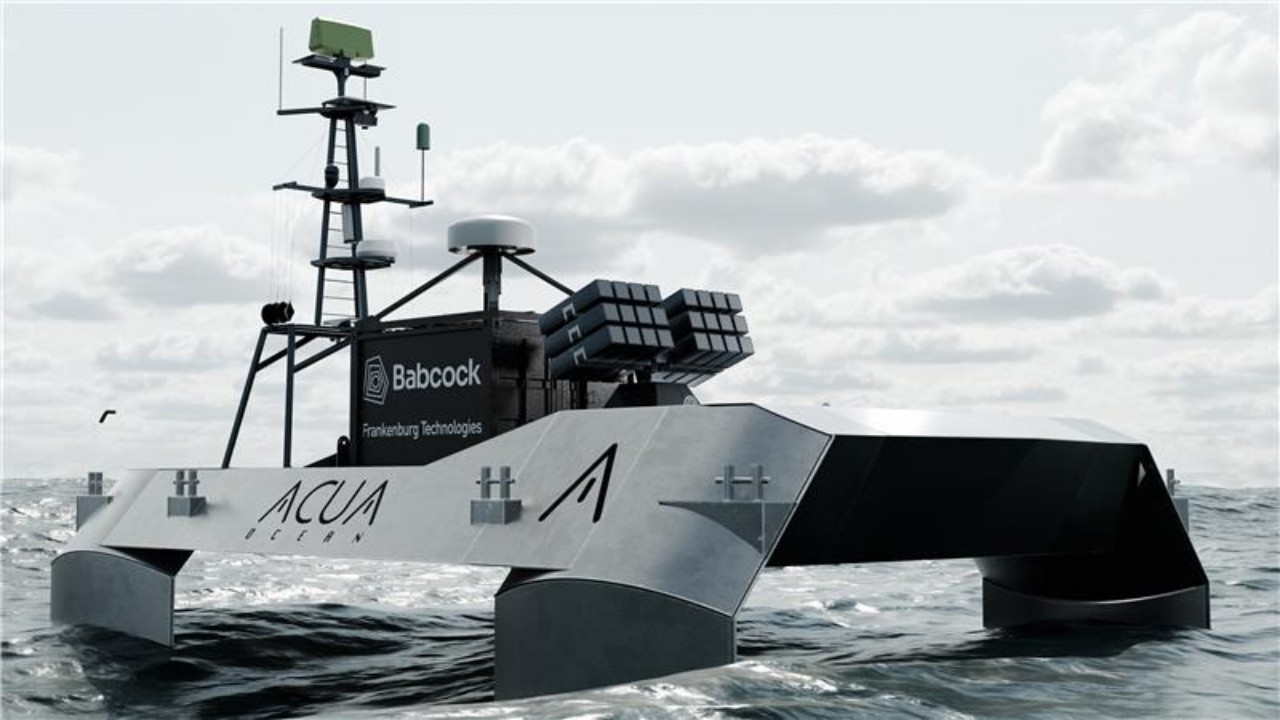
UK Defence Firms Partner to Develop Uncrewed Maritime Anti-Drone Systems
In a significant development for maritime defence innovation, Babcock International, a leading UK-based aerospace and defence company, has announced an agreement with ACUA Ocean Technologies and Frankenburg Technologies. The memorandum of understanding (MoU), signed at the recent Farnborough International Airshow, outlines a collaborative effort to explore arming uncrewed vessels with low-cost missiles specifically designed to counter the growing threat of drone attacks in the maritime domain.
This strategic partnership brings together three distinct but complementary elements crucial for developing an integrated counter-drone solution. Babcock, renowned for its engineering support services and complex programme management, will contribute its multi-domain launcher system, a versatile platform capable of deploying various payloads across different environments. Frankenburg Technologies, an Estonian-founded firm with a significant UK presence, will provide its expertise in developing low-cost, precision-guided missiles designed for mass manufacturability. Completing the triumvirate, Plymouth-based marine technology firm ACUA Ocean Technologies will supply its advanced uncrewed surface vessels (USVs), specifically the Pioneer-class, to serve as the platform for these new defence systems.
The collaboration seeks to address the evolving threat posed by inexpensive uncrewed aircraft, often referred to as ‘one-way attack drones’ or loitering munitions, which have demonstrated their disruptive potential in recent conflicts. These drones, while individually low in cost, can be deployed in large numbers, presenting a significant challenge to traditional, often expensive, air defence systems. This agreement builds upon an earlier partnership established in January between Babcock and Frankenburg, which focused on exploring air defence systems capable of withstanding the rapid rise of such attritable threats. ACUA Ocean Technologies’ involvement now adds the critical maritime dimension, providing a robust and autonomous platform to carry these defence capabilities to sea.
Sir Nick Hine, Babcock’s Chief Growth Officer, and its Future Capabilities Director, emphasized the importance of this integrated approach. “We’re excited to partner with innovative companies to develop an integrated approach that directly addresses some of the biggest challenges our customers face in today’s defence landscape,” he stated. Highlighting Babcock’s role as a systems integrator, Hine added, “Collaborations like this will help protect critical national assets and infrastructure from attritable one-way attack drones.” This underscores the need for comprehensive solutions that can manage complex interactions between different defence components, ensuring effective protection against modern threats.
A key aspect of the proposed system lies in the seakeeping capabilities of the host vessel. Neil Tinmouth, ACUA’s Chief Executive, elaborated on this critical advantage: “To counter mass drone attacks, maritime air defence must be uninterrupted, yet rough weather often forces traditional systems out of limits. The unique stability of ACUA’s Pioneer-class, which we’ll be using for this collaboration, ensures these counter UAS [Uncrewed Aircraft Systems] and interchangeable payloads remain online and fully operational in high seas where other platforms fail.” The Pioneer vessel has already demonstrated its endurance and autonomy, recently operating 16 to 20 nautical miles offshore for over 100 hours at sea without direct human intervention. Babcock further noted the adaptability of its launcher system, which can be fitted to both crewed and uncrewed vessels, and is designed for rapid production and scalability.
Frankenburg Technologies, led by Daniel Hallett in the UK, specializes in developing small, mass-manufacturable interceptor missiles. Their core philosophy is to drive down the cost of engaging drones, aiming for an engagement cost that is comparable to or even lower than the cost of the drones themselves. Hallett articulated the strategic vision: “Affordable missile defence is heading farther out to sea. By equipping ACUA’s uncrewed vessels with Frankenburg’s mass-manufacturable missiles and Babcock’s launcher technology, we aim to create a persistent and low-cost way to protect the UK’s ships, ports and critical maritime infrastructure against mass drone attacks.” This approach directly confronts the economic asymmetry often exploited by adversaries employing inexpensive drone swarms.
The operational concept envisioned by the three companies involves deploying persistent armed pickets. These autonomous USVs would be capable of holding station offshore in adverse weather conditions, providing continuous surveillance and defence capabilities that might otherwise be compromised by conventional platforms. This concept aligns directly with the Royal Navy’s strategic vision for a ‘hybrid fleet,’ which seeks to integrate crewed and uncrewed systems to enhance operational reach, resilience, and efficiency. Babcock explicitly stated that this agreement supports these ambitions by developing technologies that will underpin the next generation of autonomous maritime capabilities for defence, marking a potential shift in how naval assets are protected and deployed.
Why This Matters
This collaboration represents a significant step forward in addressing one of the most pressing challenges in contemporary maritime security: the proliferation and growing sophistication of uncrewed aerial systems (UAS). The implications extend across several critical domains:
- Evolving Threat Landscape: The rise of inexpensive, ‘one-way attack’ drones has fundamentally altered the calculus of naval warfare and maritime security. These drones offer adversaries, including state and non-state actors, a low-cost means to harass, surveil, and inflict damage on naval vessels, commercial shipping, and vital coastal infrastructure. This partnership directly confronts this asymmetrical threat by developing a cost-effective countermeasure that can be deployed persistently.
- Innovation in Autonomous Defence: The integration of uncrewed surface vessels (USVs) with advanced launcher systems and interceptor missiles pushes the boundaries of autonomous defence. It signifies a move towards a future where autonomous platforms play a more active role in protecting maritime assets, reducing risk to human personnel, and extending operational presence in dangerous or remote areas. The ability of ACUA’s Pioneer-class USVs to operate continuously in rough seas further enhances this capability, ensuring uninterrupted defence where traditional systems might fail.
- Cost-Effective Solutions for Asymmetric Warfare: A central tenet of this initiative is the development of ‘low-cost’ missiles. Traditional missile defence systems are often prohibitively expensive when used against cheap drones, leading to an unfavorable cost exchange ratio. Frankenburg’s focus on mass-manufacturable interceptors aims to nullify this economic advantage for aggressors, making drone attacks less economically viable and deterring their use.
- Enhancing Maritime Security and Critical Infrastructure Protection: By providing a persistent and affordable defence against mass drone attacks, this technology has the potential to significantly bolster the security of naval fleets, commercial shipping lanes, port facilities, and offshore energy infrastructure. This is crucial for maintaining global trade, energy security, and national defence posture in an increasingly volatile world.
- Shaping Future Naval Doctrines: The concept of ‘persistent armed pickets’ operating autonomously aligns with and potentially accelerates the adoption of hybrid fleet strategies by navies worldwide, including the Royal Navy. This could lead to new operational concepts for distributed maritime operations, where uncrewed systems extend the reach and defensive capabilities of a fleet. This paradigm shift could influence how navies design future platforms and deploy assets.
- Strengthening the UK Defence Industrial Base: This collaboration involves prominent UK defence entities and innovative technology firms, contributing to the UK’s position as a leader in defence innovation. It could foster job creation, stimulate further research and development in autonomous systems and missile technology, and potentially lead to export opportunities for these advanced defence solutions, reinforcing the UK’s industrial and technological base.
In essence, this partnership is not merely about building new weapons; it represents a strategic response to an evolving threat, leveraging cutting-edge autonomy and cost-effectiveness to reshape the future of maritime security and defence.