
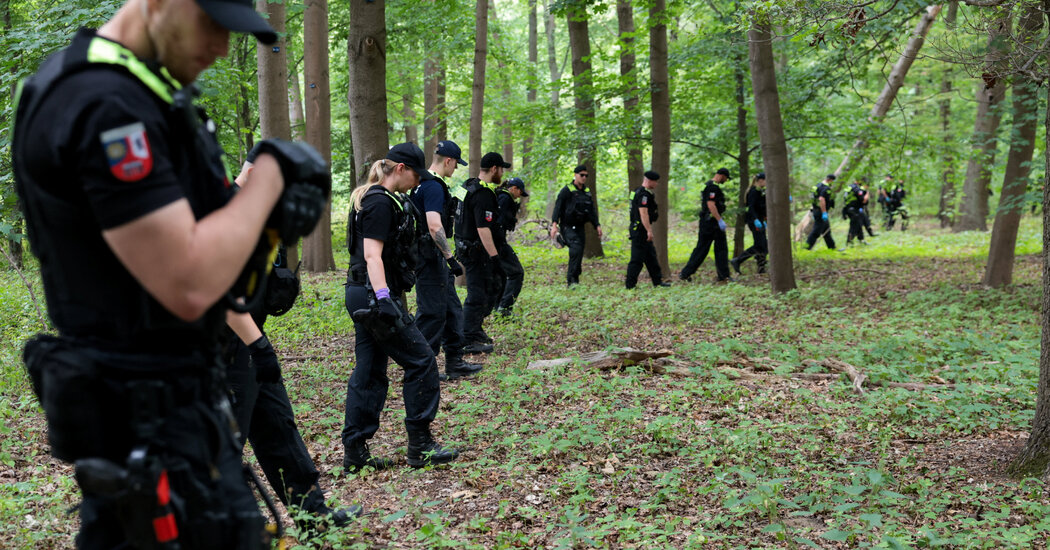
German authorities launched a city-wide manhunt on Sunday for an individual suspected of carrying out an attack at a Berlin gay Pride celebration, an incident that left one woman dead and 29 others injured. Government officials swiftly characterized the event as an Islamist terrorist attack, appealing to the public for assistance in apprehending the perpetrator.
“These criminals, these extremists, have no place in the middle of our society,” stated German Chancellor Friedrich Merz on Sunday afternoon, prior to attending a memorial service at St. Mary’s Church in central Berlin. He added, “And we will not allow this poison of terrorism and this poison against our freedom to spread further.” The Chancellor’s remarks underscored the government’s firm stance against extremism and its commitment to protecting societal values.
Berlin’s Mayor, Kai Wegner, echoed this assessment during a press conference held near the attack site on Sunday afternoon. He told reporters, “we are presumably looking at an Islamist terror attack directed at our way of life, our liberal democracy, our openness and our freedom.” This framing highlights the perceived ideological motivation behind the violence, aiming to undermine fundamental aspects of German society.
Federal Interior Minister Alexander Dobrindt further corroborated this viewpoint, stating that the attack was most likely Islamist terrorism. During the same press conference, Minister Dobrindt provided details about the primary suspect, identifying him as a 21-year-old German citizen, Abdul B., with family roots in Lebanon. The suspect is alleged to have used a rented van to strike pedestrians and then wielded a bladed weapon in the vicinity of the celebration.
Minister Dobrindt also revealed that the suspect had a documented history of radicalization and a criminal record, including a conviction at an unspecified time for which he had recently received a suspended sentence. Police officials confirmed that Abdul B. was known to them and associated with what they termed “the Islamist spectrum,” indicating prior monitoring or intelligence related to his activities.
Authorities did not rule out the possibility of more than one attacker being involved in the incident. Minister Dobrindt confirmed that a comprehensive search operation was underway across Berlin and throughout Germany, with heightened vigilance at airports, railway stations, and border crossings to prevent any potential escape.
In an appeal for public assistance, early Sunday morning, police released a photograph and the partial name of the prime suspect, Abdul B., 21. His full surname was withheld in adherence to German privacy laws. This public appeal signifies the urgency of the ongoing investigation and the authorities’ determination to quickly locate and apprehend the individual.
Berlin police had initially stated early Sunday that they were searching for “at least one suspect” following the attack, which occurred on the periphery of the annual Christopher Street Day parade. This celebration, drawing hundreds of thousands of revelers, commemorates the Stonewall riots and advocates for LGBTQ+ rights, typically culminating in a concert near the Brandenburg Gate and the Tiergarten, the city’s large central park.
The incident unfolded shortly after 10 p.m. local time, when a white minivan reportedly accelerated down a side street exiting the Tiergarten, outside the designated festival grounds and official security perimeter. The vehicle struck multiple pedestrians on a sidewalk before crashing into a tree. Eyewitness video footage captured the aftermath, showing the van with a heavily dented body and a smashed front grille, while the driver fled the scene on foot.
Minister Dobrindt confirmed that several of the 29 individuals injured in the attack sustained critical injuries. He specified that the attacker wielded what appeared to be a machete, causing stab wounds among some victims. Emergency services rapidly responded to the scene, administering first aid to the injured. “It was a horrific scene,” Minister Dobrindt remarked, conveying the gravity of the situation and the immediate impact on those present.
Berlin’s Charité hospital reported treating eight of the injured. By midday Sunday, four of these patients had been discharged, while the remaining four were still receiving intensive care for non-life-threatening injuries, according to statements released by hospital representatives on the social media platform X.
Both Minister Dobrindt and Mayor Wegner concluded their press conference without taking questions from reporters, leaving several aspects of the investigation unaddressed. Notably, they did not provide information regarding any potential links between the suspect and foreign actors or known international terrorist organizations.
This attack occurs against a backdrop of heightened security concerns in Germany. In recent months, German intelligence officials have privately warned of the potential for Tehran-sponsored attacks on German soil, particularly in light of ongoing conflicts involving the United States and Israel with Iran. However, officials did not draw a direct connection between these warnings and the current incident.
The attack brought an abrupt and somber end to the annual celebration, which had drawn hundreds of thousands to Berlin. Organizers canceled a final series of planned events scheduled for Sunday morning, shifting from festivity to mourning. The incident significantly rattled the LGBTQ+ community and its allies, who had spent much of the day celebrating under clear summer skies.
Beyond the immediate human toll, the attack has reignited an intense national debate in Germany concerning issues of migration, religious extremism, and overall public safety. This discourse is particularly sensitive as it unfolds months before closely watched regional elections in Berlin and two other eastern states, where polls indicate far-right parties are positioned to make gains, partly fueled by public anxieties regarding violence and security.
The Christopher Street Day parade, named after the New York City street associated with the Stonewall riots that are widely considered the catalyst for the modern gay rights movement, annually attracts vast numbers of participants and spectators to Berlin, celebrating diversity and advocating for LGBTQ+ equality.
On Sunday morning, roads near the attack site remained cordoned off by a significant police presence. Emergency personnel had established a tent nearby to provide care for distraught witnesses, some of whom were observed comforting each other, wrapped in thermal blankets. Hours before, the same roads, previously blocked to vehicle traffic, had been filled with throngs of revelers in colorful attire, dancing to techno music and spilling into nearby cafes and beer gardens. By late evening, the sounds of celebration had been replaced by the blare of sirens and the continuous drone of helicopters overhead.
Alfonso Pantisano, Berlin’s state government’s L.G.B.T.Q. affairs commissioner, recounted in a Sunday interview being among the crowd when an evacuation order was announced immediately after the attack. He remained to assist with the evacuation process. Mr. Pantisano, who has been instrumental in efforts to address increasing incidents of violence against Berlin’s L.B.G.T.Q. community, expressed that while the attack was a surprise, there was an underlying awareness that “at some point it would and could happen.”
“It could have been all of us” targeted by the attacker, he stated, highlighting the pervasive fear within the community. “And that is the scary thing about it.”
Philip Kaleta and Verena Hölzl contributed reporting.
Why This Matters
This attack in Berlin carries significant implications for Germany and the broader international community, touching upon issues of public safety, social cohesion, and the persistent threat of extremism. The incident, characterized by German officials as an Islamist terrorist attack targeting “liberal democracy,” underscores the vulnerability of large public gatherings, particularly those that symbolize open and inclusive societal values like the LGBTQ+ Pride celebration.
Firstly, it highlights the ongoing challenge posed by domestic radicalization and extremist ideologies within European nations. The revelation that the suspect was a German citizen with a history of radicalization and a criminal record suggests a failure in prevention or rehabilitation efforts. This will likely intensify scrutiny on intelligence agencies’ capabilities to monitor and neutralize threats from individuals known to be associated with extremist movements, even those who have received suspended sentences for prior offenses.
Secondly, the attack’s specific targeting of a Christopher Street Day parade sends a chilling message to the LGBTQ+ community. It transforms a celebration of identity and rights into a site of terror, fostering fear and potentially undermining the sense of security and acceptance that such events aim to cultivate. This act of violence reinforces the perception among marginalized communities that they remain targets for extremist groups seeking to impose their rigid ideologies.
Politically, the incident is poised to significantly impact Germany’s domestic landscape. Occurring months before crucial regional elections, where far-right parties are already projected to gain ground, it is likely to amplify public anxieties regarding immigration, integration, and security. These parties often capitalize on such events to push narratives that link crime and extremism to migrant populations, potentially shifting the political discourse further to the right and influencing voter behavior.
Internationally, the attack serves as a stark reminder of the persistent threat of terrorism in Europe, even as security measures have been enhanced in recent years. It raises questions about the effectiveness of current counter-terrorism strategies and the interconnectedness of global geopolitical tensions with domestic extremist activities, particularly given the unconfirmed but noted warnings of potential foreign-sponsored attacks.
Ultimately, this attack challenges Germany’s commitment to its foundational values of freedom, openness, and liberal democracy. The government’s strong condemnation and immediate characterization of the event as terrorism signal a resolute stance against those who seek to destabilize society through violence. However, the true test will be in how Germany responds through enhanced security, continued efforts towards social integration, and a reaffirmation of the very freedoms the attackers sought to undermine.