
Pennsylvania House Races Show Shifting Dynamics, Polls Indicate
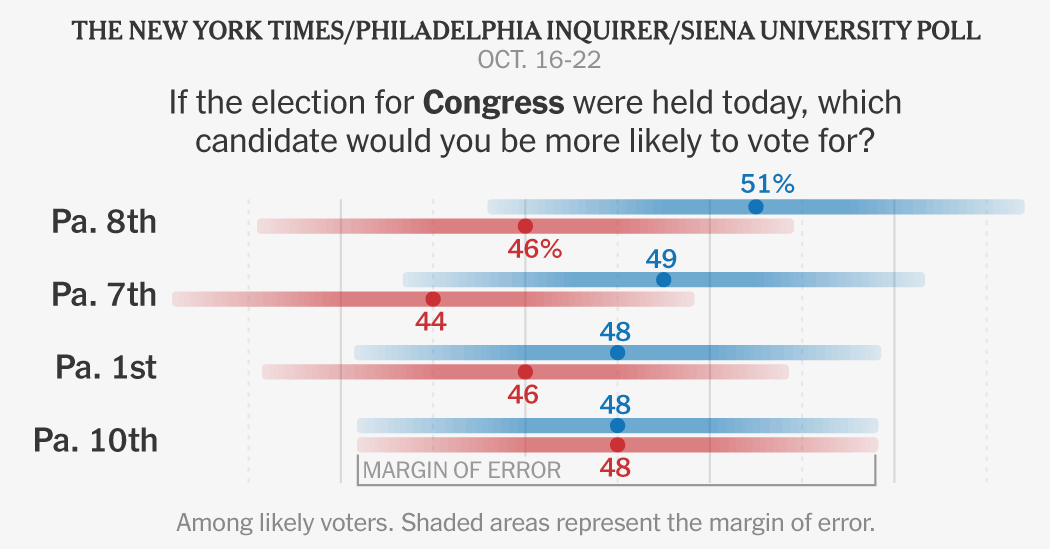
New polling data from The New York Times, The Philadelphia Inquirer, and Siena University indicates a competitive landscape in four crucial Pennsylvania House districts, with Democratic challengers currently holding leads in two races, a narrow edge in a third, and a tie in the fourth. These districts are considered bellwethers for broader national political trends and could significantly influence the balance of power in the U.S. House of Representatives.
The four districts represent a diverse cross-section of Pennsylvania’s electorate, encompassing working-class communities in the state’s northeastern region, rapidly growing areas with substantial Hispanic populations, a critical swing suburb of Philadelphia, and more conservative central parts of the state. The outcomes in these races are closely watched, as they reflect ongoing political battles playing out across the country.
During the 2024 election cycle, Pennsylvania was a prominent national battleground. Republicans experienced significant success, with President Trump winning the state and the party flipping two House seats—making Pennsylvania the only state where Republicans achieved this feat. However, the latest surveys suggest a potential reversal, with Democrats now positioned to reclaim both of those flipped districts.
These findings collectively present a potential challenge for the Republican Party, which currently holds a slim majority in the House. A shift in these competitive Pennsylvania seats could further jeopardize that majority.
District-Specific Poll Highlights
In Pennsylvania’s Eighth District, Republican Representative Rob Bresnahan faces a deficit against his Democratic challenger, Paige Cognetti, the mayor of Scranton. The poll shows Ms. Cognetti leading Mr. Bresnahan by 5 percentage points, 51 percent to 46 percent. Campaign advertising from Ms. Cognetti and her supporters has frequently highlighted accusations of insider stock trading against Mr. Bresnahan. When voters in the district were asked about which candidate they would trust more to handle issues of corruption, Ms. Cognetti held an 11-point advantage.
Similarly, in Pennsylvania’s Seventh District, Republican Representative Ryan Mackenzie trails his Democratic opponent, Bob Brooks, who serves as the head of a local firefighters union, by 5 percentage points. This district was carried by Mr. Trump in 2024 by a 3-point margin, with Mr. Mackenzie winning his race by a single point. The diverse Seventh District survey also indicated that Mr. Brooks has a significant lead among nonwhite voters, reflecting both candidates’ efforts to appeal to the Hispanic population in cities such as Allentown.
The remaining two contested races are significantly tighter. In Pennsylvania’s 10th District, Republican Representative Scott Perry is in a statistical tie with his Democratic challenger, Janelle Stelson, a former news broadcaster, with both candidates at 48 percent. This contest is a rematch of their 2024 race. Ms. Stelson holds an advantage on the issue voters identified as most important—the cost of living—but this has not yet translated into a decisive lead over Mr. Perry, who maintains a favorable position on immigration among district voters.
In Pennsylvania’s First District, Republican Representative Brian Fitzpatrick is narrowly behind his Democratic opponent, Bob Harvie, a county commissioner in Bucks County, with Mr. Harvie polling at 48 percent to Mr. Fitzpatrick’s 46 percent. This district is considered the most Democratic of the four surveyed, and Mr. Fitzpatrick is one of only three current House Republicans who represents a district that President Trump lost in 2024.
Considerable campaign funding has been directed to this race in recent weeks, as Democrats express optimism about their chances of unseating Mr. Fitzpatrick, who has historically outperformed his district’s Democratic lean in presidential elections over the past decade. On key issues, voters consistently reported greater trust in Mr. Harvie. Even on immigration, an area traditionally strong for Republicans, the Democratic challenger holds a 2-point lead. Furthermore, voters expressed concerns regarding Mr. Fitzpatrick’s relationship with former President Trump, whose district has voted against him each time Mr. Fitzpatrick has been on the ballot. Nearly half of the voters indicated worry that Mr. Fitzpatrick was too supportive of Mr. Trump.
Despite these challenges, Mr. Fitzpatrick continues to hold strong in his bid for re-election, partly supported by approximately 20 percent of voters who also plan to support Josh Shapiro, the popular Democratic governor, in his own re-election campaign. The intense competition across these four congressional races is reflected in the significant spending, with an estimated $100 million in advertising having aired since early September, according to the ad-tracking service AdImpact.
Broader Political Environment and Voter Concerns
Across the four districts surveyed, former President Trump holds an overall approval rating of 39 percent, which, while low, is marginally higher than his approval ratings nationally or statewide in Pennsylvania. Democrats are actively seeking to leverage what they perceive as a favorable political environment. Governor Josh Shapiro, who is campaigning for re-election against Republican challenger Stacy Garrity, maintains a significant lead. He is ahead of Ms. Garrity by 18 points across these four districts, consistent with his 19-point statewide lead reported in a September Times/Inquirer/Siena poll. However, even as Mr. Shapiro attracts approximately 15 percent of Republican voters in these areas, those voters appear inclined to split their tickets, supporting GOP candidates in their respective congressional races.
In Mr. Perry’s district, the former chairman of the conservative House Freedom Caucus, Mr. Trump appears to be at his most popular among the four districts polled. Half of the voters in this district approved of the president’s approach to immigration, including 44 percent of political independents. Voters also seemed to endorse Mr. Perry’s alignment with the former president, with more expressing trust in him to manage immigration and foreign policy matters. Conversely, Ms. Stelson held a substantial advantage on the cost of living, with more voters believing she would “do what’s best for ordinary Pennsylvanians.”
Economic issues emerged as the dominant concern across all four battleground districts. Approximately 25 percent of voters identified the economy as their primary issue, with an additional 13 percent prioritizing the cost of living or inflation. No other issue registered double-digit importance. While Mr. Trump’s approval rating for handling the cost of living stood at 32 percent, the Democratic congressional candidates only held a 6-point advantage over the Republican incumbents on this critical issue.
Broad voter dissatisfaction with former President Trump is evident in the poll results. In the four districts, half of white voters without a college degree—a demographic crucial to Mr. Trump’s base and a decisive voting bloc in Pennsylvania—disapproved of his job performance. This disapproval deepened regarding his handling of the cost of living, with 60 percent expressing dissatisfaction. This sentiment among white working-class voters concerning economic issues is observed nationwide.
While Democratic candidates in Pennsylvania are not currently leading among white voters without a college degree, their 40 percent support within this group represents a notable penetration into a demographic that has largely formed the Republican Party’s base during the Trump era.
Among all eight candidates across the four races, Ms. Cognetti in the Eighth District registered the most favorable image, with a net favorability rating of 10 points. This contrasts with her opponent, Mr. Bresnahan, whose net favorability was just one point. A particular concern for Republicans is Mr. Bresnahan’s favorability among political independents, where he holds a negative rating of 13 points. Voters also raised character concerns about Mr. Bresnahan, who tied for the lowest rating (39 percent) among the candidates regarding strong character. Ms. Cognetti, conversely, topped this list, with half of Eighth District voters, including 11 percent of Republicans, believing she possessed better character than Mr. Bresnahan.
On the issue of voters’ trust to address the growing concern about data centers powering artificial intelligence, Democrats showed one of their widest leads across the poll. In the Seventh District, where data centers have become a significant local issue, Mr. Brooks held a 10-point advantage over Mr. Mackenzie. However, despite its prominence in recent television advertisements, the polls suggest this issue may not be decisive, as only 2 percent of voters identified A.I. or data centers as their top concern.
These findings underscore the intense and complex political environment in Pennsylvania, with economic issues driving voter sentiment and candidate characteristics playing a significant role in highly competitive races that could determine the national legislative landscape.
Why This Matters
The outcomes of these four congressional races in Pennsylvania carry substantial weight for the balance of power in the U.S. House of Representatives and serve as critical indicators of the broader national political climate. With the Republican Party currently holding a narrow House majority, any shift in these highly contested districts could significantly alter the legislative agenda for the upcoming term. Should Democrats succeed in flipping these seats, it would not only strengthen their position in Congress but also reflect a potential shift in voter sentiment away from the Republican platform, particularly in battleground states.
These races are also a barometer for the influence of key political figures and issues. The polling data reveals the continued impact of former President Trump on voter perceptions, even in districts that have historically leaned against him. The nuances of his approval ratings and the electorate’s willingness to split tickets for popular state-level figures like Governor Josh Shapiro offer insights into complex voter behavior. Furthermore, the prominence of economic concerns—specifically the cost of living and inflation—as the top issues demonstrates that voters are prioritizing pocketbook matters over other policy debates, shaping how candidates frame their campaigns and address constituent needs.
Finally, these Pennsylvania contests provide valuable insights into demographic shifts and evolving political allegiances. The Democratic inroads among white voters without a college degree, a demographic traditionally central to the Republican base in the Trump era, suggest a potential recalibration of voting patterns that could have long-term implications for both major parties. The significant campaign spending in these districts highlights their perceived importance by national party committees and interest groups, signaling that the fight for congressional control will remain intense and well-funded. The results will not only determine who represents these communities but also offer a preview of the national electoral landscape in the broader federal elections.