
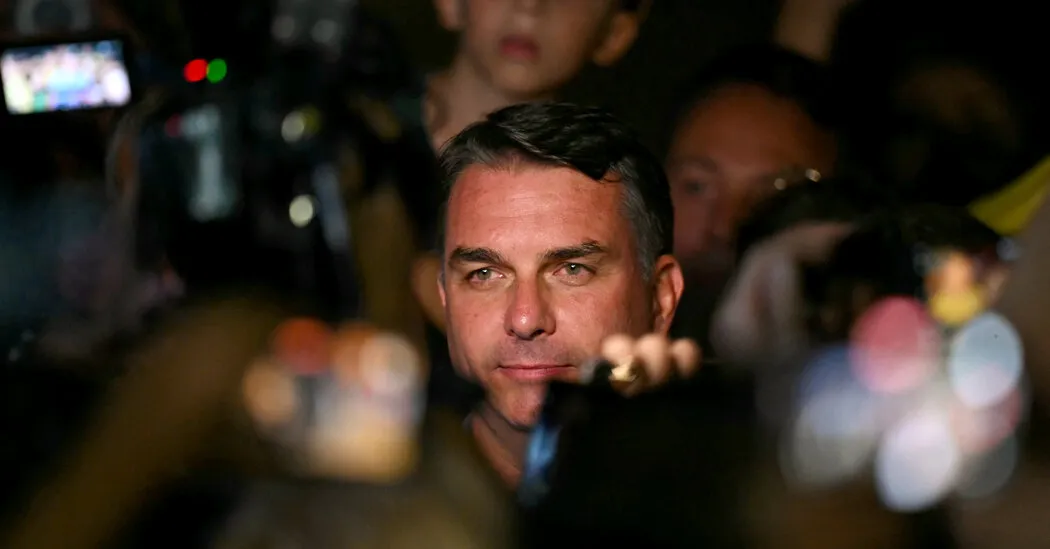
The recent first-round presidential election in Brazil concluded with an unexpected outcome, seeing right-wing candidate Flávio Bolsonaro secure more votes than the incumbent, President Luiz Inácio Lula da Silva. This result has initiated widespread analysis among political commentators regarding voter sentiment and the potential ramifications for the upcoming runoff election.
This development in the Latin American nation holds significant implications, not only for Brazil’s internal political landscape but also for its relationships within the region and with international partners, including the United States.
Flávio Bolsonaro, the right-wing challenger, did not achieve an outright victory on Sunday night, but his stronger-than-anticipated performance positioned him favorably for the second round.
His electoral showing provides a substantial boost to the conservative movement across Latin America, indicating a potential shift in the political balance. Brazil, as the region’s most populous country, represents a significant electoral prize, particularly after a series of seven consecutive victories by right-wing candidates in other Latin American nations.
The outcome also marks a notable moment for the Bolsonaro family, particularly given that Flávio Bolsonaro’s father, Jair Bolsonaro, faced significant legal challenges and a conviction that rendered him ineligible for office due to abusing his power and undermining the electoral system, following accusations of attempting to subvert democratic processes after his loss in the previous election.
Flávio Bolsonaro’s campaign contended with an ongoing corruption investigation, yet he managed to secure more votes than the leftist incumbent, President Luiz Inácio Lula da Silva. While neither candidate garnered enough ballots to win outright in the first round, Mr. Bolsonaro’s lead has led many analysts to suggest he holds an advantage heading into the runoff election scheduled for October 25.
This projection stems from the fact that approximately 9 million Brazilians who supported various minor right-wing candidates in the first round will now be courted by the two remaining contenders. Political analysts widely anticipate that a significant portion of these voters will likely gravitate towards Mr. Bolsonaro, potentially strengthening his position. Conversely, President Lula faces the challenge of mobilizing additional support to overcome this deficit.
According to experts, the regional trend towards the right is influenced by an array of factors, including public dissatisfaction with incumbent governments, increasing concerns regarding security and crime, and a perceived shift towards more conservative societal values.
For months leading up to the election, opinion polls had indicated a close contest between the two candidates, with Mr. Lula holding a narrow lead.
President Lula had positioned his campaign as essential to preventing the return of the Bolsonaro family to the highest office, referencing the events four years prior when Jair Bolsonaro lost the previous election, an outcome followed by his supporters demonstrating in the capital to challenge the results.
Mr. Lula had also sought to portray his candidacy as a defense of Brazil’s sovereignty against what he characterized as attempts by the former Trump administration to intervene in the country’s domestic affairs.
Mr. Bolsonaro’s campaign also faced scrutiny over an ongoing corruption investigation and his proposals to seek amnesty for his father and for participants in the January 8 unrest, which polarized public opinion. Despite these factors, he secured 47 percent of the vote on Sunday, two points more than his opponent, an outcome that exceeded many pre-election expectations.
“Even Jair Bolsonaro may be surprised by this result,” stated Jairo Nicolau, a prominent political scientist and professor at the Getúlio Vargas Foundation, a research institution.
Should Mr. Bolsonaro prevail in the runoff, it would mark a significant development for former U.S. President Trump, as it would lead to the departure of President Lula, who has been publicly critical of the American leader.
Furthermore, such an outcome could introduce an ally in Brazil who aligns with the regional foreign policy objectives associated with the former Trump administration.
Analysis of the Vote
The precise combination of factors that contributed to Mr. Bolsonaro’s stronger-than-anticipated performance remains subject to ongoing analysis.
“It was conceivable that Flávio could come close to Lula or even overtake him,” Mr. Nicolau commented. “But what happened in Brazil was a right-wing tidal wave. We’re going to spend a long time trying to understand.”
The electoral dynamics observed in Brazil may reflect a broader challenge faced by incumbents across the region: the difficulty in convincing voters to grant them additional time to fulfill campaign promises.
“Basically, it’s never a good thing to be president in South America,” noted Guilherme Casarões, a professor of Brazilian studies at Florida International University in Miami. Governments spanning the political spectrum, both left and right, have consistently struggled to win second consecutive terms throughout the region.
Analysts suggest Mr. Bolsonaro’s strong showing may have resulted from consolidating conservative votes that might otherwise have gone to minor right-wing candidates. Furthermore, a perceived disillusionment with Mr. Lula’s party, which has held power for nearly two decades, is also cited as a contributing factor to the challenger’s success. Public concerns over high levels of violence and significant personal debt are also prevalent among the electorate.
The broader shift to the right in Brazil was also evident in the legislative elections, where right-wing candidates, including four additional members of the Bolsonaro family, achieved significant gains in both the Congress and the Senate.
“A complete takeover of the far right,” stated Mr. Casarões, describing the legislative results.
Consequently, regardless of the eventual presidential victor, Brazil’s political trajectory appears set to continue its shift towards the right, a development welcomed by some voters, such as Carlos Augusto Marques, a 63-year-old writer voting in Rio de Janeiro.
“To improve, we need four or five center-right governments, at least,” Mr. Marques remarked.
If Mr. Bolsonaro wins, his party’s legislative gains could facilitate the implementation of some of his more polarizing campaign promises, including an amnesty for his father, pardons for participants of the January 8 unrest, and a Senate potentially more inclined to attempt to remove justices involved in his father’s conviction.
The Road to the Runoff
The presidential election now proceeds to a runoff round, anticipated to be highly competitive, as both candidates seek to secure millions of additional votes. However, analysts suggest that President Lula faces a more significant challenge in accumulating the necessary support.
Analysts indicate that a victory for President Lula remains possible, particularly if he can mobilize a substantial portion of the estimated 33 million Brazilians who abstained from voting in the first round.
In Brazil, voting is mandatory for most citizens between the ages of 18 and 70, though absentees incur only a small fine. This year, the number of Brazilians who did not participate in the first round reached a record high of 21 percent.
Why This Matters
The outcome of Brazil’s presidential election holds profound significance, both domestically and internationally. As the largest democracy in Latin America and the world’s fifth-most populous nation, Brazil’s political direction has extensive ripple effects.
**Domestic Stability and Policy Direction:** A victory for Flávio Bolsonaro would solidify a significant shift to the right within Brazil’s political landscape. Combined with the substantial gains made by right-wing parties in legislative races, a Bolsonaro presidency could lead to the pursuit of policies that have sparked considerable debate. These include controversial proposals such as amnesty for his father, Jair Bolsonaro, and for individuals involved in the January 8 unrest, alongside potential efforts to influence the judiciary. Such moves could test the resilience of Brazil’s democratic institutions and its separation of powers. Furthermore, the shift could impact economic policies, social programs, and public safety approaches, potentially leading to increased polarization within society.
**Regional Political Dynamics:** Brazil’s political alignment significantly influences the balance of power in Latin America. A rightward turn in Brazil, following similar electoral trends in other countries in the region, would further strengthen the conservative bloc. This could lead to a more coordinated conservative agenda on regional issues, potentially altering stances on economic integration, multilateral cooperation, and responses to crises in neighboring nations. This trend could also challenge existing left-leaning governments and movements within the continent.
**International Relations and Global Stance:** Brazil’s role on the world stage is substantial, particularly concerning environmental policy, trade, and global governance. A Bolsonaro presidency, informed by the political leanings of his father, could lead to a foreign policy that prioritizes national sovereignty, potentially distancing Brazil from multilateral environmental agreements and traditional alliances. The explicit mention of alignment with former U.S. President Trump’s administration suggests a potential shift towards a more transactional foreign policy, possibly impacting trade relations, diplomatic efforts on climate change, and human rights. This could reshape Brazil’s engagement with major powers and its position within international bodies, influencing global efforts on a range of critical issues.
In essence, the upcoming runoff election is not merely about choosing a leader but about defining Brazil’s future trajectory, its relationship with its past, and its role in a rapidly evolving global order. The outcome will be closely watched for its implications on democratic norms, regional stability, and international cooperation.
Brazil is currently in the throes of a deeply polarized presidential runoff election, with former President Luiz Inácio Lula da Silva and incumbent President Jair Bolsonaro vying for the nation’s highest office. The contest, set against a backdrop of significant domestic challenges and international scrutiny, has seen both campaigns intensify their strategies to win over a divided electorate.
Former President Lula, a prominent figure of the Workers’ Party, is actively pursuing broader support beyond his traditional base. His campaign strategy includes seeking coalitions with other political parties, aiming to consolidate votes from moderate individuals who have expressed dissatisfaction with President Bolsonaro’s administration. This approach is critical for Lula to bridge the gap and secure a decisive victory in the second round, following a closer-than-expected first-round result. By appealing to a wider spectrum of political ideologies, Lula hopes to present a more unified front against his conservative rival.
The complexities of voter sentiment are exemplified by individuals like Alberto Saab, a 55-year-old engineer. Saab, who supported a third-party candidate in the initial round, remains undecided for the upcoming runoff. His voting history reflects the fluidity of Brazil’s political landscape, having previously cast ballots for both Lula and Bolsonaro. Saab articulates a common dilemma among moderate voters: he is impressed by the leftist government’s past investments in education but also supports the right’s more assertive measures concerning public security. “The world is very polarized,” Saab observed, highlighting a widespread sentiment. “If we don’t return to some sort of center of balance, I think we’ll remain in a difficult situation.” His perspective underscores the struggle many Brazilians face in aligning with either of the two dominant, often ideologically rigid, political poles, seeking instead a more centrist approach to national governance.
Meanwhile, President Bolsonaro’s campaign is navigating the challenges of an ongoing investigation that has captured significant public attention. The President is under scrutiny for allegedly raising millions for a biopic about his father from a disgraced banker implicated in a large-scale fraud scheme. Details of this probe have dominated public discourse, leading to heightened expectations of further revelations as the final vote approaches. Such investigations invariably cast a shadow over political campaigns, potentially influencing undecided voters and energizing opposition efforts by focusing public debate on issues of integrity and accountability.
In response to these developments, Mr. Lula’s campaign has aggressively capitalized on the opportunity to intensify attacks on his rival’s conduct and record. His team has disseminated an online mini-documentary delving into various controversies from President Bolsonaro’s political career. Additionally, a video has been circulated aiming to link President Bolsonaro to alleged militia ties. These tactics are designed to erode public trust in the incumbent and sway voters towards the opposition, particularly those who are still weighing their options and could be influenced by renewed scrutiny of past allegations.
However, not all voters are easily swayed, and some express deep disillusionment with both leading candidates. Kailhany Machado, 23, who previously voted for a third-party candidate, plans to cast a blank ballot in the runoff. Her stance reflects a profound rejection of the political establishment. Ms. Machado explicitly criticized the perceived corruption of both sides, stating, “Flávio [Bolsonaro, the President’s son] is involved in several scandals and Lula? I don’t even need to tell you. They’re corrupt, criminal, and don’t deserve our vote.” This sentiment of widespread distrust highlights a significant segment of the electorate feeling unrepresented by the available choices and opting out of the final decision.
The International Dimension: Trump’s Shadow Over Brazil
The potential involvement of former U.S. President Donald Trump has introduced an unpredictable element into Brazil’s highly contested presidential election. Mr. Trump’s role remains a “wildcard,” with scenarios ranging from his complete silence to an explicit endorsement of President Bolsonaro, or even the imposition of new measures aimed at Brazil, which could significantly impact the electoral dynamics.
Last year, Mr. Trump reportedly intervened in an attempt to assist President Bolsonaro’s father regarding a prison term. Despite these efforts, the elder Mr. Bolsonaro was ultimately sentenced to 27 years in prison, though he is currently serving his term under house arrest due to health considerations. While Mr. Trump has not formally championed a specific presidential candidate in the current race, his former administration was perceived by some as subtly bolstering President Bolsonaro’s position ahead of the vote. This perceived influence has caused concern within Brazil, leading to accusations that the United States is attempting to sway its elections. In response, Brazil has reportedly established a “firewall” of measures designed to shield its democratic processes from external threats and interference, signaling a strong commitment to electoral sovereignty.
Flávio Bolsonaro, the son of President Bolsonaro, has openly aligned himself with Mr. Trump and other prominent right-wing leaders across the region. This alignment is reflected in his rhetoric, particularly his echoing of plans for a hard-line approach to combating drug gangs – an issue that has become a significant and pressing concern for many ordinary Brazilian citizens. This stance resonates with a segment of the electorate prioritizing security and order, and who may see such strong leadership as necessary to address pervasive crime.
Furthermore, President Bolsonaro himself has drawn comparisons to Mr. Trump in his approach to national narratives. Similar to Mr. Trump’s efforts in the United States, President Bolsonaro is perceived as attempting to “rewrite his own nation’s history,” a tactic often associated with nationalist movements seeking to redefine historical events and national identity. These parallels highlight a broader global trend of populist leaders challenging established historical interpretations and promoting a specific, often conservative, view of their nation’s past.
The confluence of internal political struggles, voter disillusionment, and the complex international dynamics involving figures like Donald Trump creates an exceptionally volatile and unpredictable electoral landscape in Brazil. As the runoff election approaches, all eyes remain on how these multifaceted factors will ultimately shape the future leadership and direction of Latin America’s largest nation, impacting its trajectory for years to come.
Isabela Cruz and Leonardo Coelho contributed reporting from Rio de Janeiro. Seth Kugel contributed reporting from São Paulo. Thayz Guimarães and Alice Maciel contributed reporting from Brasília.
Why This Matters
The outcome of Brazil’s presidential runoff election carries profound implications, not only for the nation’s 215 million citizens but also for regional stability and global dynamics. As Latin America’s largest economy and most populous country, Brazil’s political direction profoundly influences its neighbors and international partners, setting precedents and shifting alliances.
Domestically, the election will determine the future of Brazil’s economic policies, social programs, environmental regulations, and democratic institutions. A victory for Luiz Inácio Lula da Silva would likely signal a return to more interventionist economic policies, increased social spending, and renewed emphasis on environmental protection, particularly concerning the Amazon rainforest. His administration would also face the formidable challenge of uniting a deeply divided populace and addressing issues of poverty and inequality that have worsened in recent years. Conversely, a second term for Jair Bolsonaro would likely consolidate his conservative agenda, characterized by a focus on market-oriented reforms, a more robust stance on law and order, and potentially a continuation of policies that have drawn international criticism regarding deforestation and indigenous rights. The ongoing investigations into his conduct could also escalate, potentially affecting governmental stability and public trust, regardless of the election’s outcome.
Regionally, Brazil’s leadership is pivotal. Under Lula, Brazil might re-engage more actively with regional blocs and left-leaning governments, potentially altering the balance of power in South America and fostering greater multilateral cooperation. Bolsonaro’s re-election would likely see a continuation of his more isolationist foreign policy, favoring bilateral relations over broader multilateral cooperation and aligning with right-wing leaders globally. The election will thus shape the ideological landscape of the continent and affect collective responses to regional challenges like migration, economic integration, and democratic backsliding, impacting the stability and political direction of the entire South American continent.
Globally, the election’s impact is significant on several fronts. Brazil’s approach to climate change, especially regarding the Amazon, is critical for global environmental efforts. A Lula presidency is expected to bring a stronger commitment to environmental protection and international climate agreements, while a Bolsonaro second term might continue to prioritize economic development over conservation, exacerbating environmental concerns that have global repercussions. Furthermore, Brazil’s stance on international trade, human rights, and democratic norms will influence global governance and the international rules-based order. The election is also a bellwether for the durability of populist movements worldwide, particularly given the parallels drawn between President Bolsonaro and former U.S. President Donald Trump. The allegations of foreign interference and Brazil’s efforts to protect its democratic processes also underscore broader global concerns about election integrity and national sovereignty in an increasingly interconnected and polarized world.