
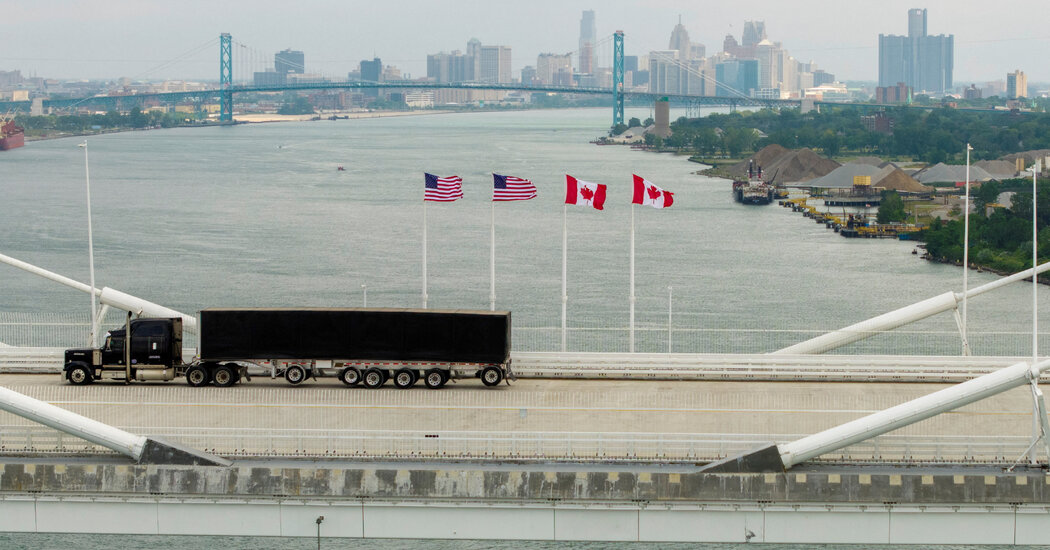
Canada is currently awaiting a critical U.S. tariff deadline set for midnight on Tuesday. At this time, a new series of levies proposed by the U.S. administration is slated to take effect unless negotiators from both nations can secure an agreement in the final hours.
Jamieson Greer, the United States’ trade representative and lead negotiator for the U.S. side, indicated last week that discussions were ongoing to review various options. Mr. Greer also expressed an expectation that Canada would withdraw certain retaliatory measures it had previously implemented in response to existing U.S. tariffs.
Speaking to reporters in Iowa on Friday, Mr. Greer stated, “If a country retaliates against us, we’re obviously not going to tolerate that. We’ll take action. My sense is the Canadians want to have a more conciliatory approach, but we’ll see.” This statement underscores the U.S. administration’s firm stance against what it perceives as Canadian aggression in trade disputes.
In response, Prime Minister Justin Trudeau has directed Canadian officials to remain in Washington over the weekend, continuing talks with their U.S. counterparts. Their mandate is to propose targeted concessions. The aim of these concessions is twofold: to prevent the implementation of the new tariffs and to alleviate the impact of existing levies on key Canadian exports.
Achieving such a comprehensive agreement presents a significant challenge. President Trump has consistently focused on leveraging tariffs to exert pressure on Canada, the United States’ closest ally and second-largest trading partner. His rhetoric toward Canada has intensified this month, with comments describing its leadership as “nasty.” These statements highlight the strained nature of the bilateral trade relationship under the current U.S. administration.
On Monday, Prime Minister Trudeau informed the news media that he anticipated a telephone discussion with President Trump before the Tuesday midnight deadline, signaling a potential high-level intervention in the ongoing negotiations.
What Are the Tariffs Being Negotiated?
The current tariff threat emerges against a backdrop of instability in the North American trade framework. The United States-Canada-Mexico Agreement (USMCA), which replaced NAFTA, includes provisions for annual reviews, a departure from the previous permanent arrangement. This structural change has introduced a continuous state of uncertainty into some of the most crucial trade relationships for the United States, challenging decades of established trade order in North America.
Adding to this complex situation, the Trump administration announced in July its intention to impose new tariffs of 50 percent on more than 500 categories of Canadian goods. These goods include items such as hockey sticks and various dairy products like cheese. The proposed tariffs would impact approximately $20 billion worth of annual trade, representing about 2 percent of the total goods trade between the United States and Canada.
Beyond these newly threatened levies, several key Canadian industries are already subject to a separate set of tariffs. Canadian negotiators are seeking significant reductions in these existing duties during the current talks. These include tariffs of up to 50 percent on steel, aluminum, and automobiles. Additionally, a range of tariffs continues to affect Canadian softwood lumber, a long-standing point of contention in bilateral trade relations.
Key U.S. Demands and Canadian Concessions
Mr. Greer has articulated specific demands that the United States expects Canada to fulfill for a deal to materialize. These include adjustments to Canada’s quotas for the duty-free entry of American dairy products, which would open Canada’s heavily protected dairy market. The U.S. also seeks the elimination of Canada’s 25 percent retaliatory tariffs on U.S. autos, implemented in response to previous U.S. tariffs. Furthermore, the U.S. demands the restoration of sales for American liquor within the government-controlled monopolies that oversee alcohol distribution across most Canadian provinces.
Canadian officials, who spoke on the condition of anonymity due to the confidential nature of the discussions, indicated that Canada is prepared to consider these measures. However, they stressed that such concessions would only be made in exchange for substantial reductions in the existing sectoral tariffs on Canadian goods exported to the United States. This suggests that Canada is seeking a broader relief package rather than merely an agreement to scrap the newly threatened tariffs.
Trudeau’s Stance on Comprehensive Deals
Prime Minister Trudeau’s objective is to secure an agreement that will both alleviate economic pressure on Canada and prevent the imposition of additional tariffs. However, he has indicated an unwillingness to make concessions merely for a series of “mini-deals” that would require further renegotiation in the future. This position reflects a desire for a comprehensive and stable resolution rather than piecemeal arrangements.
Public sentiment in Canada, particularly among those who supported Prime Minister Trudeau, also plays a role. There is a strong reluctance to see the U.S. administration achieve concessions through repeated threats of tariffs. Brian Clow, a former senior official in Prime Minister Trudeau’s government, commented on the delicate balance facing the Canadian leader: “Canadians elected Justin Trudeau to both stand up to Trump while also trying to negotiate a deal, or negotiate down the tariffs, and I don’t think those are mutually exclusive, but it is a narrow path for sure.”
Prime Minister Trudeau has previously made several concessions during various trade flashpoints over the past year, yet Canada finds itself once again confronting the threat of increased tariffs. For instance, following his administration taking office, Canada rescinded some retaliatory tariffs that had been put in place. The government also canceled an online tax that had drawn strong opposition from the U.S. tech industry. Additionally, Canada agreed to share revenues from a new bridge connecting Detroit with Ontario, despite having fully financed its construction, after President Trump threatened to block the bridge’s opening.
These past actions illustrate a pattern of Canadian willingness to compromise, but also the persistent pressure from the U.S. administration that often results in renewed tariff threats.
What Are the Possible Outcomes?
As the deadline approaches, three primary scenarios are being considered:
One: A Deal is Reached. In this scenario, Canada and the United States would finalize an agreement. This outcome would involve Canadian concessions in exchange for the U.S. scrapping the proposed new tariffs and easing existing trade levies.
Two: No Deal. If negotiations fail to yield an agreement by the deadline, the new 50 percent tariffs would be implemented, and the existing tariffs would remain in place.
Three: A Deal is Delayed. A full compromise might not be achieved by midnight, but sufficient progress could be made to prompt the United States to postpone the threatened new tariffs, thereby granting negotiators additional time to reach a comprehensive resolution.
Mr. Clow warned that the second scenario, a “no deal” outcome, would likely trigger a further escalation of trade tensions. He suggested it would compel Prime Minister Trudeau’s government to implement new retaliatory measures, aiming to regain negotiating leverage. “If the U.S. decides to proceed with imposing these new tariffs tomorrow, Canada, although this current government has eased back on retaliation, will have to respond in some way,” Mr. Clow stated, underscoring the high stakes involved.
Why This Matters
The ongoing trade dispute between the United States and Canada carries significant implications, extending beyond the immediate economic impact on specific industries. As two of the world’s largest trading partners and closest allies, the stability of their economic relationship is crucial for North American prosperity and global trade norms.
Economically, the imposition of new tariffs or the continuation of existing ones would directly impact consumers and businesses in both countries. For U.S. consumers, tariffs on Canadian goods like cheese and hockey sticks could lead to higher prices and reduced product availability. For Canadian industries, especially those already facing tariffs on steel, aluminum, and autos, additional levies could result in job losses, reduced investment, and decreased competitiveness. Supply chains, deeply integrated across the border, would face further disruption, increasing costs and uncertainty for manufacturers and retailers on both sides.
Politically, the escalating trade tensions strain a historically strong alliance. The U.S. administration’s use of tariffs as a primary negotiating tool sets a precedent that could affect future trade discussions with other nations, potentially fostering a more protectionist global environment. For Prime Minister Trudeau, successfully navigating this dispute is vital for his domestic political standing, as he seeks to balance the need to protect Canadian economic interests with maintaining a working relationship with the U.S. administration. His ability to “stand up to Trump” while securing a favorable deal is a key test of his leadership.
Furthermore, the “permanent state of flux” introduced by the annual reviews of the USMCA creates long-term uncertainty that can deter foreign investment and hinder economic planning. Businesses thrive on predictability, and the lack of a stable trade framework makes long-term commitments riskier. This instability could push companies to diversify their supply chains away from North America, leading to a broader economic restructuring with unforeseen consequences.
Ultimately, the outcome of these eleventh-hour negotiations will determine not only the immediate fate of billions of dollars in trade but also the broader trajectory of the U.S.-Canada relationship and potentially influence the future of multilateral trade agreements worldwide. A resolution could signal a return to more cooperative trade relations, while a failure could usher in a new era of heightened protectionism and prolonged economic uncertainty for North America and beyond.