
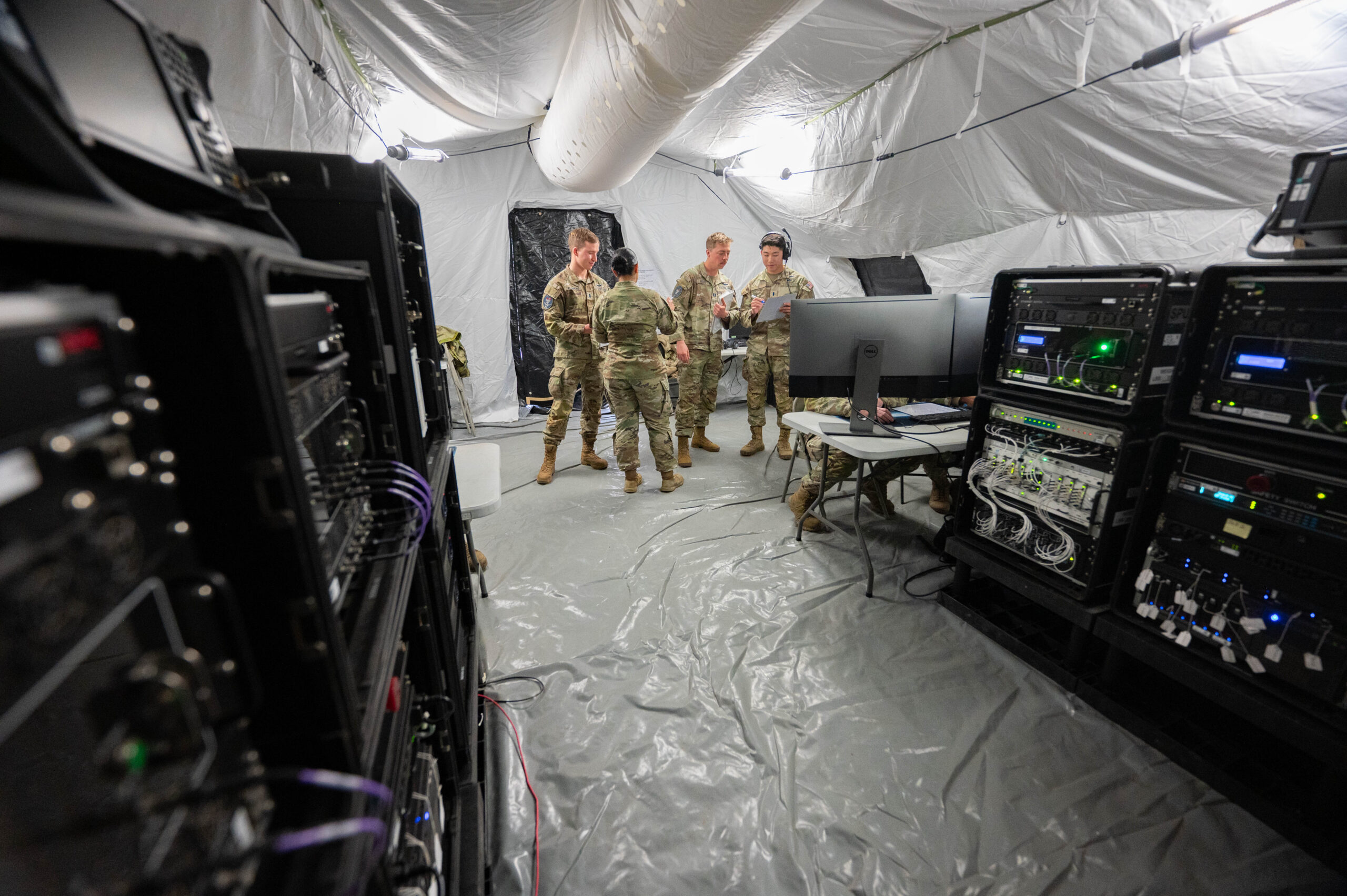
The United States Space Force has formally activated its 1st Electromagnetic Warfare Squadron (EWS), marking a significant development in its operational capabilities. The new unit, which became active on August 3 at Peterson Space Force Base in Colorado, is notable for two primary characteristics: its personnel are predominantly drawn from former Air National Guardsmen, and it is the service’s inaugural electromagnetic warfare unit to be equipped with two distinct weapon systems.
Combat Forces Command confirmed the squadron’s activation on August 14, stating that the 1st EWS operates under the command of Mission Delta 3. While headquartered at Peterson Space Force Base, the squadron’s personnel will be geographically distributed across five different locations, reflecting the expansive and often global nature of space operations.
A cornerstone of the 1st EWS’s operational mandate is its utilization of both the Meadowlands system and the Bounty Hunter weapon. Meadowlands, developed by L3Harris Technologies, is a mobile, ground-based space electronic warfare system designed to detect, identify, and, if necessary, temporarily deny, disrupt, or degrade adversary satellite communications and radar systems. Its mobility and smaller footprint represent a critical enhancement over previous systems, making it more adaptable and deployable in various operational scenarios. Combat Forces Command announced Meadowlands’ operational acceptance in June, certifying its readiness for combat missions.
Complementing Meadowlands is the Bounty Hunter weapon, a defensive electromagnetic warfare system. Bounty Hunter functions as a sophisticated listening post, primarily used to detect, characterize, geolocate, and report instances of electromagnetic interference and signal jamming that could threaten U.S. and allied satellite communications. This system has a longer operational history, having been in various forms since the early 2010s and achieving initial operational capability in 2020. It was deployed in U.S. Pacific Command in 2018 and U.S. Central Command in 2019, undergoing subsequent upgrades to maintain its effectiveness against evolving threats.
The integration of these two distinct systems within a single squadron is viewed as a strategic advantage. Charles Galbreath, a retired Space Force colonel and director of space studies at the Mitchell Institute’s Spacepower Advantage Center of Excellence, emphasized the benefits of this approach. “Combining these functions and systems within single squadrons creates a cohesive combat power and can enable better execution of both missions,” Galbreath stated. He further underscored the broader strategic importance of the squadron’s mission, explaining, “Since the command and control of satellites and all information from those satellites travels the electromagnetic spectrum, maintaining spectrum superiority is critical to the Space Force and the preservation of space superiority.” This highlights the fundamental reliance of modern military and civilian infrastructure on an unhindered electromagnetic spectrum.
The activation of the 1st EWS is part of a larger, comprehensive strategy by the Space Force to bolster its electromagnetic warfare capabilities. This broader effort includes plans to establish five new Space Electromagnetic Warfare Tactical Operations Centers (SEWTOCs). Mission Delta 3, the parent organization of the 1st EWS, already inaugurated the first SEWTOC in Colorado Springs, Colorado, last September, underscoring the interconnected nature of these initiatives.
Seasoned Personnel Integrate Into New Force
A distinctive aspect of the 1st EWS is the extensive operational experience of its personnel. Lieutenant Colonel Danielle Ryan, the squadron commander, articulated this advantage, stating, “Our competitive edge is the pairing decades of seasoned EW mastery with the innovation of our newest Guardians. We are fusing deep expertise with fresh tactics, advancing our spectrum dominance.” This blend of experience and new perspectives is central to the squadron’s operational philosophy.
The majority of the squadron’s members are former Air National Guardsmen, many of whom previously served in space-focused electromagnetic warfare units. In October, nine such Air National Guard units transitioned their missions to the Space Force, with five of these specifically focused on electromagnetic warfare, spanning locations from Hawaii to Alaska. From these units, 99 Guardsmen have been selected to transfer to the Space Force in full-time capacities, with the potential for additional personnel to follow in part-time roles. This integration strategy allows the Space Force to leverage existing talent and expertise directly into its new structures.
Galbreath commented on this personnel transition, noting, “The utilization of former [Air Force] Guardsman into the 1st [Electromagnetic Warfare Squadron] speaks to the talent and expertise that resided in the Guard and Reserve.” This seamless transfer of skilled personnel has been facilitated by recent legislative changes. The Space Force Personnel Management Act, passed as part of the fiscal 2024 National Defense Authorization Act, established a unified military personnel management system. This system allows Guardians to transition more easily between full-time and part-time statuses, circumventing the complex, legacy administrative processes that historically hindered such moves for members of other military branches. This flexibility ensures that highly trained specialists can continue to contribute their expertise within their specialty under their new service status.
Why This Matters
The activation of the 1st Electromagnetic Warfare Squadron by the U.S. Space Force carries significant implications across several domains:
Geopolitical and Strategic Importance:In an era of increasing competition in space, the ability to control and defend the electromagnetic spectrum is paramount. Adversaries are developing sophisticated capabilities to disrupt satellite communications, which are vital for military command and control, intelligence gathering, navigation (GPS), and global communications. The 1st EWS directly addresses these threats by providing both offensive (Meadowlands) and defensive (Bounty Hunter) capabilities to secure U.S. and allied space assets. This unit’s effectiveness will directly impact the balance of power in space and, by extension, on Earth, where modern militaries rely heavily on satellite-based information and services.
Technological Advancement and Operational Integration:The squadron’s dual-weapon system approach, combining the mobile and agile Meadowlands with the protective and intelligence-gathering Bounty Hunter, represents a sophisticated advancement in space warfare tactics. This integration allows for a more comprehensive and adaptive response to electromagnetic threats, moving beyond single-purpose systems. The continuous upgrade cycles of these systems, particularly Meadowlands as a “critical upgrade” to older counter-communications systems, underscore the rapid pace of technological evolution in this domain and the Space Force’s commitment to maintaining a technological edge.
Personnel Management and Expertise Retention:The decision to staff the 1st EWS primarily with experienced Air National Guardsmen is a critical strategy for talent acquisition and retention. It ensures that the Space Force benefits from existing, specialized knowledge in electromagnetic warfare without extensive new training programs. Furthermore, the Space Force Personnel Management Act, which facilitates flexible transitions between full-time and part-time service, is a forward-thinking model for military personnel management. This flexibility is crucial for retaining highly skilled specialists who might otherwise leave service, ensuring the Space Force can adapt to evolving threats with a seasoned and expert workforce.
Future of Warfare and Space Security:This squadron is not an isolated development but a foundational piece of a larger strategy to establish robust Space Electromagnetic Warfare Tactical Operations Centers (SEWTOCs). It signifies a recognition that future conflicts will increasingly extend into the space domain, with electronic warfare playing a decisive role. By establishing dedicated units and infrastructure for EW in space, the U.S. is signaling its intent to ensure freedom of operation in space for itself and its allies, safeguarding the vast array of economic, scientific, and security benefits derived from space-based technologies. The unit’s activation is a clear indication that protecting the electromagnetic spectrum is now a core mission of modern defense, essential for both projecting power and maintaining national resilience.