
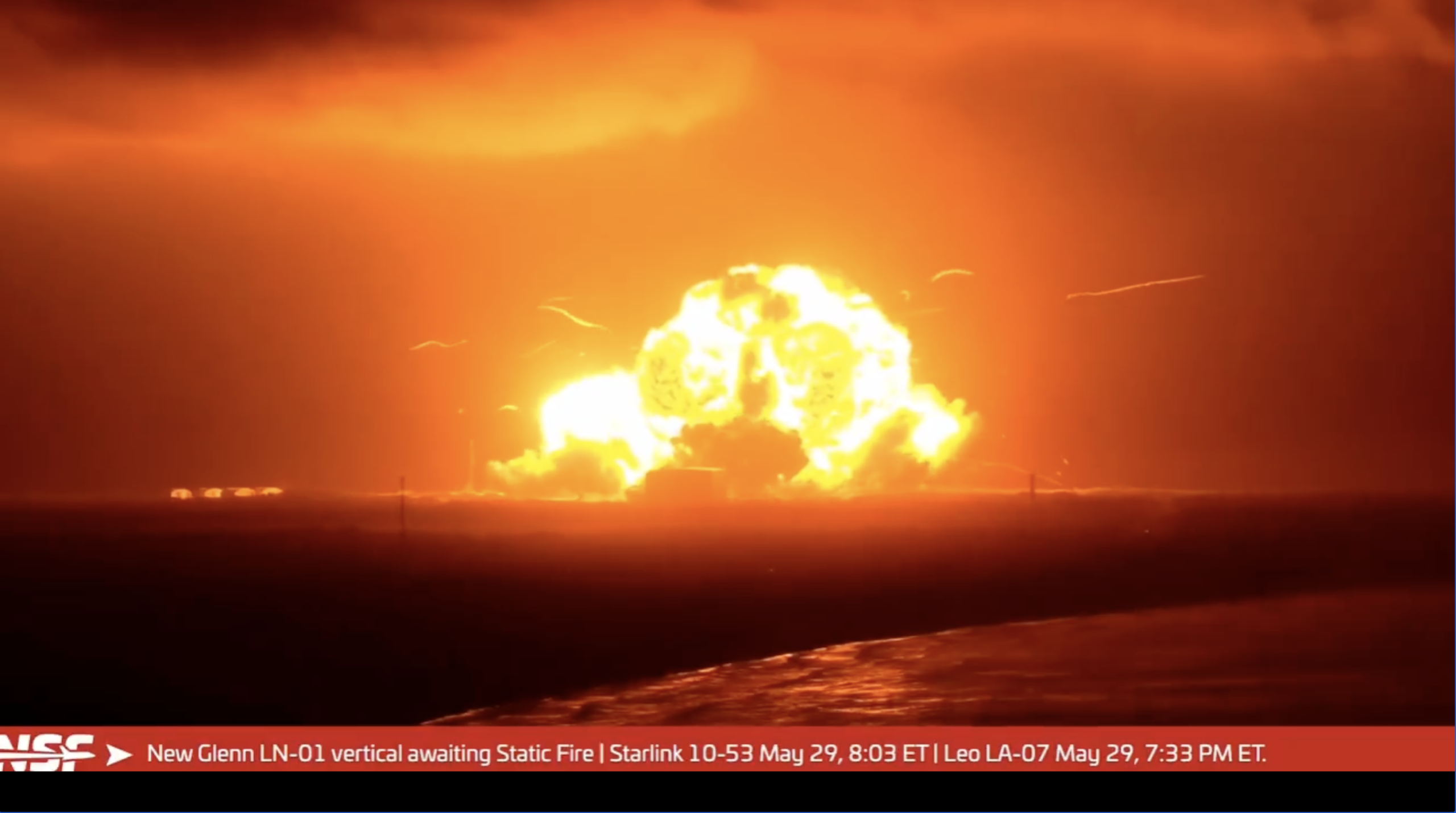
A significant incident occurred at Cape Canaveral Space Force Station, Florida, on May 28, when Blue Origin’s New Glenn rocket experienced an explosion during a routine prelaunch test. Despite the major mishap, officials at the station declared the Eastern Range “fully mission capable” shortly after, confirming its readiness to continue supporting launch operations.
The incident, which took place around 9 p.m. local time, involved a large fireball that appeared to engulf a substantial portion of Space Launch Complex 36-A (SLC-36A), the dedicated launch pad for Blue Origin’s New Glenn rocket. This facility is currently the company’s sole operational launch pad for its heavy-lift vehicle.
Blue Origin publicly addressed the event on the social media platform X, characterizing it as an “anomaly” and confirming that “all personnel have been accounted for.” The company’s founder, Jeff Bezos, also posted separately, stating, “It’s too early to know the root cause but we’re already working to find it. Very rough day, but we’ll rebuild whatever needs rebuilding and get back to flying.”
The Eastern Range, managed by Space Launch Delta 45 (SLD 45), is a critical national asset that facilitates both commercial and government space missions. In a statement released on May 29, just 12 hours after the New Glenn anomaly, SLD 45 officials confirmed that the range was operational and successfully supported a separate SpaceX launch. The statement emphasized the range’s resilience: “Despite the unexpected emergency response efforts overnight, the Eastern Range remains fully mission capable for National Security Space Launch and continues to support operations at all other launch complexes. Operating the Eastern Range requires a posture that anticipates contingencies without halting the broader mission. Space Launch Delta 45 is committed to remaining responsive, resilient, and ready to sustain the launch mission regardless of operational disruptions.”
A spokesperson for SLD 45 did not provide confirmation regarding whether any other range infrastructure sustained damage as a result of the explosion.
New Glenn, Blue Origin’s reusable heavy-lift rocket, has been positioned as a significant contender in the U.S. government and commercial launch market. This sector has largely been dominated by SpaceX, with United Launch Alliance (ULA) holding a lesser, yet important, share. New Glenn’s entry is anticipated to increase competition and provide much-needed diversity in heavy-lift launch options.
The company is actively engaged in the Space Force’s new entrant certification process. Prior to this anomaly, Blue Origin had successfully completed three of the four launches mandated under its individualized certification plan. Following a previous anomaly during the third mission, which involved New Glenn’s upper-stage, the Federal Aviation Administration (FAA) had cleared the rocket for flight on May 22. The fourth certification mission for New Glenn was scheduled for June 4, intending to carry communication satellites for Amazon, another company owned by Jeff Bezos.
The duration of Blue Origin’s recovery following this incident remains uncertain. While the company possesses additional rockets, the ensuing investigation into the anomaly will inevitably delay its return to flight. Furthermore, the damage sustained by its launch facilities presents a substantial challenge. SLC-36A is currently the only launch pad capable of supporting New Glenn missions. Blue Origin is in the process of constructing a second launch complex for the rocket at Cape Canaveral and has also secured a lease agreement to build a pad at Vandenberg Space Force Base in California, though the Space Force indicates that facility could take at least two years to complete.
Caleb Henry, director of research at Quilty Space, offered insights into potential recovery timelines. He suggested that a standard launch vehicle failure typically results in three to six months of downtime. However, the added factor of a damaged spaceport could extend this period significantly, potentially to a year, depending on the extent of the structural damage. Henry cited SpaceX’s 2016 Falcon 9 explosion at SLC-40, which necessitated approximately 15 months for repairs, as a comparable example of extensive pad damage and recovery efforts.
Henry noted that while Bezos’ considerable financial resources could potentially expedite repairs at SLC-36A or accelerate construction at the second pad, spaceport construction and repair are inherently complex endeavors where capital alone cannot entirely overcome logistical and engineering challenges.
This setback holds broader implications beyond Blue Origin. It impacts the commercial and government customers eagerly awaiting additional heavy launch providers to diversify the market. ULA has encountered its own challenges with the slower-than-expected development of its new Vulcan rocket, and other U.S. firms like Rocket Lab, Firefly, and Relativity have also experienced delays in debuting their medium and heavy-class launch systems. Globally, companies such as Arianespace and Mitsubishi are operating at a lower launch cadence, effectively positioning SpaceX as the primary heavy-lift option for many customers, according to Henry.
Although Blue Origin had not yet secured contracts for Space Force missions, New Glenn’s emphasis on reusability and plans for a high launch cadence had positioned it as a viable and attractive contender to address future demand for heavy-lift services. The Space Force has not yet commented on how this mishap might affect its launch manifest or Blue Origin’s certification prospects.
New Glenn also plays a critical role in NASA’s ambitious plans to return astronauts to the lunar surface. On May 26, NASA announced its selection of New Glenn to launch two lunar rovers in 2028. Furthermore, Blue Origin’s lunar lander, Blue Moon Mark 1, was slated to fly on New Glenn as early as this fall, a timeline now likely subject to revision.
Henry concluded, “As soon as there is a second launch provider that can hit a steady cadence of launching every one to two months, the industry will be very eager to have that. But right now, it doesn’t, and this exacerbates that issue. The market is ready to crown king whoever is second place here. . . . There is a strong desire for alternatives to SpaceX. The problem is, no one is there yet.”
Why This Matters
The explosion of Blue Origin’s New Glenn rocket during a prelaunch test is more than an isolated incident; it represents a significant setback with wide-ranging implications for the global space industry, national security, and scientific exploration.
For Blue Origin, this anomaly introduces substantial delays and considerable financial costs. The company’s sole launch pad for New Glenn, SLC-36A, sustained damage, pushing back its entry into a highly competitive market where it aims to challenge SpaceX’s dominance. This incident also poses a reputational challenge, testing the company’s resilience and its ability to recover swiftly and transparently. The extended downtime will impede its certification process with the U.S. Space Force and delay its ability to fulfill commercial launch contracts, including critical missions for its sister company, Amazon.
From a broader industry perspective, this event exacerbates the current lack of heavy-lift launch diversity. With other potential competitors like ULA, Rocket Lab, Firefly, and Relativity also facing development challenges and delays, the market remains heavily reliant on SpaceX. A healthy and competitive launch market is crucial for innovation, cost reduction, and ensuring access to space even if one provider faces issues. The prolonged absence of New Glenn from active launches intensifies this imbalance, limiting options for both government and commercial entities seeking to deploy satellites or conduct research.
Crucially, this incident directly impacts strategic national and international space initiatives. NASA’s plans to return humans to the Moon and deploy lunar rovers, which rely on New Glenn for key missions, now face potential delays. Any disruption to Blue Origin’s lunar lander program, Blue Moon Mark 1, would also ripple through the agency’s exploration roadmap. For national security, a diverse and robust launch capability is paramount to ensure assured access to space for military and intelligence assets, reducing reliance on a single provider and mitigating risks associated with launch failures or geopolitical disruptions. In an era of increasing geopolitical competition in space, dependable and varied launch options are not merely a commercial convenience but a strategic imperative.