
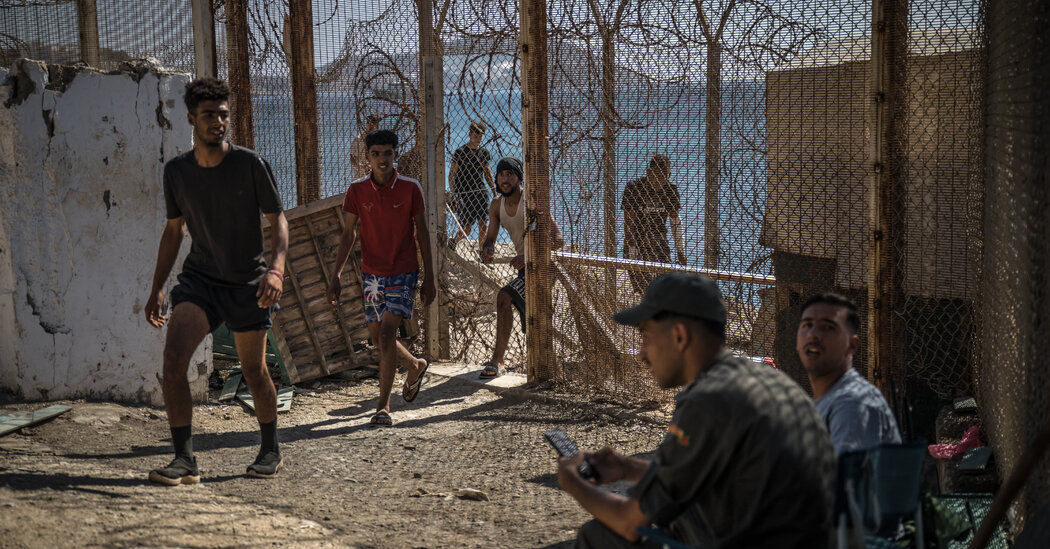
RABAT, Morocco — A recent address by King Mohammed VI of Morocco, in which he expressed optimism about his nation’s future, was swiftly followed by a mass movement of tens of thousands of Moroccan citizens attempting to cross into the Spanish territory of Ceuta. This exodus underscored a significant discrepancy between the official narrative of national progress and the lived realities of many young Moroccans.
On Wednesday, during a speech commemorating his 27th year on the throne, King Mohammed VI outlined a hopeful vision for Morocco. He characterized the North African nation as safe and stable, highlighting a growing economy that was making substantial advancements in sectors such as tourism, foreign investment, and manufacturing. “This is a pivotal moment in our nation’s development,” the 62-year-old monarch stated, adding that “a time when confidence and optimism should prevail over despair and frustration.”
However, over the subsequent two days, a significant number of his citizens initiated attempts to leave the country. Driven by a perceived lack of opportunities and a bleak outlook for their future within Morocco, these individuals undertook perilous journeys, often involving confrontations with law enforcement and dangerous swims in the sea, to reach the Spanish enclave of Ceuta. Their objective was to find better lives and economic prospects in Europe.
One such individual, Mohammed Kinani, a 21-year-old construction worker who was later returned to Morocco, articulated his motivations. “I tried to work and have a job and make a living, but there is nothing for me here,” he said. “If I don’t leave this country, there is nothing that will save me.” Mr. Kinani was part of a sudden influx that commenced on Thursday, involving an estimated 50,000 to 60,000 migrants who attempted to force their way into Ceuta, a small Spanish territory situated on the North African coast.
By Saturday, many of the migrants had departed Ceuta voluntarily, reportedly due to a lack of food and water, while others were expelled by Spanish security forces. The crisis, despite its rapid resolution, quickly resonated across Europe, providing additional arguments for far-right political parties seeking to advocate for more restrictive immigration policies.
The human toll of the border events was considerable. Spanish authorities reported 72 deaths recorded during the crisis by Sunday, with the Moroccan government reporting 11 fatalities. Officials from both nations indicated that the majority of these deaths resulted from drowning during the perilous attempts to cross the maritime border.
In the period leading up to the border events, the Moroccan government had indeed garnered several positive developments and international accolades. These included substantial investments in logistics and industrial sectors, the ongoing preparations to co-host the men’s FIFA World Cup in 2030, and robust diplomatic relations with the United States. During his presidency, Donald Trump had frequently expressed praise for the country of 38 million people and its monarch.
However, the Ceuta migration crisis exposed a deep sense of frustration and lack of opportunity among Morocco’s youth. This demographic, facing challenges such as limited job availability, the detrimental effects of recurrent droughts on agricultural livelihoods, and reports of arrests of government critics, often feels compelled to seek alternatives abroad. Ahlam al-Adnan, 22, who had attempted to swim to the territory with her four siblings, including her 8-year-old brother, reflected this sentiment. Sitting near the border on Sunday, visibly exhausted after being returned to Morocco, she responded to a query about her past employment: “Do you think if I had a job I would have gone?” She recounted hiding in a forest in Ceuta before hunger forced her to search for food, leading to her detention and subsequent return.
Over the weekend following the mass returns, thousands of the migrants, predominantly young Moroccan men, were observed in the streets of Fnideq, a Moroccan town adjacent to the border. Many rested on sidewalks or slept in open lots, typically dressed in shorts, T-shirts, and sandals, and possessing minimal personal effects.
Teams of Moroccan police, dressed in black uniforms, conducted sweeps through the town, moving migrants from public areas and transporting those who resisted into vans. Outside of Fnideq, dozens of buses were stationed near a gas station, prepared to ferry apprehended migrants back to their respective home regions across the country.
Along the roads, anxious relatives of migrants who had departed for Ceuta and had not yet returned sat, hoping for news of their loved ones. They approached groups of newly returned individuals, displaying photographs of the missing in the hope that someone might have seen them. Among these relatives were Abdelkhalek Moumouh, 50, and his wife, Kawtar Alalej, who were searching for their eldest son, Saad, 18.
Saad had recently completed high school but had not been accepted into university programs in engineering, aviation, or architecture, according to his father. The family expressed a desire for him to study in Europe but stated they lacked the financial resources to facilitate this. Upon observing social media reports of migrants entering Ceuta, the parents made the decision to drive their son to the border, believing it might be his opportunity. They had not received any communication from him since. “Other people went to Europe and benefited from it,” Mr. Moumouh explained. “We already wasted our lives in Morocco. We don’t want him to.”
The collective determination of these migrants to leave their country indicates that Morocco, despite its frequent portrayal as a success story in North Africa, has not consistently provided sufficient hope and opportunities for a significant portion of its younger generation.
Internationally, Morocco is recognized for its political stability, its attractiveness to foreign investors and tourists, and its strategic partnership with the United States. This relationship deepened during the Trump administration, during which Morocco joined a small group of Arab states that established diplomatic relations with Israel. In parallel, the Trump administration officially endorsed Morocco’s claim of sovereignty over Western Sahara, a territory whose status remains disputed under international law.
As a gesture of this strengthened alliance, King Mohammed VI informed former President Trump that a 656-mile expressway through the disputed territory would be named the “Donald J. Trump Highway.” In recent years, the Moroccan government has continued to pursue various development initiatives and cultivate international partnerships, aiming to bolster its economic standing and regional influence, even as internal pressures regarding economic opportunity persist.
Why This Matters
The mass migration event at the Ceuta border critically highlights the persistent socio-economic challenges within Morocco, particularly for its youth, despite official narratives of national progress and stability. This incident serves as a stark reminder that even countries with strong international partnerships and significant economic investments can harbor deep-seated domestic discontent, especially when job opportunities and future prospects remain elusive for a substantial segment of the population.
For Spain and the European Union, the influx of migrants into Ceuta underscores the ongoing pressures at their southern borders and the complexities of managing irregular migration. It fuels debates on immigration policies, border security, and the humanitarian responsibilities associated with these enclaves. The event provided immediate political leverage for far-right movements across Europe, reinforcing their arguments for stricter controls and potentially influencing future policy decisions on a continent already grappling with internal divisions over migration.
Geopolitically, the crisis reveals potential vulnerabilities in Morocco’s perceived stability and its role as a key partner for nations like the United States. While Rabat maintains robust diplomatic ties and has engaged in significant regional agreements, such as normalization with Israel and securing U.S. recognition of its Western Sahara claims, internal socio-economic instability can complicate these partnerships and raise questions about the long-term effectiveness of such alliances. The incident suggests that economic development alone, without equitable distribution of opportunities, may not be sufficient to quell public frustration and prevent large-scale migration attempts.
Furthermore, the human tragedy of the deaths recorded during the crisis emphasizes the desperate measures individuals are willing to take to escape perceived hardship. It calls attention to the broader humanitarian aspect of migration from North Africa, compelling a re-evaluation of aid, development strategies, and international cooperation aimed at addressing root causes rather than solely focusing on border enforcement. The incident serves as a powerful illustration of the urgent need for comprehensive strategies that combine economic development with social inclusion and political participation to foster genuine hope and opportunity within countries of origin.
Morocco’s Economic Ambitions Face Headwinds of Unemployment and Youth Discontent
Morocco is actively pursuing an ambitious economic development strategy, marked by substantial investments in modern infrastructure and major international events. The kingdom has showcased large-scale projects, including significant upgrades to a Mediterranean port and the development of a high-speed rail network, intended to bolster its economic standing and connectivity. Furthermore, Morocco is investing heavily in new stadiums and facilities as it prepares to co-host the 2030 FIFA World Cup alongside Spain and Portugal, an undertaking projected to bring global attention and tourism.
However, this strategy, which prioritizes large companies and significant infrastructure initiatives, is facing scrutiny from economists and segments of the population. Critics argue that while these projects enhance Morocco’s international image and provide temporary construction jobs, they are failing to generate sufficient lasting employment opportunities, particularly for the nation’s burgeoning youth population.
Najib Akesbi, an economist at the Institute of Agronomy in Rabat, articulates this concern, suggesting that the government’s economic model is primarily a “showcase.” He observes that while visitors may find Morocco aesthetically pleasing due to these developments, the underlying economic approach may not adequately address the fundamental needs of its citizens. Akesbi describes many of these investments as “white elephants,” projects that entail substantial initial construction work but do not translate into sustainable, long-term job creation once completed. He emphasizes that the current policies appear disconnected from the pressing requirements of the general populace, especially the youth.
Statistical data from international bodies corroborate these concerns about job creation. The World Bank reported last year that over the preceding decade, Morocco’s working-age population had expanded by 11.4 percent. In stark contrast, employment growth during the same period was a mere 1.5 percent. The bank explicitly identified job creation as a “fundamental challenge” for the Moroccan economy, highlighting a growing disparity between the number of individuals entering the workforce and the available opportunities.
The national unemployment rate in Morocco stands at approximately 11 percent, according to official government statistics. However, this figure masks a more acute problem among younger demographics. For individuals aged between 15 and 24, the unemployment rate is nearly three times higher, signaling a profound challenge for a generation seeking entry into the labor market. This high youth unemployment fuels widespread frustration and contributes to a desire among many to seek opportunities abroad.
The stark economic disparity between Morocco and its European neighbors serves as a powerful magnet for migration. Per capita income in Morocco is estimated at $4,600 by the World Bank. In stark contrast, Spain, which includes the North African enclave of Ceuta, boasts a per capita income of $38,600. Ceuta, geographically proximate and easily visible from Moroccan coastal towns like Fnideq, represents a perpetual draw for those seeking better economic prospects and a higher standard of living, despite the inherent dangers of illegal migration.
In response to growing public discontent over economic conditions, the Moroccan government has demonstrated a low tolerance for public expressions of frustration. Last autumn, youth-led demonstrations erupted in over half a dozen Moroccan cities. These protests, organized primarily through social media platforms, voiced strong grievances over the escalating cost of living, rampant youth unemployment, and the government’s perceived misprioritization of economic resources, including the significant expenditure on World Cup preparations.
Authorities responded to these demonstrations with arrests and subsequent prosecutions of activists involved. This approach mirrors responses to earlier waves of protests that focused on economic hardship in rural areas, which also concluded with mass arrests and punitive prison sentences for protest leaders, suggesting a consistent governmental strategy in managing public dissent.
The human dimension of these economic challenges is exemplified by individuals like Mohammed Said, a 36-year-old from Fnideq. Having left school after the seventh grade, Said has worked intermittently in construction but has never secured stable employment. His personal struggle reflects the broader issue of precarious work and limited opportunities for many young Moroccans. He recounted joining a group headed towards Ceuta, only to retreat amidst chaos at the border involving clashes with security forces and burning vehicles.
Said’s determination to reach European territory remains undeterred. He revealed that he had attempted to swim to Ceuta twice the previous year, only to be intercepted by Moroccan authorities. This time, he arrived prepared for another attempt, carrying essential items such as a can of tuna, crackers, a phone charger, a comb, two extra T-shirts, and a plastic sleeve for his cellphone, all packed in a plastic bag. His resolute statement, “I’ll try again. It’s in God’s hands,” underscores the desperation and hope driving many like him to risk everything for a perceived better future.
Why This Matters
The economic trajectory of Morocco and the challenges it faces are significant for several reasons, impacting both domestic stability and broader international dynamics. Understanding these issues is crucial for grasping regional developments in North Africa and the Mediterranean basin.
Firstly, **regional stability** is directly influenced by high youth unemployment and economic stagnation. A large cohort of disillusioned and underemployed young people can become a source of social unrest, potentially leading to increased protests, political instability, and security challenges within the country. The government’s response to dissent, characterized by arrests and prosecutions, further highlights tensions that could escalate if fundamental grievances are not addressed.
Secondly, the situation in Morocco sheds light on a critical debate concerning **economic development models**. The focus on large-scale infrastructure projects and international events versus inclusive growth strategies raises questions about which approaches are most effective in fostering sustainable development and broad-based prosperity. The “white elephant” critique suggests that an overemphasis on prestige projects might divert resources from more impactful initiatives that could create lasting jobs and improve the quality of life for the majority of the population.
Thirdly, the stark economic disparity between Morocco and Europe, particularly with Spain’s enclaves like Ceuta, fuels **migration pressures**. This flow of people creates humanitarian concerns, strains international relations (especially with Spain and the European Union), and often leads to dangerous journeys for migrants. Morocco’s role as a transit country and its efforts to manage migration are critical aspects of Euro-African relations and border security.
Fourthly, issues of **governance and human rights** come to the forefront. The government’s suppression of peaceful protests and prosecution of activists raise concerns about freedom of expression and assembly. How a government responds to legitimate public grievances over economic hardship is a key indicator of its commitment to democratic principles and its ability to maintain social cohesion.
Finally, Morocco’s aspirations as a co-host of the 2030 World Cup place it on the global stage, presenting an opportunity for economic growth and international recognition. However, if the underlying socio-economic challenges, particularly youth unemployment and dissatisfaction, are not effectively addressed, the perceived success of such mega-events could be overshadowed by domestic instability and a growing sense of disillusionment among its own citizens. This situation underscores the complex interplay between national ambition, economic policy, and societal well-being.